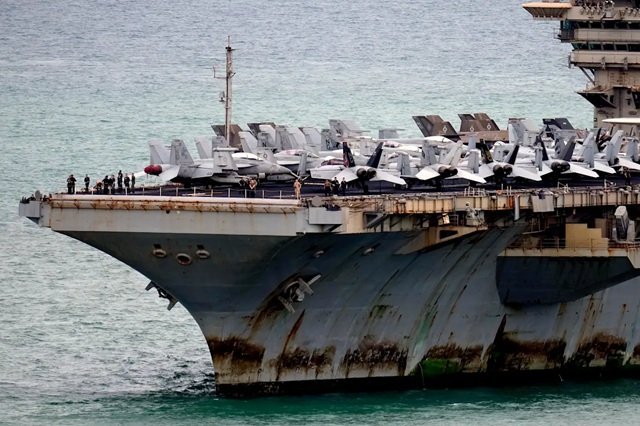
For nine months, the sailors of the USS Abraham Lincoln have lived largely within the confines of a warship. This week, 5,000 American military personnel arrived in and around Pattaya, Thailand, as their carrier strike group began a period of shore leave after 286 days at sea — a record-length deployment that has attracted sustained attention in the American press.
The arrival, documented by Die Zeit, turned Pattaya into a temporary stage for one of the US Navy’s oldest traditions: Rest and Recreation, or R&R. The practice dates back to the 1960s, when American troops serving in Vietnam were given periods away from the battlefield. In Pattaya, however, R&R has a history that reaches far beyond military relaxation. The city’s modern identity as an international party and nightlife destination is deeply connected to that earlier era.
Gajendra Kumar, 28, the manager of the Jalwa nightclub on Pattaya’s famous Walking Street, personally monitored the arrival of the sailors through the club’s security cameras. The club, known for laser shows and Thai and Uzbek go-go dancers, is among the most elaborate venues on the strip. Kumar was watching closely to see whether the arrival of thousands of sailors would bring trouble.
Only 10 or 20 of the Americans came to his club initially, he said. They danced, drank and left. There were no problems. Kumar expected more sailors to arrive in the following days, but after watching the first groups on his monitors, he appeared relaxed about their presence.
The first buses and vans arrived at the Hard Rock Hotel at about 2pm on Wednesday. Young men and women emerged wearing shorts and T-shirts, carrying backpacks and small travel bags. After nine months aboard a ship, they were once again standing on solid ground. Shore Patrol personnel accompanied some of the groups, while television crews recorded their arrival.
The Hard Rock was designated as the headquarters for the shore leave. Hundreds of rooms were reserved there and at surrounding hotels, while police and the Navy established a joint coordination centre. Pattaya’s mayor, police chief and district chief were present to welcome the sailors, placing garlands made from Thai fabric around them. Captain Dan Keeler, commander of the aircraft carrier, thanked the hosts and said the crew was looking forward to a “well-deserved” rest.
The celebration comes against a backdrop of controversy surrounding the extraordinary length of the deployment. The Lincoln had been at sea for 286 days after its sustained operation in the war against Iran. There had also been public discussion in the United States about conditions aboard the carrier, including allegations of mould, broken toilets, limited food and contaminated water. Democratic US senators Richard Blumenthal and Ruben Gallego had raised such claims based on accounts from relatives of sailors.
The Die Zeit report also recalls an incident on 3 August in which a sailor went overboard in heavy seas and was recovered about an hour later by a rescue helicopter. US Central Command said he had fallen, while American government officials described a psychological crisis and his wife told a television broadcaster that he had jumped.
Keeler acknowledged that the ship currently looked like a dirty car in a car park. But he disputed the wider portrayal of life aboard the carrier, saying there was a gap between reports in the United States and the reality on the ship. Complaints from sailors on their first deployment about food and accommodation, he suggested, had been amplified by concerned relatives at home. Food remained plentiful, he said, although fresh fruit and vegetables had become scarce. Soap and toothpaste had also had to be rationed.
For the sailors arriving in Pattaya, the immediate purpose was simpler: rest.
The connection between that idea and Pattaya is historic. During the Vietnam War, the United States maintained a naval base and a launch site for B-52 bombers in the region. At the height of the conflict, almost 50,000 American soldiers were stationed in Thailand. Another 6,000 arrived each month for five-day periods of Rest and Recreation, travelling from Saigon to Bangkok. At that time, a substantial proportion of visitors to Thailand were American servicemen on leave.
The economic and social consequences were profound. Women moved by the tens of thousands from Thailand’s agricultural north-east, where an economic crisis was emptying villages, towards Pattaya in search of employment connected to the military presence. Thailand had prohibited prostitution in 1960, but in 1966 legislation created the category of entertainment establishments, covering bars, nightclubs, massage parlours and bathhouses. The prohibited activity was subsequently conducted under this new legal framework.
In 1967, Bangkok and Washington formally agreed on arrangements for Rest and Recreation.
The history has left an uncomfortable legacy. Thailand and the United States have been connected by a friendship treaty since 1833, the oldest treaty relationship Washington maintains in Asia, and they became allies under the Manila Pact of 1954. Yet Pattaya demonstrated that military relationships could have consequences extending beyond bases, airspace and access to ports. The Vietnam-era R&R system also helped shape an economy centred on entertainment and commercialised sex.
When American forces left in 1976, Pattaya’s visitor numbers initially fell by half. They later recovered as tourists from Germany, Russia, China, Malaysia, India and elsewhere arrived. In more recent years, American military personnel have again become more visible. The carrier group of the USS Carl Vinson spent five days at Laem Chabang in February 2025. In March this year, the flagship of the Seventh Fleet visited the region, while 8,000 soldiers from 30 countries took part in exercises in nearby Rayong.
For Pattaya’s business community, the arrival of the Lincoln was therefore more than a military visit. The city was emerging from its worst season in years, and the mayor calculated that 5,000 Americans could provide a substantial boost to local businesses, estimating that each might spend around $100 a day.
The sailors were permitted to visit Walking Street, but under restrictions. They were expected to return by 2am, while the more notorious Soi 6, Soi 6/1 and Soi 7 were officially off limits. Cannabis shops, pharmacies and jet skis were also prohibited. Many of the restrictions, the mayor said, had been imposed by the Navy rather than the city, amid concerns about possible fights.
The restrictions did not entirely hold.
As evening fell, groups of sailors began appearing along Walking Street, passing through checkpoints and into its brightly lit collection of clubs and bars. Shore Patrol officers and Navy police accompanied groups through the streets. The police chief warned that any American sailor who broke Thai law would be prosecuted under Thai law.
At least two sailors were removed from the nightlife altogether after becoming involved in a fight while drunk early on Friday morning. Thai police allowed them to leave, but the US military was still considering the case.
Elsewhere, the mood was largely one of youthful curiosity. Some sailors visited shopping centres and sports shops. Others gathered in cafés and restaurants. Many were 18 or 19, the age at which Americans commonly join the Navy, and some were experiencing Thailand for the first time.
The contrast between their lives aboard the carrier and their brief freedom ashore was striking. Sailors who initially appeared in standard black T-shirts and shorts soon changed into colourful shirts, chains, bandanas and novelty hats.
At Soi 6, one of Pattaya’s most notorious nightlife streets, the crowds became more animated. Bars prepared for the American visitors, with women standing outside and calling to passing sailors. The commercial exchange was straightforward: a sailor paid for his own drink and another for the woman who joined him. Some talked; others pursued relationships or private encounters upstairs.
Among those meeting the sailors were young women from Thailand’s impoverished north-east, as well as Myanmar and Laos. One was described as an athlete who moved between competitions and work in Pattaya’s nightlife economy. Another, aged 19, said she preferred working on Soi 6 to the go-go clubs of Walking Street because she did not have to expose her body to every customer.
The encounters revealed a striking parallel. Some of the young American sailors had entered the Navy because of limited opportunities at home, while some of the young women in Pattaya had entered the nightlife economy because of difficult circumstances in their own communities.
After nine months aboard a warship, the sailors had arrived in a city whose modern identity was partly created by earlier generations of American servicemen seeking exactly what they were seeking now: a few days away from military life.
In Pattaya, the Vietnam-era tradition of Rest and Recreation has never entirely disappeared. Decades after the war that helped transform the city, the arrival of the USS Abraham Lincoln has brought it back into view — not simply as a military stopover, but as a reminder of how war, tourism, commerce and the lives of young people can become intertwined across generations.