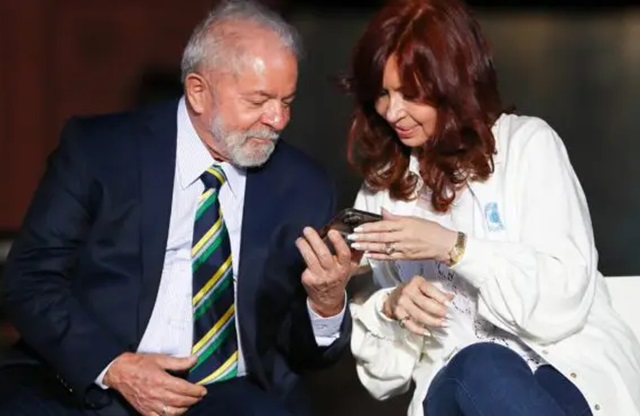
Brazilian President Luiz Inácio Lula da Silva made a politically charged visit to Argentina’s former leader Cristina Fernández de Kirchner on Thursday, embracing the embattled leftist icon at her Buenos Aires apartment where she remains under house arrest. The move, widely seen as a show of ideological unity, has deepened tensions between Lula and Argentina’s libertarian president, Javier Milei.
Kirchner, who was sentenced in 2022 to six years in prison for corruption and banned from public office, has been confined to her home since the country’s Supreme Court upheld the ruling last month. She maintains the conviction was politically motivated — a view echoed by Lula and other allies who see both leaders as victims of “lawfare,” or the use of legal systems to target political opponents.
“Lula was also the victim of lawfare,” Kirchner said in a post on X following the nearly hour-long meeting. “They tried to silence him too. They could not. His visit was much more than a personal gesture: it was an act of political solidarity.”
The visit comes during Lula’s trip to Buenos Aires for a Mercosur summit, where he assumed the bloc’s rotating presidency from Milei in a frosty handover. The Argentine president, a fierce critic of regional protectionism, used the occasion to denounce Mercosur as “an iron curtain,” underscoring his sharp ideological rift with the Brazilian leader.
Lula, who spent 19 months in prison after a 2018 corruption conviction that was later annulled, has long been aligned with Kirchner and her Peronist movement. Their meeting marked a reunion of two towering figures of Latin America’s 21st-century left — and a visible rejection of Milei’s hardline stance.
Diplomatic relations between Argentina and Brazil have deteriorated significantly since Milei took office in December 2023. The two leaders have yet to meet one-on-one. Instead, each has gravitated toward ideological allies: Milei has met twice with Jair Bolsonaro, Lula’s far-right predecessor and political adversary, and has echoed Bolsonaro’s claims of being persecuted by the judiciary.
The image of Lula embracing Kirchner in her apartment was splashed across local media, which have closely tracked the saga surrounding her house arrest — from her ankle monitor to the court-approved visitor logs. Supporters often gather outside her residence, where she has made balcony appearances reminiscent of her time in office.
Though personal and political hostilities have marked relations at the highest level, lower-tier cooperation between the neighboring countries continues. During this week’s Mercosur summit, the bloc agreed to expand tariff exemptions in response to Milei’s demands for greater economic flexibility.
Lula’s visit to Kirchner also highlights a broader regional trend: in recent years, several Latin American leaders — from Peru’s Alberto Fujimori to Ecuador’s Rafael Correa — have faced prosecution or imprisonment. Kirchner’s defenders argue that her trial was biased and that the judiciary has been weaponized for political purposes, a claim often dismissed by conservatives as a deflection tactic.
A recent poll by Opina Argentina suggests public opinion remains split: 57% believe Kirchner is guilty of corruption, while 37% believe she is innocent. Her legal team has pledged to appeal the conviction in international courts, following a path similar to Lula’s legal comeback in Brazil.
As Lula settles into the Mercosur presidency, his visit to Kirchner sends a clear signal — not only of personal loyalty, but of continued resistance to the rise of right-wing populism in the region. For Milei, it’s another reminder that his ideological foes remain vocal and deeply entrenched, both at home and abroad.