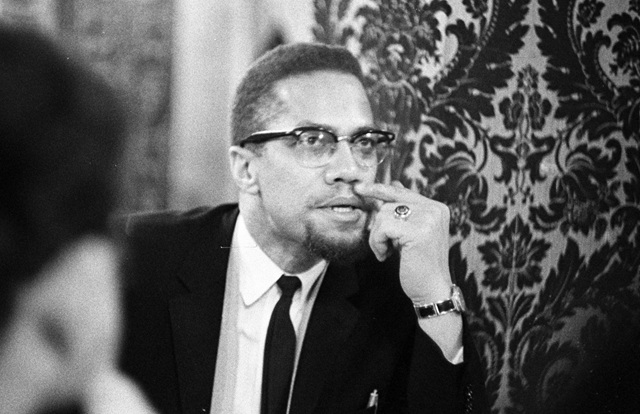
Born Malcolm Little on May 19, 1925, in Omaha, Nebraska, he entered a world that had already marked him for struggle. His father, a Baptist minister and fervent disciple of Marcus Garvey’s radical “Back to Africa” movement, dared to challenge white supremacy head-on—a boldness that cost him his life. The Ku Klux Klan’s relentless terror forced Malcolm’s family to flee, only for fate to strike harder. At six years old, Malcolm lost his father to murder, his family’s home reduced to ashes in a fire of racial hatred.
But the brutality didn’t stop there. His mother, broken by the weight of systemic oppression and personal tragedy, was institutionalized for 26 years. The family shattered. Malcolm, just a child, was tossed into the cold machinery of the foster care system—a system never built for Black survival, let alone success. By 15, Malcolm had dropped out of school. The American Dream had already failed him.
From the gutters of Boston’s underbelly to the cold confines of a prison cell, Malcolm’s early life was a descent into crime—a rebellion fueled by despair. Yet prison didn’t break him; it forged him. Behind bars, Malcolm encountered the Nation of Islam, absorbing Elijah Muhammad’s radical teachings that declared the white man inherently evil, doomed by Allah’s judgment. Malcolm’s response? Embrace the fire. He devoured knowledge, rebuilt his mind, and emerged from prison not as Malcolm Little, but Malcolm X—symbolizing the lost African identity stolen by slavery.
By the early 1950s, Malcolm X had become a fiery prophet of Black separatism, challenging the comfortable narratives of integration that mainstream civil rights leaders peddled. While Martin Luther King Jr. preached nonviolence and assimilation, Malcolm X demanded separation, self-respect, and power—ideas that terrified white America and unsettled even some Black leaders. He didn’t want Black people to integrate into a burning house. He wanted them to build their own.
His infamous words on the assassination of John F. Kennedy—”the chickens coming home to roost”—shook the nation and led to his suspension from the Nation of Islam. But instead of silencing him, this rupture unleashed a new, more revolutionary Malcolm. He left the Nation and founded the Muslim Mosque, Inc. and the Organization of Afro-American Unity, seeking not just Black liberation but human unity on a global scale.
It was his pilgrimage to Mecca in 1964 that redefined Malcolm’s understanding of race and brotherhood. There, in the heart of Islam, he witnessed a unity that transcended skin color—a revelation that shattered his earlier convictions. In his own words:
“I have eaten with people who in America would be considered ‘white’ but the ‘white’ attitude was removed from their minds by the religion of Islam.”
This evolution wasn’t weakness—it was growth. But America wasn’t ready for this version of Malcolm X. The system could tolerate the firebrand separatist—someone easy to demonize—but not the visionary who saw a pathway to true global solidarity.
On February 21, 1965, at just 39 years old, Malcolm X was assassinated—shot down while addressing a crowd in Harlem. His death was inevitable in a society that couldn’t handle his evolution from militant to enlightened revolutionary.
Malcolm X remains one of the most polarizing figures in American history. To some, he was a dangerous radical; to others, a truth-teller unafraid to expose the rot of white supremacy. What’s undeniable is his legacy: a challenge to the false comforts of racial harmony built on oppression.
His words still burn through the pages of history:
“History is a people’s memory, and without a memory, man is demoted to the lower of animals.”
Decades later, America still struggles to reckon with Malcolm’s memory. His message wasn’t just about Black liberation—it was about human dignity, truth, and the terrifying cost of confronting power head-on. Malcolm X didn’t just die for his beliefs—he was martyred because he dared to evolve.
And that’s the truth many still refuse to face.