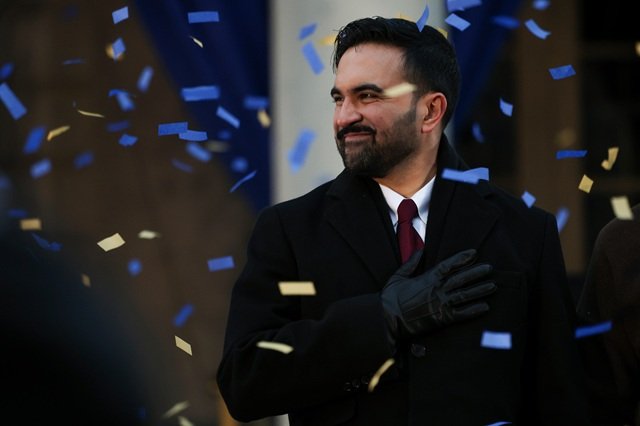
New York Mayor Zohran Mamdani’s Independence Day address has emerged as a focal point in the United States’ increasingly polarized political landscape, drawing sharp reactions from across the ideological spectrum and prompting renewed debate over the meaning of American identity. Writing in Project Syndicate, philosopher Slavoj Žižek argues that Mamdani’s speech represents a rare attempt to construct a broad political narrative capable of reaching beyond entrenched partisan divisions.
Žižek describes the address as an example of ideology in what he calls the positive sense of the term: a simplified but mobilizing vision that challenges competing political narratives rather than merely responding to them. In his view, Mamdani’s remarks overturned both the right-wing populist account of the United States as a nation under siege and the progressive “woke” critique that, according to Žižek, has struggled to build a broad political coalition.
The debate unfolds against the backdrop of a longer transformation in Western political thought. Žižek traces the last widely shared liberal narrative to political scientist Francis Fukuyama’s “end of history” thesis in the 1990s, which argued that liberal-democratic welfare-state capitalism represented the culmination of political development. Within that framework, the principal question was when, rather than whether, other societies would eventually adopt similar systems.
According to Žižek, that consensus fractured after 2001, giving way to what he describes as an era of pragmatism in which coherent ideological visions became increasingly scarce. In its place, he argues, right-wing nationalist movements in the United States and Europe advanced a narrative portraying the developed Christian West as an exceptional civilization threatened by immigration, cultural change, LGBT+ activism, and what they describe as cultural Marxism.
Žižek contends that progressive identity politics has also failed to establish an equally expansive narrative. He argues that it concentrates on specific forms of oppression without offering a unifying political vision capable of appealing to a broader electorate. Instead of presenting a common national project, he suggests, it often leaves much of the public outside its central framework.
It is within this political environment that Žižek situates Mamdani’s rise. He notes that the New York mayor secured office not through what he characterizes as academic ideological debates, but by campaigning on practical local concerns affecting ordinary residents. His platform included proposals for free childcare, fare-free buses, rent control, and expanded access to health services, policies aimed at addressing economic inequality rather than cultural divisions.
Žižek argues that Mamdani extended that approach into a wider national vision during his July 4 address marking the 250th anniversary of the Declaration of Independence. Rejecting the idea that American exceptionalism rests primarily on military strength, wealth, or global power, Mamdani instead presented the United States as a nation defined by the continuing pursuit of the principles first articulated in the Declaration. Speaking to newly naturalized citizens, he described American identity as something that remains open to renewal, emphasizing that each generation—and particularly newcomers—helps determine what the country ultimately becomes.
For Žižek, the significance of the speech lies less in whether it offers a complete historical account than in its ability to provide an alternative political narrative. He argues that Mamdani reframed openness to immigrants—often portrayed by nationalist movements as a threat—as the defining source of American strength and exceptionalism. Rather than depicting newcomers as outsiders, the speech presented them as participants in the continuing realization of the country’s founding ideals.
The address quickly became part of a broader political confrontation. Žižek points to President Donald Trump’s own Independence Day remarks, in which Trump described communism as the greatest threat to American liberty and made historical comparisons that Žižek characterizes as inaccurate. According to Žižek, the comments reflected the intensity with which conservative opponents have responded to Mamdani’s political message.
Criticism also emerged from sections of the political left. Žižek highlights a commentary published by Jacobin under the headline “Burn the Constitution Once Again,” which argued that the US Constitution had enabled rather than restrained Trump’s presidency. The article questioned Mamdani’s favorable references to the Declaration of Independence and the Constitution, suggesting that those founding documents contain structural limitations that continue to shape American politics.
Žižek acknowledges that such critiques draw on longstanding historical arguments. The Federalist Papers reveal concerns among the founders about limiting direct popular influence, while institutions such as the Electoral College reflected those priorities. He notes that many leading founders belonged to the wealthy elite, voting rights were initially restricted, slavery was constitutionally protected, and discrimination persisted against groups including Irish-Americans in certain areas of public life.
The philosopher also examines divisions within left-wing intellectual circles, observing that debates over the legacy of cultural Marxism continue to produce conflicting interpretations. While right-wing critics frequently associate contemporary progressive politics with thinkers such as Antonio Gramsci, Herbert Marcuse, and Theodor Adorno, some left-wing scholars, including Villanova University philosopher Gabriel Rockhill, argue that Western cultural Marxism itself functioned as an anti-communist project supported by the Central Intelligence Agency to undermine Soviet-style socialism. Žižek invokes Jean-Paul Sartre’s observation that ideas attacked from opposing directions often occupy a more complex position than either side acknowledges.
Throughout his essay, Žižek maintains that Mamdani’s address succeeded because it replaced competing narratives with one centered on the continuing possibility of national renewal. He argues that the speech presented the United States as a society whose defining characteristic is its capacity to offer opportunity to successive generations of immigrants, rather than a nation whose identity depends on excluding outsiders or dwelling solely on historical injustice.
Žižek concludes that Mamdani has positioned immigrants and working-class newcomers at the center of a renewed version of the American dream. Whether that vision ultimately reshapes the country’s political landscape remains uncertain, but the speech has already become a prominent point of reference in the debate over patriotism, democracy, and the future direction of American politics.