


Mariupol, once a bustling industrial hub on Ukraine’s Azov coast, has become one of the most contested symbols of the war between Russia and Ukraine. In a detailed investigation originally published by Die Zeit, the city is portrayed as both a site of immense wartime destruction and a laboratory for political, demographic and cultural transformation under Russian occupation.
For many Ukrainians, Mariupol represents the darkest chapter of the conflict. In the early weeks of the invasion, the Russian military encircled the city of roughly 500,000 inhabitants, cutting off escape routes and trapping civilians in basements for weeks. Food, water and electricity disappeared as the city became a battlefield of relentless shelling and street fighting. Residents who survived describe burying neighbours and relatives in makeshift graves in courtyards and gardens, a reflection of the collapse of basic civilian infrastructure.
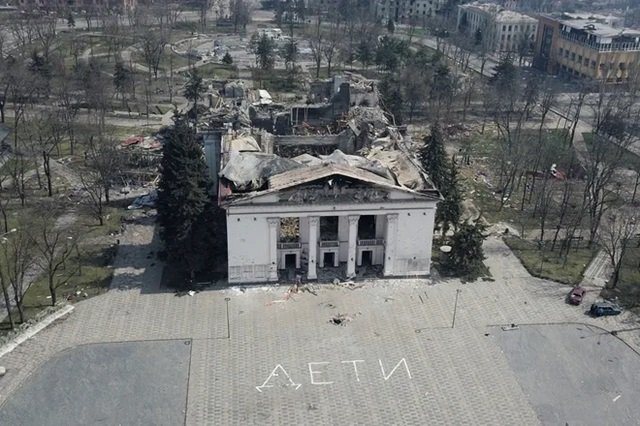
One of the most searing images of the siege was the bombing of the Mariupol drama theatre, where hundreds of civilians, including children, had sought shelter. The word “Дети” (“children”) had been written in large white letters outside the building in a desperate attempt to signal its civilian use. The building was nevertheless struck by an air-dropped bomb, an event that has since become emblematic of the war’s brutality. According to estimates cited by United Nations experts, around nine out of ten buildings in Mariupol were damaged or destroyed during the fighting, while Ukrainian authorities and humanitarian organisations believe at least 12,000 civilians were killed, with some survivors claiming the true toll is significantly higher.
Despite this devastation, Mariupol has also become central to Russian political messaging. The Die Zeit report describes how the Kremlin considers the city a strategic “trophy” of the war. Shortly after taking control, Russian authorities reportedly developed plans to rebuild Mariupol as a model city under occupation, designed to reflect Moscow’s vision of order and integration, while encouraging resettlement from across Russia and other occupied territories.
In the years since the siege, reconstruction has transformed parts of the city. Satellite imagery and on-the-ground reporting suggest that major restoration work has focused on central districts, where damaged Soviet-era apartment blocks and administrative buildings have been repaired or replaced. Cranes dominate the skyline, and some neighbourhoods now appear visibly rebuilt, with renovated facades and restored infrastructure.
However, this reconstruction is uneven. According to testimonies gathered by Die Zeit, while the city centre has regained a degree of normality, many side streets remain heavily scarred by war damage. Entire residential blocks have been demolished rather than restored, with new developments replacing them. In some areas, up to three-quarters of former housing stock in central districts has reportedly been rebuilt or repaired, while other zones remain in ruins.
Public life has also partially resumed. Shops, cafés and services have reopened, and basic utilities such as electricity and mobile internet are more stable than in other parts of the occupied Donbas region. Yet the industrial base that once defined Mariupol has largely collapsed. Only a handful of factories, including a bakery and small food-processing plants, remain operational. Employment is now concentrated in construction, administration and retail.
Wages, while still modest, are reportedly higher than in some surrounding occupied territories, attracting new residents from across Russia. The Die Zeit investigation describes a gradual demographic shift, with an estimated 100,000 original residents remaining or returning, while others are replaced by newcomers from Russian regions and other occupied areas. Local occupation authorities, however, claim the population has recovered to more than 330,000, a figure that independent observers question.
Beyond physical reconstruction, the transformation of Mariupol also involves ideological restructuring. Public education and commemorative events are used to reinforce the Russian narrative of the war. On Victory Day celebrations, school events in newly rebuilt institutions have reportedly been used to present an official version of history in which Ukraine is blamed for the conflict and Russia is portrayed as a liberating force. These narratives are reinforced through school curricula and public messaging controlled by the occupation administration.
According to Die Zeit, Ukrainian identity has been increasingly marginalised. Since 2025, Ukrainians in occupied territories are treated as foreign nationals, requiring residency permits. Access to employment, healthcare and education is tied to the acquisition of Russian citizenship, effectively forcing many remaining residents to adopt Russian legal identity in order to function in daily life.
Property ownership has become another source of tension. Many displaced residents who fled during the siege have found their homes reassigned or placed in registries of “ownerless property.” Some have attempted to reclaim their apartments through legal or administrative channels, but face bureaucratic and political obstacles. Former residents interviewed by Die Zeit describe losing both their homes and their legal claim to return, as reconstruction projects proceed over demolished neighbourhoods.
One of the most controversial aspects of the rebuilding effort is the large-scale construction of new residential complexes. Entire Soviet-era districts have been razed and replaced with modern apartment buildings, some marketed at prices far beyond the reach of ordinary residents. Although authorities have promised housing allocations for those who lost homes during the war, many residents say these promises have not been fulfilled in practice.
In eastern Mariupol, for example, an entire residential quarter once built for industrial workers has been cleared and replaced with new developments. Satellite images show that only foundations remain where schools, kindergartens and dozens of apartment blocks once stood. According to Die Zeit, these new projects are part of a broader plan to reshape the city’s social and demographic structure by 2030, including the planned settlement of tens of thousands of new residents.
At the same time, those who oppose the occupation or have left the city are effectively excluded from its future. One displaced resident quoted in the report describes how returning is no longer a realistic option, as properties risk confiscation under Russian administrative rules if not formally registered within the occupied system.
The human cost of displacement is illustrated through individual testimonies. Survivors describe families separated by arrest, imprisonment and forced migration. Some civilians who attempted to return to Mariupol have faced detention on suspicion of sabotage or political opposition, with human rights groups questioning the legitimacy of such charges.
The Die Zeit investigation portrays Mariupol not only as a destroyed city being rebuilt, but as a space where memory, identity and ownership are being actively contested. The physical reconstruction of buildings runs parallel to a deeper transformation of the city’s political and cultural landscape.
For Ukraine, Mariupol remains a symbol of wartime devastation and loss. For Russia, it is being reshaped into an example of post-conflict integration under occupation. Between these competing visions lies a city still struggling to define its identity, where rebuilding and erasure proceed side by side.









