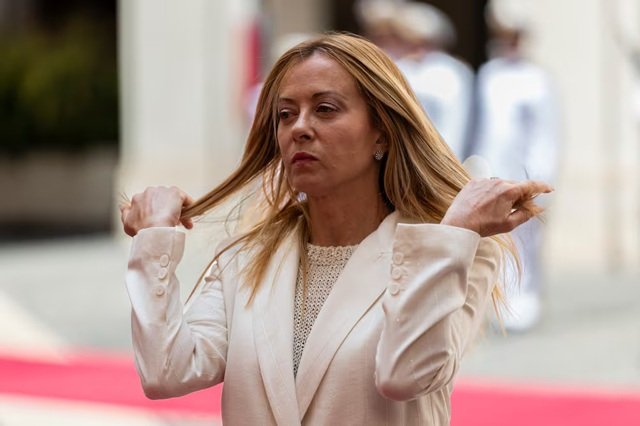
Italian Prime Minister Giorgia Meloni on Wednesday criticised a diesel supply agreement between the United States and Russia, calling it a “very risky choice” that could undermine international efforts to pressure Russian President Vladimir Putin into negotiations with Ukraine.
The United States and Russia said last week they had agreed that Moscow would initially supply more than 300,000 metric tonnes of diesel to US and global markets. Meloni warned that the consequences of the arrangement remained uncertain, while its potential risks were clear, ahead of a European Union summit scheduled for this week.
“The outcome of this decision is uncertain, while the risks are clear,” Meloni told the Italian parliament. She argued that the agreement could weaken the pressure being applied to Moscow over its war against Ukraine.
“It provides Moscow with legitimacy as its bombs continue to fall on Ukrainian cities, generates new revenue to finance the war, and implicitly weakens the effectiveness of sanctions,” she said.
The criticism highlights a difference in approach over how to deal with Russia while the war continues. Meloni’s remarks focused on the potential consequences of allowing Russian diesel to enter international markets, particularly the possibility that additional revenue could help finance Moscow’s military campaign and that the agreement could diminish the impact of sanctions.
US President Donald Trump defended the agreement on economic grounds, saying after its announcement that it would lower energy prices in the United States. Energy costs have become a significant political concern for Trump’s Republican Party ahead of pivotal midterm elections that will determine control of Congress.
The deal’s expected impact on energy prices contrasts with Meloni’s emphasis on its diplomatic and strategic risks. Her statement did not specify what alternative arrangements should replace the agreement, but she linked the issue directly to the wider objective of bringing Putin to the negotiating table with Ukraine.
Meloni also called for the European Union’s 27 member states to appoint “an authoritative figure” to represent Europe in negotiations over the Russia-Ukraine war. She argued that any European initiative should have a clear mandate from the member states, while leaving open the possibility of delegating the task to a smaller group of major European powers.
Her proposal included the E3 group, comprising Germany, France and Great Britain, as a possible negotiating vehicle. Meloni did not rule out allowing the three countries to lead discussions, provided they acted formally on behalf of the wider European Union.
“If France, Germany, and Great Britain believe they can do better on their own than we could all do together, and so far that is the choice they have made, then at least let them do so on behalf of everyone and with an official mandate,” she said.
The comments place the question of European representation alongside the dispute over the diesel agreement, with Meloni arguing for a more clearly authorised European role in efforts to address the war. Her remarks came as EU leaders prepared to meet later in the week, with the question of how to engage with Moscow remaining central to the diplomatic response to the conflict.
Meloni’s position, as expressed to parliament, was that arrangements involving Russia should be assessed not only in terms of their immediate economic effects but also for their implications for sanctions and negotiations. She maintained that the diesel agreement could confer legitimacy on Moscow and provide resources for the war, while calling for European countries to establish who would negotiate on their behalf and under what authority.