


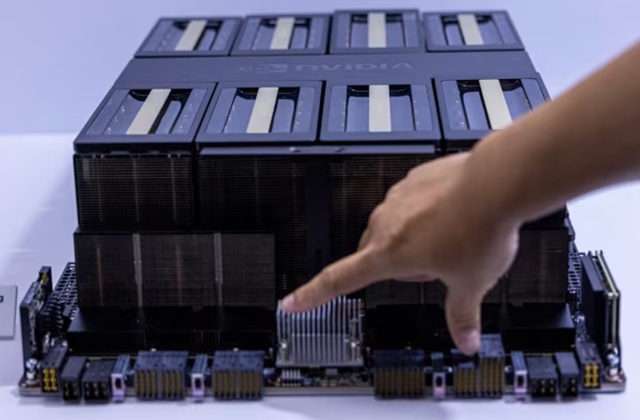
According to a report by the Financial Times, Microsoft has emerged as the dominant purchaser of Nvidia’s flagship AI chips in 2024, securing nearly half a million of Nvidia’s “Hopper” GPUs this year—more than double the acquisitions of its closest competitors in the U.S. and China. Analysts at Omdia, a technology consultancy, estimate that Microsoft’s 485,000 chip orders far outstripped those of Meta, Amazon, Google, and Chinese tech giants ByteDance and Tencent, positioning Microsoft as a leader in the race to build advanced AI infrastructure.
The unprecedented demand for Nvidia’s GPUs stems from a surge in investment in artificial intelligence technologies, driven by innovations like ChatGPT, which have sparked fierce competition among global tech companies. Microsoft’s strategic advantage lies in its aggressive expansion of data center capabilities through its Azure cloud platform, which supports both its own AI initiatives, such as Copilot, and third-party clients like OpenAI, in which Microsoft has invested $13 billion.
Microsoft’s chip purchases this year represent a significant increase from 2023, underscoring its commitment to AI development. Alistair Speirs, Microsoft’s senior director of Azure Global Infrastructure, emphasized the importance of multi-year planning and strategic investments to accommodate rapid growth and sustain a buffer for future demand. The company’s forward-thinking approach has allowed it to build robust AI systems that integrate advanced GPUs with complementary technologies in storage, software, and infrastructure management.
This surge in GPU demand reflects a broader trend, with tech companies worldwide expected to spend $229 billion on servers in 2024. Microsoft alone leads with $31 billion in capital expenditure, followed by Amazon at $26 billion. Nvidia GPUs accounted for a staggering 43% of global server spending, with Omdia noting this could represent a peak in the market’s dependence on Nvidia’s chips.
Despite Nvidia’s dominance, competition is growing. AMD has made significant strides, with companies like Meta and Microsoft incorporating AMD’s MI300 chips into their infrastructure. Additionally, Big Tech firms are accelerating the deployment of their own custom AI chips to reduce reliance on Nvidia. Google and Meta have ramped up production of their tensor processing units (TPUs) and Meta Training and Inference Accelerator chips, respectively, while Amazon has advanced its Trainium and Inferentia chips.
Microsoft, however, remains in the early stages of developing its proprietary Maia AI chips, with about 200,000 installed this year. Speirs noted that while chips are a critical component, Microsoft’s competitive edge lies in its ability to integrate them with comprehensive AI infrastructure to deliver tailored services.
Nvidia’s market dominance has propelled its valuation past $3 trillion this year, but challenges loom. Concerns about slowing growth, increasing competition, and geopolitical uncertainties, including U.S. export restrictions on AI chips to China, have tempered its meteoric rise. ByteDance and Tencent, despite restrictions, have become major buyers of Nvidia’s modified H20 chips for the Chinese market, illustrating the global demand for cutting-edge AI hardware.










