


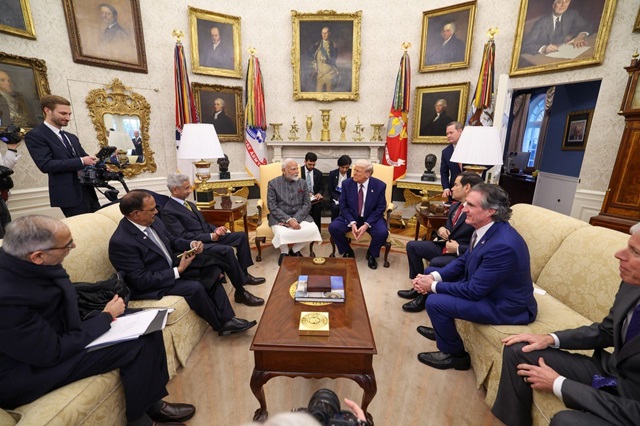
Prime Minister Narendra Modi and US President Donald Trump met at the White House in a high-profile bilateral meeting, marking Modi’s first visit since Trump returned to office. Their discussions covered a broad range of topics, from defense and trade to emerging technologies and multilateral cooperation, with both leaders reaffirming their commitment to strengthening the US-India relationship.
A key outcome of the meeting was the approval of the extradition of Tahawwur Rana to India, a move welcomed by the Indian government. On defense, the two nations agreed to a new ten-year framework for their Major Defense Partnership, with the US expanding defense sales and co-production initiatives. The procurement of six additional P8I aircraft was finalized, while negotiations for a Reciprocal Defense Procurement (RDP) agreement are set to begin this year. The US also announced a review of its policy on releasing fifth-generation fighters and undersea systems to India. Additionally, a new initiative, the Autonomous Systems Industry Alliance (ASIA), was launched to bolster cooperation in underwater domain awareness technologies.
In trade and investment, the leaders set an ambitious goal of doubling bilateral trade to $500 billion by 2030 under the “Mission 500” initiative. A multi-sector Bilateral Trade Agreement (BTA) is expected by the fall of 2025, with both sides committing to resolving trade barriers. Trump’s administration acknowledged the contributions of Indian investments in the US, which currently amount to over $7.3 billion and have created thousands of high-quality jobs.
Technology and innovation were central to the discussions, with the launch of the US-India TRUST initiative aimed at fostering collaboration in critical sectors such as artificial intelligence, semiconductors, biotechnology, and space. The two nations committed to finalizing a roadmap for accelerating AI infrastructure by the end of the year, while a new initiative, INDUS Innovation, will promote industry and academic partnerships in emerging technologies. India’s pharmaceutical sector is set to expand its manufacturing capacity, including in the US, to ensure a stable supply of critical medicines. The Strategic Mineral Recovery initiative was also launched, focusing on extracting and processing essential minerals such as lithium and cobalt.
On energy security, both countries reaffirmed their commitment to the US-India Energy Security Partnership, with the US supporting India’s bid for full membership in the International Energy Agency. Plans to advance US-designed nuclear reactors in India, including potential technology transfers and localization, were also discussed. The leaders emphasized the need for collaboration on developing small modular reactors for scalable nuclear power generation.
The meeting highlighted the strong people-to-people ties between the two nations, recognizing the significant contributions of the 300,000-strong Indian student community in the US, which contributes over $8 billion annually to the American economy. Efforts to streamline legal mobility for students and professionals were reinforced, alongside commitments to address illegal immigration and human trafficking. Strengthening law enforcement cooperation to combat organized crime syndicates, including narco-terrorists and arms traffickers, was also a focal point.
Multilateral cooperation remained a priority, with both leaders reaffirming their commitment to the Quad and the Indo-Pacific region. India is set to host the next Quad Leaders’ Summit, and plans were announced to convene partners from the India-Middle East-Europe Corridor and the I2U2 Group to launch new initiatives in 2025. A new bilateral forum, the Indian Ocean Strategic Venture, was introduced to enhance economic connectivity and commerce. Meanwhile, Meta announced a multi-billion-dollar investment in an undersea cable project that will span 50,000 km to strengthen digital infrastructure across five continents.
The two leaders strongly condemned terrorism and called on Pakistan to ensure that those responsible for the 26/11 Mumbai attacks and the Pathankot attack are brought to justice. Trump’s administration confirmed that the extradition of Tahawwur Rana has been approved. Additionally, the leaders pledged to take decisive action against Khalistani-linked organized crime syndicates. Addressing speculations about the US’s involvement in Bangladesh’s internal affairs, Trump stated that he would leave the matter to Modi’s leadership.









