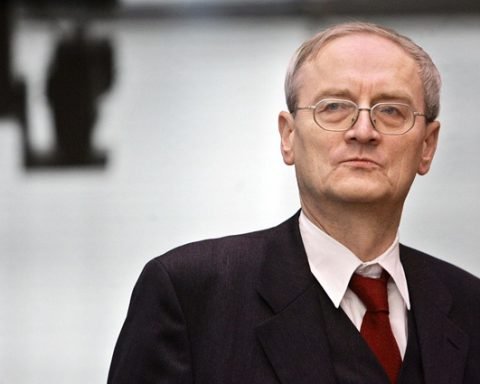

United Nations High Commissioner for Human Rights Volker Türk is scheduled to visit Colombo later this month. The House on June 5 announced the visit, two days after the UN Resident Coordinator in Sri Lanka, Marc-André Franche, informed Speaker, Dr. Jagath Wickramaratne, of the impending visit.
A press release issued by the Parliament, dated June 5, 2025, mistakenly identified Volker Türk as the High Commissioner of the International Commission on Human Rights. Parliament never bothered to correct the statement posted on its website. Franche was accompanied by UN Peace and Development Resident Advisor Patrick McCarthy.
BTF (British Tamil Forum) General Secretary V. Ravi Kumar, in a letter dated May 27, 2025, urged the UN rights chief to visit Mullivaikkal where he alleged a genocide was committed in 2009. Kumar also requested the Austrian lawyer to visit Chemmani, where mass graves have been unearthed recently, as alleged by the BTF. Kumar, a former member of the Liberation Tigers of Tamil Eelam (LTTE), received British citizenship many years ago. The Tamil Diaspora, spread over Europe, Canada and various other parts of the world, includes a significant number of former members of Tamil terrorist organisations.
The National People’s Power (NPP) government, without hesitation, should allow the UN official to visit Mullivaikkal, Chemmani or any other place desired by the Tamil Diaspora. The government shouldn’t allow the BTF and other interested parties to make wild allegations on the basis of not including Mullivaikkal and Chemmani in the UN official’s itinerary. The government should also invite Volker Türk to visit Nanthikadal lagoon where the Army eliminated the LTTE leader Velupillai Prabhakaran and his remaining diehard members in a last encounter on May 19, 2009, the day after Sri Lanka brought the war to a successful conclusion.
Senior military commanders, who spearheaded the successful war against the LTTE, should declare their support for the UN Human Rights chief’s visit to Sri Lanka. Whatever the differences they may have had among themselves during the war, retired Army, Navy and Air Force officers must sink their differences to set the record straight.
The BTF shouldn’t be allowed to manipulate the forthcoming UN human rights chief’s visit here. Perhaps, they should consider seeking a meeting with the UN official to explain their position. There is absolutely no harm in making representations on behalf of Sri Lanka as all stakeholders want to ascertain the truth.
As for the impartiality of previous High Commissioners, like South African of Indian Tamil origin Navaneethan ‘Navi’ Pillai, the less said is better.
The last UN High Commissioner for Human Rights to visit Colombo was Zeid Ra’ad Al Hussein. The Jordanian was here in 2016, the year after Yahapalana leaders Maithripala Sirisena and Ranil Wickremesinghe betrayed the war-winning military by co-sponsoring a US-led resolution against Sri Lanka at the Geneva-based UNHRC. A treacherous act, indeed. There had never been a previous instance of a government betraying its own war-winning military. The UN official must be reminded that a terrorist organisation had never been defeated before the way the Sri Lankan military crushed the LTTE in a relentless combined security forces campaign (August 2006 to May 2009) that brought the LTTE to its knees by January 2009.
Those who cannot stomach Sri Lanka’s victory over the LTTE conveniently forget that Prabhakaran launched Eelam War IV on August 11, 2006, with the intention of capturing the Jaffna peninsula. They tend to forget how the Nordic truce monitoring mission found fault with the LTTE for launching the war. Declaring that the LTTE advanced over the forward defence lines near Muhamalai entry/exit point and cadres landed on several beaches on Kayts and Mandaithivu islands, the Norwegian-led five-nation truce monitoring mission said: “…. considering the preparation level of the operations it seems to have been a well prepared LTTE initiative.” (SLMM blames LTTE for Jaffna battle, The Island, Sept. 08, 2006).
Human shields
The majority of those who had been demanding accountability on the part of the Sri Lankan military and war-winning political leadership never asked Prabhakaran not to compel the civilians to accompany the retreating LTTE units. After having fiercely resisted the fighting formations on the Vanni front for several months, the LTTE began gradually withdrawing and, by January 2009, Prabhakaran was in a desperate situation. The man who ordered former Indian Prime Minister and Congress leader Rajiv Gandhi’s assassination was taking cover among hapless Tamil civilians.
The then National List member and presidential advisor Basil Rajapaksa received a one-page missive on Feb. 16, 2009, from the then Norwegian Ambassador, Tore Hattrem. The following is the text of Ambassador Hattrem’s letter, addressed to Basil Rajapaksa: “I refer to our telephone conversation today. The proposal to the LTTE on how to release the civilian population, now trapped in the LTTE controlled area, has been transmitted to the LTTE through several channels. So far, there has been, regrettably, no response from the LTTE and it doesn’t seem to be likely that the LTTE will agree with this in the near future.” (Secret missive to Basil Rajapaksa revealed: Norwegians believed LTTE won’t release hostages, The Island, April 01, 2015).
Unfortunately, the war-winning government and post-war governments never made an honest attempt to use all available information to prove that the LTTE used civilian shields to hinder the advancing Army. Perhaps, the retired military commanders should bring Hattrem’s letter to UN Human Rights official’s attention.
Having succeeded Michelle Bachelet (2018 to 2022) Volker Türk may not be aware of some of the developments and some interested parties in Geneva are widely believed to have suppressed vital information contrary to their narrative.
The BTF never asked Prabhakaran not to hold civilians hostage. Tamil Diaspora never appealed on behalf of the civilians forcibly held by the LTTE. Regardless of anti-government/military propaganda, civilians sought refuge in the government-held areas at an early stage of the Vanni offensive that was launched in March 2007.
In February, 2007 the LTTE detained two UN workers for helping civilians to reach government lines (LTTE detains UN workers, The Island, April 20, 2007). The NGO community and the truce monitoring mission remained silent to protect Tiger interests. What really baffled the government was the UN Office in Colombo having secret negotiations with the LTTE for the release of its workers (UN workers in LTTE custody: “UN had talks with Tigers on the sly,” The Island, April 23, 2007).
The so called human rights defenders turned a blind eye to the developing situation. Western powers, Tamil Diaspora and the Tamil National Alliance (TNA) that infamously declared the LTTE as the sole representative of the Tamil-speaking people in the run-up to the Eelam War IV, remained silent. Had they taken a stand against holding civilians against their will, the armed forces could have eradicated the LTTE’s conventional fighting power much quicker and spared many a life on both sides.
In the wake of The Island revelation, then Defence Secretary Gotabaya Rajapaksa urged the UN not to mollycoddle terrorists. Rajapaksa questioned the rationale in the UN trying to secure the lease of its abducted workers through secret negotiations (UN workers in LTTE custody: Lanka urges UN not to shield Tigers, The Island, April 25, 2007).
The UN mission in Colombo not only kept the government in the dark, it refrained from informing the UN Secretary General’s Office of the abduction of UN workers. When the media raised the abduction of UN workers at their daily press briefing in New York, the Secretary General’s spokesman Michele Montas disclosed they weren’t alerted (The Island expose of UN employees abducted by LTTE: UN HQ admits Colombo Office kept it in the dark, The Island April 28, 2007).
In other words, the UN mission in Colombo in a way facilitated the LTTE’s sordid operations. Had the UN resorted to tough action, the LTTE wouldn’t have held Tamil civilians as human shields for their protection.
No basis for comparison with Israeli actions
UN Under-Secretary-General for Humanitarian Affairs and Emergency Relief Coordinator Tom Fletcher made reference to Sri Lanka’s war against the LTTE when he addressed the United Nations Security Council in May this year on the massive death and destruction inflicted by Israel on Gaza.
It would be pertinent to remind all concerned that the Israeli military action directed at Gaza and other countries, with the backing of the US-UK combine, cannot be compared in any way to Sri Lanka’s war against the LTTE simply because of the terrible monstrosity of Israeli actions. Top British diplomat Fletcher cannot be unaware how successive UK governments encouraged the LTTE to wage war here with covert support, especially by the partial British media that white-washed LTTE atrocities, while magnifying even the slightest transgression by the Sri Lankan security forces, with the help of NGOs funded by them.
However, the British provided critical support during JRJ’s time by allowing ex-British personnel to train Sri Lankans.
The UK allowed the LTTE to establish its International Secretariat in London at a time India sponsored several terrorist groups fighting to divide Sri Lanka on ethnic lines.
It would be pertinent to ask whether the UK at least secretly urged Prabhakaran to give up human shields as the Army pressed its dwindling fighting cadre on the Vanni east front. Instead, the UK, with the French backing, sought to pressure President Mahinda Rajapaksa to halt the offensive. The President and his brother, Defence Secretary Gotabaya Rajapaksa, steadfastly refused to bow down to combined British-French pressure. They sustained the offensive until the eradication of the terrorist organisation. The war could never have been won without their resolute leadership.
Geneva must recognise that until the eradication of the LTTE, conscription of Tamil children continued. The LTTE sacrificed thousands of children in high intensity battles with the military after a steep decline in adults joining the fighting cadre. The UN had been so concerned about deaths of children it sought to reach a consensus with the LTTE to halt deployment of child combatants.
The NGO community, or Tamil Diaspora, never asked the LTTE to stop throwing children into battle. In spite of agreeing to halt child recruitment, following talks with Olara Otunnu, the Secretary-General’s Special Representative for Children and Armed Conflict (CAAC), Prabhakaran never stopped the despicable practice (Pledge to stop using children in combat: UN, LTTE to discuss modalities, The Island, May 11, 1998). UNICEF, too, appealed to the LTTE not to forcibly conscript children. The LTTE simply ignored such requests. Otunnu travelled to the North, in May 1998, to meet Prabhakaran’s representatives, British passport holder Anton Balasingham (died and buried in the UK in December 2006) and S.P. Thamilselvam (killed in SLAF strike in November 2007). They agreed on halting children, below 18, in combat operations and stopping recruitment of those under 17 (Tigers agree to end use of children below 18 in combat, The Island, May 9, 1998).
The Tamil Diaspora never ever demanded an end to child conscription. They felt comfortable as their children were not living in northern and eastern Sri Lanka. Child recruitment had never been an issue for the Tamil Diaspora or the TNA. The child recruitment was finally brought to an end after the combined security forces eradicated the LTTE.
How many children escaped with their lives thanks to the annihilation of the LTTE militarily? The LTTE had to be destroyed at any cost. Sri Lanka paid a very heavy price to restore peace. The Gaza conflict with Sri Lanka’s war against the separatist Tamil terrorism cannot be equated as the modern massive firepower of the Israeli Defence Forces (IDF) by land, air and sea is simply overwhelming in comparison to the combined Sri Lanka security forces, under any circumstances.
Sri Lanka actually fought a lone battle against the most ruthless terrorist outfit with immense conventional capability. Western covert support and availability of ship loads of arms, ammunition and equipment and a steady sea supply allowed the LTTE to wage war until Vice Admiral Wasantha Karannagoda’s Navy sunk their floating warehouses on the high seas. Intelligence provided by the Directorate of Military Intelligence (DMI), and the US, led to the total destruction of the LTTE. Therefore, the US, too, helped Sri Lanka to save children by hastening the LTTE’s destruction, albeit only to speed up its fall when it became clear that the Tigers were not invincible as they earlier tried to make them out to be.
The Air Force carried out operations in support of the Army while carrying out a strategic campaign that relentlessly targeted the enemy. That was meant to break the backbone of the LTTE.
Dhanapala’s advice disregarded
One of Sri Lanka’s famed career diplomats, the late Jayantha Dhanapala, discussed the issue of accountability when he addressed the Lessons Learnt and Reconciliation Commission (LLRC), headed by one-time Attorney General, the late C. R. de Silva, on August 25, 2010. Dhanapala, in his submissions, said: “Now I think it is important for us to expand that concept to bring in the culpability of those members of the international community who have subscribed to the situation that has caused injury to the civilians of a nation. I talk about the way in which terrorist groups are given sanctuary; harboured; and supplied with arms and training by some countries with regard to their neighbours or with regard to other countries. We know that in our case this has happened, and I don’t want to name countries, but even countries which have allowed their financial procedures and systems to be abused in such a way that money can flow from their countries in order to buy arms and ammunition that cause deaths, maiming and destruction of property in Sri Lanka are to blame and there is therefore a responsibility to protect our civilians and the civilians of other nations from that kind of behaviour on the part of members of the international community. And I think this is something that will echo within many countries in the Non-Aligned Movement, where Sri Lanka has a much respected position and where I hope we will be able to raise this issue.”
Dhanapala also stressed on the accountability on the part of Western governments, which conveniently turned a blind eye to massive fundraising operations in their countries, in support of the LTTE operations. It is no secret that the LTTE would never have been able to emerge as a conventional fighting force without having the wherewithal abroad, mainly in the Western countries, to procure arms, ammunition and equipment.
Sri Lanka could have built its defence on Dhanapala’s statement to the LLRC. Even more importantly Sri Lanka ignored wartime US military advisor Lt. Col. Lawrence Smith’s defence of the Army that it didn’t execute surrendering LTTE cadres. In other words, the US official contradicted the then retired General Sarath Fonseka, who, with no shame whatsoever, accused the Army (that he earlier led to victory against all odds), of war crimes, to curry favour with the LTTE lackey TNA ahead of the 2010 presidential election.
Similarly Lord Naseby provided a golden opportunity to counter lies when he obtained confidential British diplomatic cables that were sent to the Foreign Office in London from Colombo during January-May 2009. In spite of them being heavily censored, the cables that had been sent by Smith’s British counterpart in Colombo, Lt. Col. Anthony Gash, effectively countered the wild UN allegation pertaining to the deaths of over 40,000 civilians on the Vanni east front.
The British estimated the number of deaths around 7,000. The British figure tallied with a survey carried out by the UN in Colombo during August 2008 to May 13, 2009, in the Vanni region. The UN recorded over 7,000 deaths but Sri Lanka never had a cohesive strategy to utilise all available information in a manner to counter lies.
***
How Geneva erred on Mannar mass graves
The Tamil Diaspora wants United Nations High Commissioner for Human Rights Volker Türk to visit what they call Chemmani mass graves. There must be mass graves all over the northern and eastern provinces. Have they forgotten the large number of Tamils executed by the LTTE? Where did the LTTE bury the body of Velupillai Prabhakaran’s deputy Gopalswamy Mahendraraja alias Mahattaya? Mahattaya was executed on the mere suspicion of serving India’s interests. There can be skeletons of Indian officers and men killed in the northern and eastern regions during 1987-1990 deployment here. India altogether lost well over 1,300 personnel here.
Let me remind you of the Mannar mass grave farce. Radiocarbon dating analysis by the Beta Analytic Testing Laboratory in Florida, US, in respect of six skeletal samples sent there in January 2019 with the intervention of the Office of Missing Persons (OMP) established in accordance with October 2015 Geneva Resolution, proved that the skeletons belonged to a period that covered the Portuguese and the Dutch rule.
This was after Volker Türk’s predecessor Michelle Bachelet, typical of UN hacks negatively dealt with Mannar mass grave site in a report titled ‘Promoting Reconciliation, accountability and human rights in Sri Lanka’ submitted to the ongoing 40th session of the HRC.
The following is the relevant section bearing No 23: “On May 29, 2018, human skeletal remains were discovered at a construction site in Mannar (Northern Province), Excavations conducted in support of the Office on Missing Persons, revealed a mass grave from which more than 300 skeletons were discovered. It was the second mass grave found in Mannar following the discovery of a site in 2014. Given that other mass graves might be expected to be found in the future, systematic access to grave sites by the Office as an observer is crucial for it to fully discharge its mandate, particularly with regard to the investigation and identification of remains, it is imperative that the proposed reforms on the law relating to inquests, and relevant protocols to operationalise the law be adopted. The capacity of the forensic sector must also be strengthened, including in areas of forensic anthropology, forensic archeology and genetics, and its coordination with the Office of Missing Persons must be ensured.”