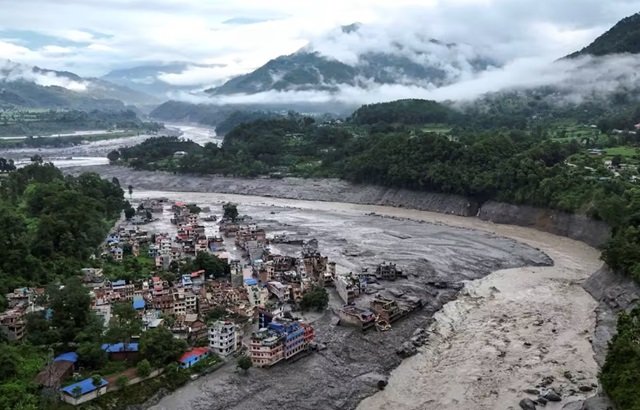
When Milan Shrestha returned to the aftermath of devastating floods in northern Nepal, his family hotel in Betrawati was gone. His parents, both in their late 50s, had escaped by moving uphill, but his uncle, aunts and cousin remained missing. The hotel, which could earn up to 30,000 Nepali rupees ($220) a day during peak season, was among the businesses swept away by floods that destroyed towns, roads, hotels and power plants.
“The building was not even close to the river,” said Shrestha, 35. “But now everything is gone.”
The destruction has struck Nepal at a particularly vulnerable moment, threatening a tourism recovery that has become increasingly important to the country’s service exports and foreign-exchange earnings. Preliminary losses in the tourism sector exceed 50 billion rupees, according to the tourism ministry, including damage to 142 hotels, 57 restaurants, 141 tourism vehicles and other infrastructure.
The floods came just before Nepal’s main autumn tourism season, which runs from September to November. Clear weather during these months attracts trekkers and mountaineers to the Himalayas and accounts for nearly 40% of annual foreign arrivals. Langtang Valley, one of the country’s most popular trekking destinations, has already been cut off after sections of its access road collapsed.
The industry was still recovering from the Gen Z protests of September 2025, which caused losses estimated at more than 25 billion rupees after hotels and resorts were attacked and visitors cancelled bookings. The latest disaster has been particularly damaging for the Kailash Mansarovar pilgrimage market, with about 600 foreign tourists reported missing, many of them Hindus of Indian origin returning from the pilgrimage in China’s Tibet Autonomous Region.
Sagar Pandey, president of the Trekking Agencies’ Association of Nepal, said around 118 Nepali guides and support workers were also missing. The Rasuwagadhi-Gyirong crossing had become an important gateway for pilgrims, handling more than 13,500 tourists in the fiscal year ended in mid-July, according to the tourism department.
Pandey said operators serving the pilgrimage market had reported cancellations of 60% to 70%, while cancellations across Nepal’s wider tourism industry could reach 30% this season. Some visitors, he said, had cancelled or reconsidered trips because they believed roads and supply chains had been disrupted throughout the country.
“The news coverage has given the impression that the entire country has been devastated,” Pandey said. “That is incorrect. The disaster has affected only the Bhotekoshi River and valleys in Rasuwa and Nuwakot districts.”
The government has responded with a #NepalCalling campaign, emphasising that the worst destruction was concentrated in river valleys northwest of Kathmandu, while major destinations including the Everest and Annapurna regions remain accessible. Pandey argued that the disaster should not bring the tourism season to a halt because travellers could use alternative routes or visit unaffected destinations.
The stakes extend beyond tourism. The floods also disrupted hydropower at the end of the monsoon, when Nepal’s rivers are running high and surplus electricity can be exported to India and Bangladesh. In fiscal 2025-26, Nepal recorded an electricity-trade surplus of 18.75 billion rupees, its first since electricity trading with India began nearly a decade ago.
A preliminary assessment by the Nepal Electricity Authority estimated that hydropower and solar plants with a combined capacity of 784 megawatts had been affected, causing 76.34 billion rupees in damage. Hydropower accounted for 759 MW and 68.34 billion rupees of that total. A 25 MW solar plant sustained 4 billion rupees in losses, while substations and transmission lines suffered estimated damage of 2.5 billion rupees and 1.5 billion rupees respectively.
The resulting outages are expected to reduce monthly generation by about 210 gigawatt-hours from hydropower and 17.54 GWh from solar, costing an estimated 1.34 billion rupees a month in lost revenue.
The damage highlights Nepal’s dependence on hydropower and the difficulty of replacing it at the scale required by the economy. Energy expert Bibek Raj Kandel said Nepal has no domestic oil or gas reserves, while solar, although important to a more resilient energy mix, cannot yet match hydropower’s generating capacity.
“No energy alternative is a safe haven from our climate and terrain,” Kandel said. He argued that Nepal should strengthen rather than abandon hydropower by introducing early-warning systems, strict safety zones and higher engineering standards. With billions of dollars invested across the country’s river basins, he said infrastructure must be protected while risks to workers and downstream communities are reduced.
“We can’t change the physics of these steep mountains,” Kandel said, “but we can re-engineer our systems to survive.”