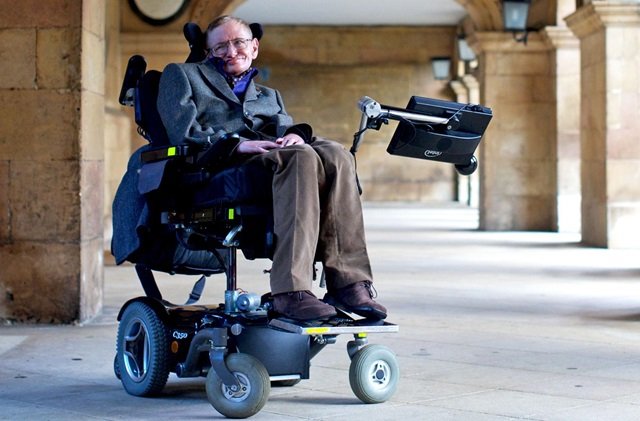
A new biography of Stephen Hawking presents the renowned physicist not simply as a scientific celebrity who overcame severe disability, but as a researcher whose relationships, intellectual clarity and determination were central to his achievements.
In a review published by Nature, the book, Hawking: His Life and Work by physicist and science writer Graham Farmelo, is described as a meticulously researched and readable account of Hawking’s life. Published by John Murray in 2026, the biography follows his development from an undergraduate at Oxford into one of the most influential theoretical physicists of the twentieth century and one of the world’s best-known science communicators.
Hawking was diagnosed with motor neuron disease just as he began his PhD at Cambridge and was initially given only two or three years to live. He survived to the age of 76. As his physical condition deteriorated, he increasingly relied on a computer to communicate, but continued to conduct research, teach students and explain complex scientific ideas to the public.
Farmelo places particular emphasis on Hawking’s relationships with students and colleagues. The biography describes his commitment to supporting younger researchers and the reciprocal assistance he received from those around him. His sociability, humour and ability to establish friendships are presented as important parts of his professional life.
The book also examines more difficult periods, including the breakdown of Hawking’s two marriages and the persistent dangers associated with his fragile health. Its account of his life is deliberately restrained, avoiding the more sensational treatment that often surrounded Hawking during his lifetime.
Scientifically, Hawking chose one of the most demanding areas of twentieth-century physics: using Albert Einstein’s general theory of relativity to investigate gravity, black holes and the origins of the Universe.
A crucial turning point came during his PhD. After mathematician Roger Penrose demonstrated that sufficiently massive stars must collapse under general relativity to form black holes, Hawking recognised that similar mathematical techniques could be applied to cosmology. He extended Penrose’s methods to questions concerning the Big Bang and the structure of the Universe.
Hawking’s doctoral thesis, Properties of Expanding Universes, emerged from this period. Penrose, who served as an external examiner, found an error in its final chapter but was impressed by the work and became one of Hawking’s strongest supporters.
The biography also provides a detailed account of Hawking’s later scientific career, including his work on black holes, supergravity, superstring theory and attempts to reconcile general relativity with quantum mechanics. Some of his later theoretical proposals did not produce the predictions he hoped for, and the search for a unified theory remains unresolved.
One of Hawking’s most significant achievements was his prediction concerning black-hole thermodynamics. Subsequent observations of gravitational waves from merging black holes have provided evidence consistent with his prediction that the total surface area of black holes increases when they merge.
His influence extended well beyond specialist physics. A Brief History of Time, published in 1988, became a global bestseller and brought cosmology to a mass audience. His public lectures combined difficult scientific questions with humour and accessible explanations.
The biography also examines Hawking’s changing views and occasional scientific misjudgements. His belief in the potential of supergravity as a final theory of nature proved premature, while some of his public statements and scientific bets were later revised. Farmelo includes these episodes without diminishing Hawking’s broader contribution.
Nature also notes that the biography gives relatively little attention to Hawking’s involvement in international social-justice issues. He supported causes involving South Africa and the Palestinian territories, visited Birzeit University in 2006 and became a patron of the African Institute for Mathematical Sciences in South Africa. His friendship with Roelof Botha, a former South African foreign minister involved in negotiations surrounding the end of apartheid, was another important part of this side of his life.
Hawking also visited Vietnam in 1997 and maintained relationships arising from the trip, including becoming godparent to a Vietnamese orphan.
His concerns eventually extended to artificial intelligence. In a 2014 BBC interview, he warned that sufficiently advanced artificial intelligence could pose an existential threat to humanity. His earlier prediction that computers might eventually take over theoretical physics has acquired new relevance as artificial-intelligence systems become increasingly capable.
At the centre of Farmelo’s biography is Hawking’s intellectual ability to identify the essential problem within extraordinarily complicated theories. The Nature review describes him as possessing an exceptionally clear and uncluttered mind, a quality that helped him both in theoretical research and in communicating science.
Hawking’s most enduring intellectual preoccupation remained the origin and fate of the Universe. Among the work he regarded most highly was the “no-boundary proposal”, developed with James Hartle, which offered a mathematical account of how the Universe might have begun.
The biography therefore portrays a scientist whose legacy extends beyond individual theories. Hawking transformed discussions of black holes and cosmology, made advanced physics accessible to millions and used his public prominence to engage with wider questions about humanity’s future. His scientific ideas continue to be tested and developed, while the personal story behind them remains central to understanding the unusual career documented in Farmelo’s book.