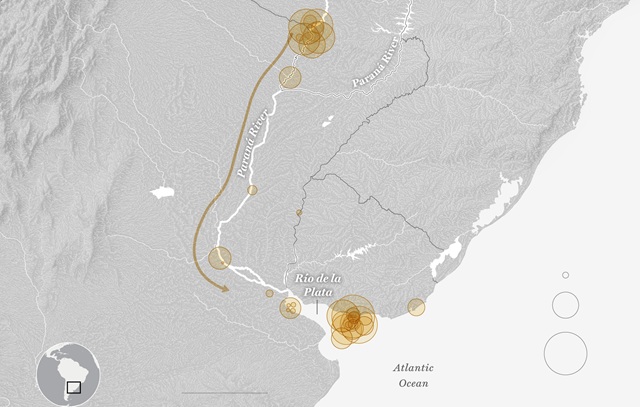
Originally envisioned as South America’s answer to the Mississippi River, the Paraguay-Paraná waterway has become a critical artery for global commerce—and a new battleground in the fight against drug trafficking. Spanning 2,100 miles, this waterway links five nations—Brazil, Bolivia, Paraguay, Argentina, and Uruguay—and 150 ports. It moves millions of tons of cargo annually, making it indispensable for the continent’s economic vitality. However, as reported in The Washington Post, the waterway now doubles as a major conduit for smuggling cocaine to Europe, exposing its vulnerabilities to organized crime.
From Commerce to Cocaine
The Paraguay-Paraná waterway, dredged in 1992 to facilitate trade, was designed to bolster South America’s economic integration. Yet, its strategic geography has turned it into a favored route for traffickers. As the global container shipping industry exploded, drug cartels shifted tactics, exploiting the waterway to send cocaine southward instead of northward. This unconventional direction—from Bolivia’s airstrips to Paraguay’s ports and onward to Uruguay and Argentina—has proven alarmingly effective.
According to the United Nations Office on Drugs and Crime (UNODC), seizures along the waterway have surged fivefold between 2010 and 2021, reflecting Europe’s burgeoning appetite for cocaine. In one instance, Paraguayan authorities celebrated the installation of new high-tech scanners, only to face international embarrassment months later when over 12 tons of cocaine, concealed in sesame seed shipments, were seized in Hamburg, Germany.
A Cat-and-Mouse Game
Despite technological advances, including mandatory scanning of all containers leaving Paraguayan ports, traffickers remain a step ahead. They employ sophisticated methods, mixing cocaine into liquids and powders to evade detection. In June 2023, over four tons of cocaine hidden in sugar bags were discovered in Asunción en route to Antwerp, Belgium—proof of traffickers’ ingenuity and law enforcement’s limitations.
Oscar Chamorro, head of Paraguay’s coast guard, acknowledged the challenge: “The evolution of organized crime has been faster than the evolution of the security forces.” The country’s sparse population and lack of air radars make it an ideal transit hub for cocaine smuggled from Bolivia to Paraguay’s northern warehouses, where it is prepped for shipment.
Political and International Implications
Paraguay’s role as a cocaine transit hub has significant geopolitical ramifications. Earlier this month, the country’s decision to halt cooperation with the U.S. on anti-drug investigations sparked outrage, particularly regarding cases like that of fugitive drug kingpin Sebastián Marset, who allegedly controls much of the riverine trafficking. Following criticism, including revelations in The Washington Post, the Paraguayan government reversed its decision, pledging to strengthen ties with the U.S. Drug Enforcement Administration.
A High-Stakes Voyage
The human toll of this illicit trade was evident aboard the Josamo, a container ship navigating the waterway to Uruguay with 292 containers. Captain Néstor Riquelme and his crew performed exhaustive searches for contraband before departure, underscoring the ever-present risks. For them, avoiding entanglement in drug trafficking is as much about survival as it is about duty.
As the Josamo made its way downstream, it passed through Rosario, Argentina, a port city deeply entwined with the cocaine trade. Rosario, historically significant as Lionel Messi’s hometown and a revolutionary hub, is now synonymous with gang violence and narcotics. Local authorities recently seized over 1.5 tons of cocaine branded with Louis Vuitton logos, bound for Spain, illustrating the global reach of South American trafficking networks.
The Global Implications
From its quiet origins as a trade route, the Paraguay-Paraná waterway has transformed into a gateway for cocaine bound for European markets. Countries along the route now face mounting pressure to balance economic opportunity with law enforcement challenges. As The Washington Post notes, this is a battle of resources—one in which traffickers seem to hold the upper hand.