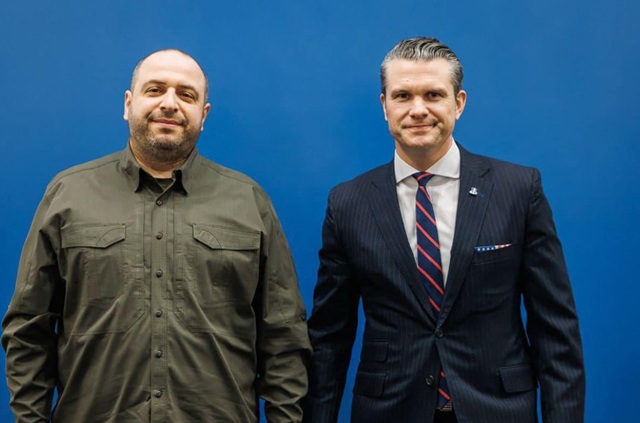
US Defense Secretary Pete Hegseth has stated that America can no longer be relied upon to guarantee the security of Europe, citing the need to prioritize domestic borders and the growing threat from China. Hegseth’s comments, made during his first address at NATO headquarters in Brussels on Wednesday, raised eyebrows among alliance members, with many experts predicting that they could “rock” NATO’s foundational principles.
In his speech, Hegseth emphasized that the United States, while committed to supporting its allies, can no longer be the primary security guarantor in Europe, particularly in light of the ongoing threats from China. With NATO’s core principle of collective defense, outlined in Article 5, under scrutiny, Hegseth made it clear that the US would not be sending troops to uphold a potential peace deal in Ukraine, instead placing responsibility on European nations like the UK and France to lead peacekeeping efforts should talks succeed.
“The United States faces consequential threats to our homeland,” Hegseth told NATO leaders. “We must — and we are — focusing on securing our own borders. We also face a peer competitor in the communist Chinese with the capability and intent to threaten our homeland and core national interests in the Indo-Pacific,” he continued. Hegseth’s stark message came just days before the Ukraine Defence Contact Group meeting in Brussels, where Ukraine’s allies from across NATO were set to gather.
During the meeting, Hegseth made clear that the US intends to refocus its defense strategy, emphasizing the need for Europe to take a more active role in its own security. “We will no longer tolerate an imbalanced relationship that encourages dependency. Instead, our relationship will prioritize empowering Europe to own responsibility for its security,” he said.
The remarks stirred a swift response from UK Defence Secretary John Healey, who acknowledged the challenges ahead while reaffirming Europe’s responsibility to step up its defense contributions. Healey, who was chairing the Ukraine Defense Contact Group meeting, expressed solidarity with Hegseth’s concerns, though he reminded him that NATO’s security is a shared responsibility. “We know our responsibilities. We are doing more of the heavy lifting. Sharing more of the burden. Europe is stepping up,” he said, adding that the war in Ukraine was “never just about the fate of one nation” and had global implications, particularly for other adversarial powers like China, Iran, and North Korea.
The issue of NATO’s burden-sharing has become a focal point as European nations, particularly Germany, seek to ensure US support for any potential European-led initiatives. Despite contributions of over €50 billion to Ukraine’s defense from European allies, which surpasses the $40 billion target, some members are concerned that Hegseth’s stance signals a shift in US commitment to European security.
Hegseth also dismissed any hopes of Ukraine returning to its pre-2014 borders, calling such a goal “unrealistic” and warning that pursuing it would only prolong the conflict. Instead, he argued that the war could only end with a “realistic assessment” of the battlefield and emphasized that Ukraine’s future peace must be secured by a robust international peacekeeping force that does not rely on NATO forces or Article 5 commitments.
While the Pentagon chief’s comments have rattled NATO allies, particularly in relation to the potential of a European-led security force in Ukraine, they also underscore growing concerns in Washington about the expanding influence of China. As the US continues to pivot toward the Indo-Pacific region, Hegseth’s remarks mark a significant shift in Washington’s foreign policy, calling on European nations to take greater responsibility for their own defense.
As tensions within NATO escalate, the future of US involvement in European security remains uncertain. With US President Trump’s “America First” rhetoric and increasing pressure on NATO allies to share the burden of defense spending, the alliance faces a delicate balancing act in navigating its future role in the face of both traditional and emerging global threats.