The US Federal Reserve held its benchmark interest rate unchanged on Wednesday, as expected by financial markets, but the decision was accompanied by two dissenting votes and changes to the central bank’s meeting schedule that will reduce the number of regularly scheduled opportunities to adjust rates in 2027.
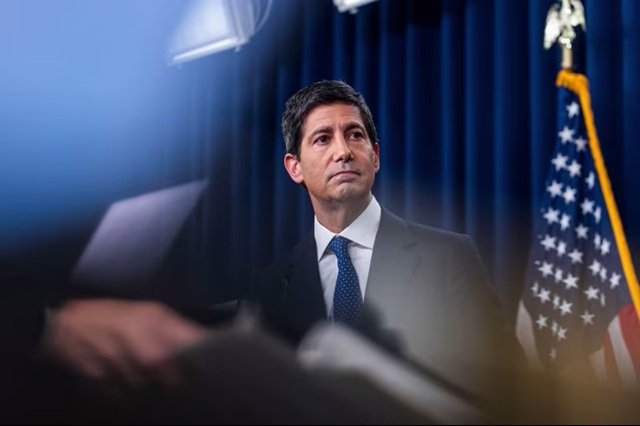
At a news conference following the Federal Open Market Committee (FOMC) meeting, Federal Reserve Chair Kevin Warsh explained the central bank’s approach to inflation and economic growth. The committee reiterated its commitment to returning inflation to its 2% target, without providing a clear indication that it would raise rates at its next meeting in December.
“The accumulation of more information will help the Committee determine the policy stance appropriate to ensure a timely return of inflation to the Committee’s 2 percent goal,” the FOMC said in its statement, signalling that officials wanted further evidence before deciding on their next move.
One of the meeting’s most notable developments was Warsh’s disclosure of a change to the committee’s schedule. The FOMC will continue to meet eight times in 2027, but one meeting will be devoted to strategy discussions without a rate vote or a post-meeting statement. The committee will hold two such strategy meetings the following year, leaving six regularly scheduled opportunities to adjust interest rates in 2028, apart from emergency meetings.
The decision also produced two dissenting votes. Federal Reserve Governor Lisa Cook opposed the move to hold rates steady, alongside Cleveland Federal Reserve President Beth Hammack. Cook’s dissent was particularly notable because governors rarely oppose rate decisions and she had not dissented since joining the board in 2022. Both officials were expected to issue statements explaining their positions before the end of the week.
Warsh also discussed the contribution of artificial intelligence to economic growth, describing the expansion as strong while presenting AI as one of several factors supporting economic activity. His remarks came as policymakers continued weighing the outlook for inflation against the broader performance of the US economy.
Market analysts differed in their interpretations of the Fed’s position and the likely direction of interest rates. Phil Camporeale, chief investment strategist at JPMorgan Wealth Management, said the central bank was adopting a patient approach while waiting for additional information amid uncertainty linked to geopolitical developments.
“The Fed has time on its side,” said Seema Shah, chief global strategist at Principal Asset Management. She argued that the direction of policy remained towards tighter monetary conditions, adding that the two dissents indicated a tightening bias. Shah said her firm expected a rate increase in December and another in early 2027.
Thomas Simons, chief US economist at Jefferies, said Warsh’s communication was not clearly dovish or hawkish. He cautioned against treating the Fed’s policy response as a simple choice between the two positions, adding that markets had adjusted to the chair’s communication style but might need more time to align fully with it.
The latest meeting also reflected changes in how the Fed communicates with the public. Warsh’s September news conference was shortened from the usual 45 minutes to about 30 minutes, the duration of Wednesday’s event. Reporters have also been limited to one question, replacing the previous practice under which journalists could sometimes ask follow-up questions.
The seating arrangement for reporters has changed as well. After moving to alphabetical order in September, the Fed used reverse alphabetical order at Wednesday’s news conference, continuing a series of procedural changes under Warsh’s chairmanship.