The streets of Geneva became the stage for a sweeping display of political anger and social unrest on the eve of a G-7 summit set to take place in nearby Évian-les-Bains. What began as a largely peaceful and even festive demonstration gradually evolved into a tense and fragmented protest marked by ideological diversity, symbolic acts, and pockets of violence that unsettled parts of the Swiss city.
From the outset, the march carried a layered atmosphere of urgency and emotional intensity. Music echoed through the streets, amplified by the acoustic resonance of the Rue de la Servette tunnel, where a band led crowds in singing the antifascist anthem Bella Ciao. The moment briefly unified participants in a shared rhythm, transforming the demonstration into something closer to a collective release of sentiment than a conventional political rally.
Among the sea of placards and slogans, the diversity of messages reflected a broad spectrum of concerns. A young girl walked holding a sign reading “We want snow in winter,” a simple phrase set against the backdrop of a complex and increasingly fragmented protest landscape. Nearby, symbolic expressions of anger and dissent continued to accumulate, forming what observers described as a mosaic of grievances spanning anti-imperialist, antifascist, anti-elitist, environmental, and feminist demands.
As the march progressed, signs of tension became increasingly visible. Large numbers of police were deployed across the city, while many shops pre-emptively boarded up their windows in anticipation of possible unrest. The presence of masked participants further heightened concern among authorities and bystanders, signaling the potential for escalation as the afternoon unfolded.
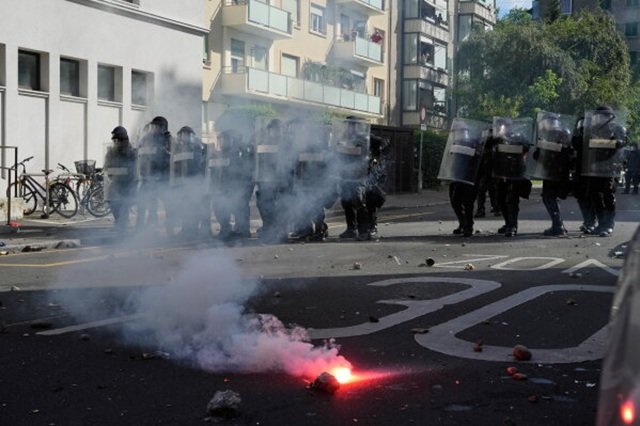
By early evening, those concerns materialised in parts of the city. Acts of vandalism were reported in multiple locations, and law enforcement deployed tear gas to disperse sections of the crowd at the tail end of the demonstration. The transition from a peaceful procession to scattered disorder unfolded gradually but decisively, marked by the sound of helicopters overhead, emergency sirens, and damaged street furniture in several districts.
Some groups broke away from the main demonstration and targeted symbolic structures associated with global finance and international institutions. Banks and United Nations facilities were among those affected, as projectiles were thrown and property was damaged. In one notable incident earlier in the day, a Tesla vehicle was set on fire, becoming one of the most visible early signs of the unrest that would later spread through parts of the city center.
Despite the growing tensions, many participants continued to articulate their motivations in terms of political and moral urgency. Audrey Petoud, a 34-year-old trade union representative from Lausanne affiliated with UNIA, expressed concern over what she described as the rise of fascism. Holding a placard reading “G-7 rage en moi,” she described a sense of internalised anger shaped by broader global developments and social anxieties.
Her sentiment was echoed in different forms across the march, where individual expressions of frustration converged into a broader narrative of discontent. The concept of “rage,” once explored by philosopher Peter Sloterdijk in the early 2000s, appeared implicitly present in the atmosphere of the demonstration, with participants linking their emotional responses to wider political and economic structures.
Among the younger demonstrators, political concerns were often expressed through specific global conflicts. Nelia De-dea, a 16-year-old student wearing a keffiyeh, joined the march alongside many others voicing solidarity with the Palestinian population. For her, participation was framed as a response to perceived inaction in the face of humanitarian suffering, reflecting one of several overlapping causes represented in the protest.
The diversity of perspectives extended beyond individual testimonies. Some participants focused on international law and democratic decline, while others pointed to the role of social media and technology companies in amplifying polarization. A staff member of an international institution, speaking anonymously, expressed concern about what she described as violations of international law by global powers and warned of the influence of “tech oligarchs” in shaping public discourse and limiting collective understanding.
Another demonstrator, 26-year-old student Christophe Kobaich, accused G-7 countries of complicity in global abuses and conflicts. His remarks reflected a recurring theme throughout the protest: the belief among some participants that leading global powers are either directly responsible for or indirectly complicit in acts of violence and injustice around the world. This view appeared alongside more moderate critiques of governance and economic inequality, underscoring the ideological range present within the demonstration.
Symbols of past protest movements were also visible throughout the march. One banner reading “Carlo vive” referenced Carlo Giuliani, the young activist killed during the 2001 G-8 summit in Genoa. His death is widely remembered as a turning point in the anti-globalisation movement of the early 21st century, marking both its peak and its fragmentation in the years that followed.
As the evening progressed, the atmosphere in Geneva reflected a complex convergence of historical memory, contemporary political frustration, and emerging global tensions. While the G-7 summit was set to begin just across the border in France, the events unfolding in Switzerland underscored the persistent volatility surrounding international economic and political institutions. The demonstration, marked by both collective expression and episodic violence, concluded with authorities maintaining heightened security across the city as the situation continued to evolve.