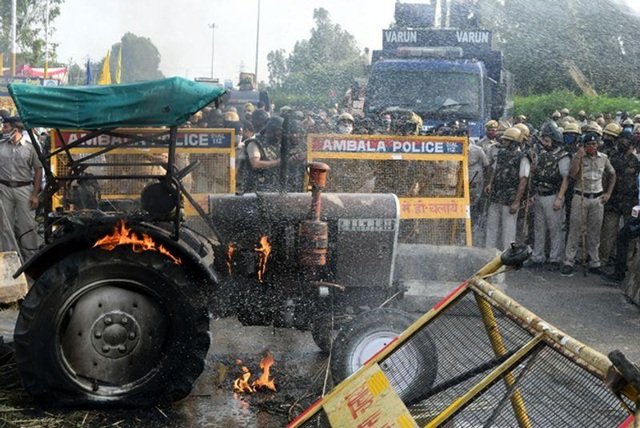
On August 13, 2026, a protest near Ambala Cantonment, Haryana, over an assault on International Anti-Khalistani Terrorist Front (IAKTF) leader Gursimran Singh Mand on August 7, turned violent, leaving nine police personnel, including a Deputy Superintendent of Police (DSP, whose finger was severed), and several protesters injured. Police used tear gas and a lathi (baton)-charge to disperse demonstrators who had blocked National Highway 44 for nearly six hours. The protesters included members of the Haryana Sikh Gurdwara Management Committee (HSGMC), factions of the Bharatiya Kisan Union (BKU), and elements associated with Akali Dal-Waris Punjab De and other radical Sikh groups. They demanded the release of two Sikh youths arrested in connection with the August 7 incident, withdrawal of cases against them, and registration of an attempt-to-murder case against Mand and his son Bhavjot Singh. Police alleged that some protesters, armed with spears, battle-axes, swords and other weapons, attacked personnel, snatched keys from vehicles, including a gas tanker, and engaged in stone-pelting.
On August 7, 2026, Mand, his son, and two police personnel were injured during a confrontation with a group of youths at a religious congregation near Panjokhra Sahib Gurdwara in Ambala district, Haryana. Mand alleged that he and his son were assaulted because of his pro-government and anti-Khalistan stance. He further claimed that they were forced to raise pro-Khalistan slogans and that the protesters demanded the release of jailed Member of Parliament (MP) Amritpal Singh. The HSGMC, however, alleged that Mand’s vehicle was driven recklessly through the congregation, seriously injuring a devotee, Surinder Singh. It also accused Mand, who was provided Y-category security, of conduct deemed disrespectful to the sanctity of the religious premises and alleged that his subsequent actions further escalated tensions.
On August 15, 2026, two days after the Ambala clashes, protesters under the banner of the Qaumi Insaf Morcha, associated with campaigns for the release of Sikh prisoners, clashed with police at YPS Chowk, Chandigarh. The protesters demanded parole for Jagtar Singh Hawara, convicted for his role in the assassination of former Punjab Chief Minister Beant Singh, and the release of other Bandi Singhs (Sikh prisoners) who were convicted for crimes during the militancy period of the 1980s-90s and had completed their sentences. Police sealed the Chandigarh-Mohali border and used water cannons and tear gas, including drone-mounted tear gas, after protesters attempted to breach barricades with a tractor. Shiromani Akali Dal (Amritsar) president and former MP Simranjit Singh Mann was taken into custody after reaching near Governor House. The Morcha subsequently announced a Punjab-wide Bandh (general strike) on August 21, 2026, to intensify its agitation.
A third concurrent development was the second attack in less than two years on Shiromani Akali Dal (SAD) president and former Punjab Deputy Chief Minister Sukhbir Singh Badal. On August 13, 2026, at Gurdwara Mata Sahib Devan Ji in Nanded, Maharashtra, Jaspal Singh, a Pune-based lawyer and former sevadar dressed in Nihang attire, allegedly attacked Badal with a kirpan (ceremonial sword), injuring his right forearm; a security officer was also injured while intervening. The attacker was arrested, and police have so far found no clear evidence of an organised conspiracy. Jaspal reportedly described the assault as a spontaneous act, claiming that he received an aadesh (command) from Waheguru while praying at the Nanded Gurdwara. The incident follows the December 2024 shooting attempt on Badal by former Khalistani militant Narayan Singh Chaura outside the Golden Temple. Badal was performing sewa after being declared tankhaiya (guilty of religious misconduct) by the Akal Takht over alleged failures of the SAD-Bharatiya Janata Party (BJP) governments during 2007-17, particularly their handling of the 2015 sacrilege cases involving the desecration of the Guru Granth Sahib and subsequent deaths in police firing.
In another significant development, former Akal Takht Jathedar Giani Raghbir Singh reported on August 13, 2026, that his police security vehicle was fired upon outside his residence in Partap Bazaar, Amritsar. A .32-bore shell and bullet mark were found, while CCTV showed a youth approaching the house on a scooter and leaving. The motive and identity of the shooter remain unknown.
As Punjab approaches the 2027 Assembly election, its political landscape is increasingly shaped by a familiar but fragmented cycle: local grievances acquire a community dimension, protests expand through farmer and Panthic networks, police action generates fresh grievances, and political parties and hardline actors seek to appropriate the resulting mobilisation. The recent incidents, especially the August 2026 Ambala confrontation illustrates this dynamic. What began as a dispute involving anti-Khalistan activist Gursimran Singh Mand at Gurdwara Panjokhra Sahib quickly escalated from arrests, to a highway blockade, clashes with the police, and a lathi charge and the use of tear gas at Ambala in Haryana, before evolving into a wider Sikh political controversy extending into Punjab.
As the dispute quickly spread beyond Ambala, with HSGMC leaders, farmer unions, Akali Dal-Waris Punjab De representatives, Sikh hardline groups, and religious authorities linked the mobilisation to Punjab. HSGMC president Jagdish Singh Jhinda announced a larger congregation at Pipli Grain Market on August 25, 2026, inviting Sikhs from across the country. The involvement of farmer organisations is significant, given their extensive village, gurdwara, highway, and border networks, which could facilitate rapid and wider mobilisation. The convergence of religious and agrarian networks could therefore turn the dispute into a broader regional pressure movement.
The ideological appropriation of the Ambala incident is equally consequential. Although Mand is an explicitly anti-Khalistan activist, the protesters as a collective cannot be characterised as Khalistani. Nevertheless, the confrontation provides pro-Khalistan and radical Sikh actors with a ready-made narrative centred on alleged state bias, persecution, and threats to Sikh identity. Images of police action circulate without the legal and factual context of the original dispute, enabling actors in Punjab and abroad to recast the incident within broader grievance narratives. Thus, a localised dispute entered a wider mobilisation ecosystem without requiring evidence of a centrally coordinated conspiracy.
The same mechanism is evident in the Bandi Singh issue. The demand for the release of long-incarcerated Sikh prisoners has a genuine constituency rooted in questions of sentence completion, equal treatment, and historical grievance. It also intersects with the unresolved legacy of the 1984 anti-Sikh violence and the subsequent years of militancy, which remain deeply embedded in Sikh political memory. More than four decades after 1984, justice remains incomplete for many victims and their families. The recent acquittal of former Congress MP Sajjan Kumar in a riot-related case has further revived anger among victim families in Punjab, reinforcing the broader sense of unresolved grievance.
Crucially, Punjab’s political parties increasingly use the Bandi Singh issue to expand their political constituencies. In August, 2026, Chief Minister Bhagwant Mann sought a 10-days parole for Jagtar Singh Hawara, a convicted militant and prominent figure in the Bandi Singh campaign, on humanitarian grounds to enable him to meet his ailing mother. For the ruling Aam Aadmi Party (AAP), the intervention seeks to create space within the Panthic constituency traditionally associated with the Akalis, while framing the demand in humanitarian terms. For the SAD and emerging political factions, the issue offers an opportunity to reconnect with a constituency among which the traditional Akali establishment has increasingly lost support. For hardline actors, however, the Bandi Singh narrative links present-day incarceration with a broader discourse of perceived state injustice.
Sacrilege remains a potent issue in Punjab politics, with the 2015 Bargari sacrilege and subsequent Behbal Kalan police firing continuing to shape political discourse and weakening the SAD’s Panthic credibility. In 2026, the AAP Government claims to have strengthened Punjab’s anti-sacrilege framework, while opponents accused it of exploiting a Panthic issue without addressing the unresolved political and moral questions surrounding the 2015 incidents. SAD, despite its leadership facing Akal Takht censure in 2024, has sought to regain relevance by attacking the Mann Government over sacrilege. The result is a self-reinforcing cycle in which unresolved grievances fuel political competition, political competition intensifies emotive mobilisation, and heightened mobilisation creates greater space for hardline narratives.
The weakening of SAD has created political space for newer formations such as Akali Dal-Waris Punjab De, associated with jailed MP Amritpal Singh, whose 2024 victory in Khadoor Sahib demonstrated the electoral potential of a confrontational Sikh-identity narrative. Sarabjit Singh Khalsa, son of former Prime Minister Indira Gandhi’s assassin Beant Singh, also won the Faridkot seat. Waris Punjab De is seeking to institutionalise this space through an explicitly Panthic agenda, with the reported nomination of Satwant Singh, son of Indira Gandhi assassination convict Kehar Singh, from Bassi Pathana for the 2027 Assembly elections, carrying strong symbolic significance. This brings the vocabulary of sacrifice, martyrdom, militancy, religious grievance, and historical memory directly into electoral competition. Such developments should not automatically be equated with support for Khalistan; rather, they demonstrate how challengers can mobilise around symbols and historical narratives that mainstream parties find difficult to own.
The broader political contest in Punjab helps explain the intensity of recent mobilisation. The central paradox is that every major political formation competes for Panthic credibility, yet none exercises decisive control over the Panthic political space. AAP seeks Sikh legitimacy while simultaneously expanding its Hindu outreach; the Congress invokes Sikh grievances amid organisational weakness; SAD seeks to reclaim its traditional constituency; the BJP aims to expand its presence among Sikh voters; and Akali Dal-Waris Punjab De seeks to redefine Sikh political representation. Religious institutions, farmer organisations, and other radical groups further fragment this landscape, creating multiple and competing centres of mobilisation.
The security implication is the potential for a recurring escalation cycle in Punjab, with the next flashpoint emerging from sacrilege, Sikh prisoner-release demands, Gurdwara management, police action, agrarian grievances, or some other politically charged controversy.
As the 2027 Assembly elections approach, the boundaries between religious sentiment, electoral competition, protest politics, and security narratives are likely to become increasingly porous. The state’s challenge is, consequently, not merely to prevent a Khalistani revival, but also to ensure that legitimate grievances do not become vehicles for radical mobilisation. Political parties may be tempted to exploit emotive issues, while security agencies must distinguish lawful dissent from organised violence without treating Sikh mobilisation itself as a security threat. The recent incidents must be viewed as an early warning: in Punjab’s pre-election environment, escalation itself can become political currency.