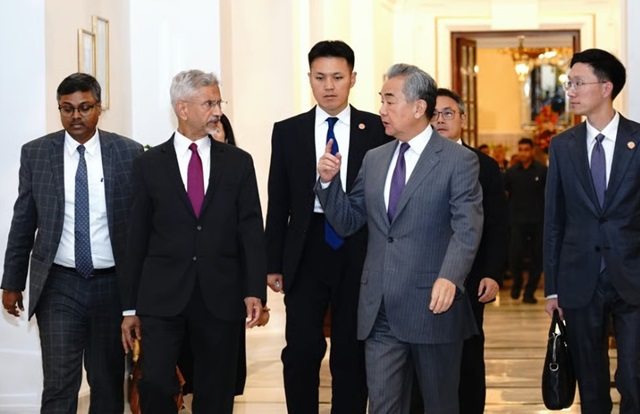
China and India appear to be charting a cautious path toward rapprochement, as Chinese Foreign Minister Wang Yi visited New Delhi for the first time in three years, underscoring a renewed effort to stabilize ties between the two Asian giants after years of strained relations.
Speaking alongside Indian Foreign Minister Subrahmanyam Jaishankar on Monday, Wang called for both nations to treat each other as “partners and opportunities” and to provide the world with “much-needed certainty and stability.” He urged that China and India channel their “precious resources into development and revitalisation” while fostering mutual respect, trust, and cooperation.
Jaishankar, in turn, stressed that the two countries must work on the basis of “mutual respect, mutual sensitivity and mutual interest,” cautioning that “differences must not become disputes, nor competition conflict.” He acknowledged the challenges of the past few years but described the current moment as one requiring a “candid and constructive approach from both sides.”
The high-level exchanges come amid reports in Indian media that Beijing has pledged to address Delhi’s concerns over access to rare earths, fertilizers, and tunnel boring machines — commodities vital to India’s economic growth. At a press briefing in Beijing, Chinese Foreign Ministry spokesperson Mao Ning said she was not aware of specific media reports about the lifting of rare earth restrictions but emphasized that China “is willing to strengthen dialogue and cooperation with relevant countries and regions to jointly maintain the stability of the global supply chain.”
Wang’s visit marks a notable turning point in a relationship that nosedived after the deadly 2020 border clash in the Galwan Valley. Since then, both countries have sought to de-escalate tensions, most recently with a border patrol agreement and a leaders’ meeting between Chinese President Xi Jinping and Indian Prime Minister Narendra Modi at last year’s BRICS summit in Russia.
The visit also sets the stage for Modi’s upcoming trip to China to attend the Shanghai Cooperation Organisation (SCO) summit, his first in seven years, where he is expected to hold bilateral talks with Xi.
The timing is significant. Relations between India and the United States have soured, with Washington reportedly preparing steep tariffs on Indian goods amid disputes over trade and Delhi’s continued energy partnership with Moscow. At the same time, the U.S. has signaled warmer ties with Pakistan, India’s regional rival, further straining Washington-Delhi relations.
Analysts say these shifting dynamics are accelerating China and India’s rapprochement. However, challenges remain, including Beijing’s deepening ties with Islamabad. Notably, Wang is set to travel to Pakistan immediately following his Delhi visit.