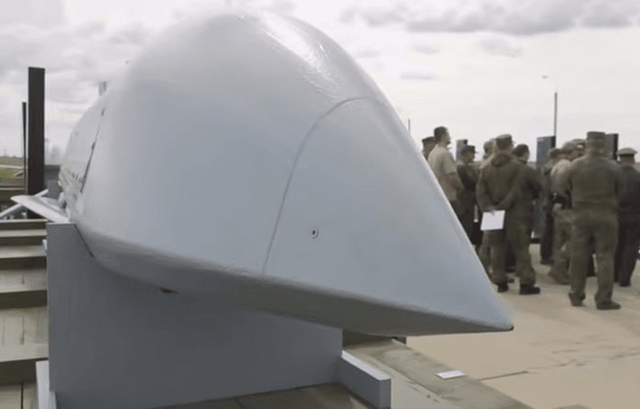
A newly unveiled Russian cruise missile has emerged as a deadly force in the ongoing war against Ukraine, raising alarm over both its battlefield impact and the failure of international sanctions to stop its creation.
Known as the S8000 “Banderol” — meaning “small parcel” in English — the missile has been used in precision strikes on southern Ukrainian cities including Odesa and Mykolaiv since at least February, according to Ukraine’s military intelligence agency, HUR.
What makes the Banderol particularly dangerous is its design: a lightweight, low-cost missile that travels at speeds up to 400mph and can reach targets over 300 miles away. It carries a 115kg high-explosive warhead and is launched from Russia’s Orion drones, eliminating the need to risk manned aircraft and giving Russia a new long-range, unmanned strike capability.
“This is a formidable weapon system,” said military analyst Vijainder K Thakur, warning that it could provide Russian forces with a significant edge in the field.
Frankenstein Weapon: Made of Foreign Parts
Despite being produced by the sanctioned Russian defense firm Kronstadt Group, the missile is heavily reliant on foreign-made components — a fact that highlights the vast gaps in global sanctions enforcement.
An examination of downed missiles by HUR revealed that the Banderol incorporates more than 20 key components from at least 30 companies worldwide. These parts come from countries including the United States, Switzerland, Japan, South Korea, and Australia — many of which are allies of Ukraine and active participants in sanctions against Russia.
Among the components identified were:
- A US-made motion tracking device
- A Swiss microcontroller
- An Australian information exchange module
- A Japanese battery pack
- A South Korean servo drive
Perhaps most notably, the missile is powered by the SW800Pro jet engine, manufactured by Chinese company Swiwin and sold on online platforms like AliExpress and Alibaba for around £12,000.
“This missile is essentially a Frankenstein’s monster of off-the-shelf parts,” said Maria Shagina, senior sanctions expert at the International Institute for Strategic Studies. “And it flies in the face of everything sanctions were meant to prevent.”
Sanctions Evasion Through Third Countries
The Banderol’s development sheds light on how Russia continues to obtain foreign technology through complex supply chains routed via third-party nations such as China, Turkey, the UAE, and former Soviet states.
HUR specifically identified Russia’s “Chip and DIP” network — one of its largest electronics distributors — as a central player in acquiring these parts. The company is sanctioned by the US and Ukraine, but not by other key allies including the EU, UK, Japan, and Australia.
“This is not just a weapons issue — it’s a sanctions enforcement issue,” said Shagina. “Too many manufacturers are failing in their due diligence, and enforcement remains weak.”
Strategic Implications for the War
The Banderol marks a new chapter in Russia’s strategy: mass-producing affordable precision-guided munitions to overwhelm Ukrainian air defenses. According to John Hardie, deputy director at the Foundation for Defense of Democracies, the aim is clear.
“Russia wants to increase its strike depth and fire missiles in larger volumes,” he said. “Ukraine is good at intercepting missiles, but if Russia can saturate their defenses, even a few getting through could be devastating.”
Ukraine’s defense ministry believes the Banderol may soon be launched not only from drones but also from Mi-28 attack helicopters, expanding its deployment options further.
The missile’s advanced capabilities — including radar-evading tech and anti-jamming systems — suggest it could be Russia’s attempt to mirror or rival Western weapons like the US’s Joint Air-to-Surface Standoff Missile (JASSM), long considered a key part of NATO’s precision strike arsenal.
A Wake-Up Call for the West
The unveiling of the Banderol and its foreign-sourced internals is a stark warning that Western sanctions — while comprehensive on paper — are failing in practice.
“Russia cannot keep this war machine running without access to foreign technology,” said a statement from Ukraine’s military intelligence. “Every microchip, every servo, every engine sold to them fuels further destruction.”
With this revelation, pressure is mounting on Western governments and manufacturers to tighten export controls, close loopholes, and invest in more aggressive enforcement mechanisms to stop the flow of dual-use technologies into Russia’s war effort.