


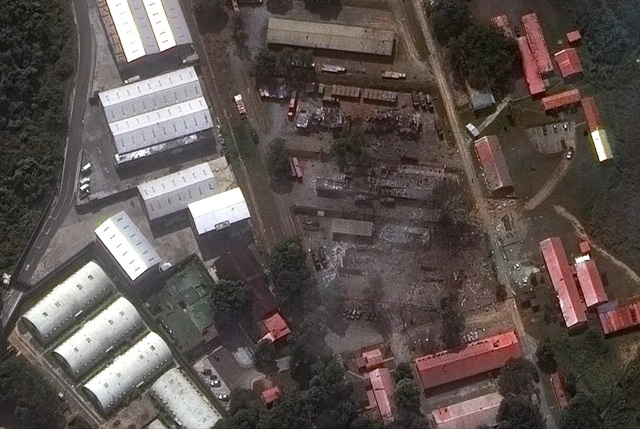
New satellite imagery is offering the clearest picture yet of how the U.S. military carried out its operation to capture Venezuelan leader Nicolás Maduro, shedding light on the scale, targets, and precision of the mission known as Operation Absolute Resolve. According to analysis published by The War Zone, the images reveal extensive damage to key military facilities in Caracas, particularly at the sprawling Fuerte Tiuna complex, long regarded as the nerve center of Venezuela’s armed forces.
While U.S. officials have not confirmed the exact location where Maduro and his wife were seized, Fuerte Tiuna has emerged as the most likely site. The base reportedly contains a fortified residential compound used by Maduro, and Venezuelan ruling party leader Nahum Fernández told the Associated Press that the couple was inside the complex when they were captured. President Donald Trump described the location as “a house that was more like a fortress,” a characterization that aligns with Fuerte Tiuna’s hardened infrastructure. Satellite images reviewed by The War Zone show concentrated U.S. airstrikes across the base during the operation.
The Pentagon has confirmed that a wide array of assets took part in the strikes, including F-22 and F-35 stealth fighters, F/A-18 and EA-18 aircraft, B-1 bombers, and multiple drones. The capture phase was spearheaded by helicopters from the U.S. Army’s elite 160th Special Operations Aviation Regiment, known as the Night Stalkers. Imagery suggests that MH-60 helicopters may have landed at or near Fuerte Tiuna as part of the raid.
Before-and-after satellite images from late December and January 3 show dramatic destruction across several sections of the base. Three long buildings in one area were completely destroyed, along with adjacent structures near a forested zone that some unverified sources claim may have been close to a concealed entrance to Maduro’s compound. The absence of large craters suggests the use of precision-guided munitions or submunitions designed to neutralize equipment rather than demolish entire sections of terrain.
Further imagery reveals the destruction of storage buildings believed to house long military vehicles or semi-trailers, possibly linked to air defense systems—known priority targets during the operation. Additional strikes obliterated gate security buildings located along a wooded road bend, which analysts believe may have guarded access points to underground bunkers or tunnel networks built into the nearby hillside. Fuerte Tiuna is known to contain such hardened features, reinforcing its role as a strategic stronghold.
The War Zone also reports that U.S.-made Dragoon 300 armored fighting vehicles were among the equipment damaged or destroyed at the base. In other parts of Caracas, U.S. forces struck Palacio de Miraflores, the Venezuelan presidential palace, though analysts believe Maduro was likely not there at the time and instead remained at the more secure Fuerte Tiuna complex.
While many details of the raid remain classified, the satellite imagery underscores what analysts describe as a meticulously planned, multi-domain operation involving airpower, special operations forces, and intelligence coordination. As The War Zone notes, the precision and scope of the strikes suggest that Operation Absolute Resolve was designed not only to capture Maduro but also to cripple key elements of Venezuela’s military infrastructure, with more revelations about the mission expected in the days ahead.









