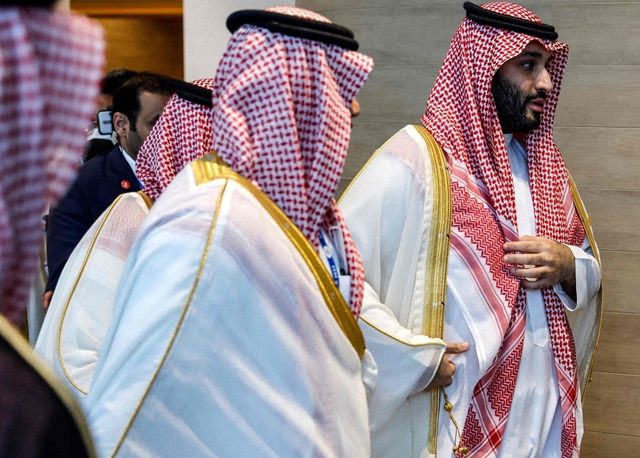
Saudi Arabia will reassess its government spending and development priorities in response to a sharp drop in oil revenues, Finance Minister Mohammed al-Jadaan told the Financial Times in an exclusive interview. Despite rising fiscal deficits and growing debt, the kingdom aims to maintain its current pace of public spending while using the slowdown as an opportunity to recalibrate major economic initiatives.
“We’re not going to waste the crisis,” Jadaan said. “People think that what’s happening in the world is a crisis, but our economy is doing very well. It’s a chance to look at things — if there’s an opportunity to do something bold, do it.”
The comments come as Riyadh faces heightened economic headwinds, including an 18% year-on-year drop in oil revenues during the first quarter of 2025 and a fiscal deficit that swelled to $15.6 billion — the highest since 2021. Oil prices have also slipped, with Brent crude trading around $64 a barrel, down from an average of $82 last year.
Jadaan emphasized that the government’s top priority is to avoid the historical “trap of booms and busts” that has long plagued oil-dependent economies. “We are very aware of how important it is that we don’t go procyclical, but countercyclical,” he said. “Instead of working to just balance the books, by design we are making sure that we spend in support of the growth.”
The minister’s remarks reflect the broader strategy behind Crown Prince Mohammed bin Salman’s $1 trillion push to diversify the Saudi economy away from oil. Under this vision, megaprojects led by the Public Investment Fund (PIF), such as the $500 billion Neom smart city, are under active review to ensure financial prudence amid market volatility. The Financial Times previously reported that Neom’s new CEO is conducting a comprehensive reassessment of the project’s scope and priorities.
While the government has slightly trimmed its budgeted expenditure for 2025, sectors such as tourism, renewable energy, manufacturing, logistics, and technology remain top priorities. Jadaan noted that both the finance ministry and PIF are engaging in a “very prudent exercise” to reassess spending and investment timing.
Saudi Arabia’s economy has also been impacted by voluntary cuts to oil production under the OPEC+ agreement, which has reduced exports to their lowest levels since 2011. Although the bloc is now gradually increasing output, this move could exert additional pressure on oil prices — complicating the kingdom’s fiscal outlook.
Despite these challenges, Jadaan expressed confidence in the country’s financial buffers. Saudi Arabia’s debt-to-GDP ratio remains relatively low at 26%, with a borrowing ceiling set at 40%. “There will possibly be more deficit than we anticipated in the budget, but not significant,” he said. “We still have plenty of room in our fiscal buffers, ample foreign reserves, and significant government reserves.”
The International Monetary Fund (IMF) projects that the kingdom’s budget deficit will exceed 4% of GDP this year, well above the government’s target of 2.3%. Still, Jadaan indicated he would not be alarmed by a deficit in the range of 3% to 5%, provided spending continues to support non-oil economic growth.
He also maintained that Saudi Arabia’s GDP is still expected to grow by 4.6% this year, buoyed by non-oil sectors — a sharp increase from 1.3% in 2024. The IMF, however, has revised its own growth forecast for the kingdom down to 3%.
“What makes us comfortable is that a lot of the targets have been reached or are on track to be achieved,” Jadaan told the Financial Times. “That gives us a lot of confidence. But we aren’t complacent.”