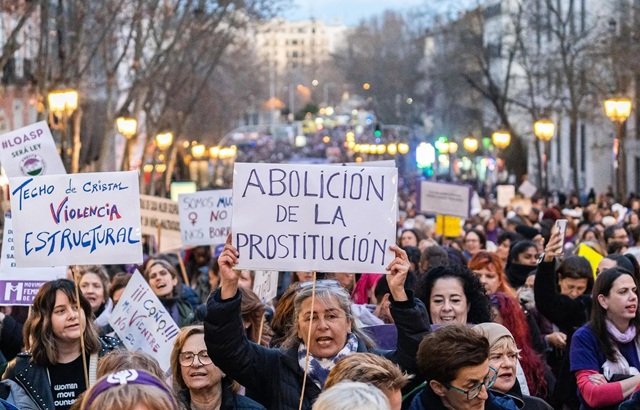
The question Europe thought it had settled is returning with unexpected force: should prostitution be abolished, regulated or treated as work?
The debate is once again moving from feminist theory into the political mainstream. In Spain, Germany and France, governments and political parties are revisiting laws governing the sex trade, while feminists remain sharply divided over whether prostitution represents women’s economic and sexual autonomy or one of the most entrenched forms of gendered exploitation.
A recent examination by El País captures the breadth of the renewed European argument, tracing a debate that reaches back to the radical feminism of the 1980s and the influential work of Andrea Dworkin and Catharine MacKinnon. Their uncompromising opposition to prostitution and pornography helped establish the intellectual foundations of modern abolitionism.
But four decades later, the political battlefield has changed.
The central question is no longer simply whether prostitution is harmful. It is who should have the authority to decide what constitutes harm — the state, feminist movements, or the women who sell sexual services themselves?
That question has become increasingly difficult to answer.
The abolitionist case
For abolitionists, prostitution cannot be separated from the unequal social and economic conditions in which many women enter it.
Alice Schwarzer, one of Europe’s most prominent abolitionist feminists and founder of Emma, has spent decades making that argument. Speaking to El País, she rejected the idea that technological change or softer forms of commercial sex fundamentally alter its nature.
“Prostitution is prostitution,” Schwarzer argues. “Whether soft or hard, it is equally destructive to women because it penetrates the deepest part of their being: it turns them into objects, commodities, someone who can be bought.”
For sociologist Rosa Cobo, the argument is equally structural. She describes sex work as “the absolute triumph of capitalism”, arguing that prostitution conflicts with the feminist struggle to establish women’s sexuality around their own desire rather than male demand.
“Feminism has fought for women’s sexuality to be based on desire,” Cobo says. “Prostitution is founded on male desire and denies women’s desire.”
The abolitionist argument therefore goes beyond individual transactions. It asks whether a society can meaningfully describe sexual consent as freely chosen when the transaction is shaped by economic inequality, gender expectations and the purchasing power of one person over another.
Yet this is precisely where the counterargument begins.
Is choice itself being dismissed?
One of the strongest challenges to abolitionism comes from researchers who argue that women cannot simply be treated as passive victims of an inherently oppressive system.
The British researcher Natasha McKeever, whose work examines whether sex work is inherently gendered, challenges several assumptions commonly used to justify abolition. Economic hardship can be a factor, she argues, but it does not explain every decision to enter sex work.
Her research points to a more complicated reality: some people enter the industry for reasons that cannot simply be reduced to coercion or poverty.
“There are people who genuinely want to do sex work,” McKeever argues.
That proposition creates an uncomfortable problem for abolitionist politics.
If some women freely choose prostitution, can a government legitimately prohibit that choice in the name of protecting women?
And if the answer is yes, where does that principle end?
Martha Nussbaum has approached the question from another direction. In the account examined by El País, she argues that society already accepts numerous forms of labour involving the human body. The stigma surrounding particular forms of bodily labour, she suggests, cannot by itself establish that prostitution is inherently immoral.
The crucial issue, instead, is whether people have genuine alternatives.
“Legalisation of prostitution improves conditions for women who have very few options,” Nussbaum argues.
That distinction is important. It separates the question of whether prostitution can be exploitative from the much larger question of whether prostitution is inherently exploitative.
The two propositions are not identical.
Regulation versus prohibition
Regulation advocates argue that criminalising prostitution does not necessarily eliminate it. Instead, it can push the industry underground, making workers more vulnerable to violence, exploitation and police abuse.
Erin O’Brien, a feminist political scientist who supports regulation, argues that recognising sex work as employment can provide access to legal protections without forcing workers to live under the stigma associated with criminalisation.
She dismisses laws aimed at punishing clients and reducing demand as ineffective, describing them as policies that “come closer to symbolic politics than real laws that protect health, provide safety and guarantee human rights”.
That argument has become particularly contentious in Europe.
The continent has experimented with radically different models. Some countries have pursued legalisation and regulation; others have adopted versions of the Nordic or abolitionist model, criminalising clients rather than women who sell sex.
Neither approach has produced an uncontested victory.
Germany is now at the centre of the backlash against regulation. After two decades of legalisation, critics argue that the country has become what the Christian Democratic Union calls “the brothel of Europe”.
The phrase is deliberately provocative. But behind it lies a broader question: did legalisation create a safer and more autonomous sex industry, or did it simply give a larger commercial structure legal protection?
Germany’s experience has consequently become ammunition for abolitionists elsewhere.
Yet France offers a different warning.
Since 2016, France has penalised clients rather than criminalising sex workers themselves. Supporters argue that the model attacks demand and challenges the commercialisation of women’s bodies. Critics, including sex workers, argue that it has made their working conditions more dangerous by pushing clients and transactions further underground.
The French experience therefore exposes the difficulty of turning feminist theory into workable public policy.
A law can be designed to protect women and still produce consequences that some women themselves regard as harmful.
Spain’s unresolved battle
Spain may now become one of the most important arenas in this European argument.
According to El País, the Spanish Socialist Workers’ Party has spent years attempting to advance legislation aimed at abolishing prostitution. The political debate has gained renewed momentum following the Koldo affair and its links to prostitution.
Equality Minister Ana Redondo has indicated that, even if legislation does not immediately pass, a broader public and potentially parliamentary debate could follow.
The controversy places the Spanish left in an uncomfortable position.
Some politicians favour abolition as an extension of feminist politics. Others argue that women engaged in sex work must be listened to before legislation is imposed upon them.
The divide is not simply between conservatives and progressives.
Indeed, one of the most striking features of the contemporary debate is that abolitionism and regulation no longer fit neatly into conventional political categories.
The French example demonstrates this perfectly. A politician from the far-right National Rally proposed reopening brothels and allowing sex workers themselves to manage them as cooperatives.
An idea traditionally associated with the political left can therefore find unexpected support on the right.
Meanwhile, some feminists who regard themselves as fundamentally progressive remain deeply opposed to commercial sex.
The old political boundaries are becoming increasingly difficult to maintain.
The woman at the centre of the argument
Perhaps the most important question has become the simplest one: what do women who actually perform the work want?
Abolitionists fear that the language of individual choice can conceal coercion, poverty, trafficking and deeply unequal power relations.
Regulationists counter that denying women agency can itself become paternalistic.
Both arguments contain uncomfortable truths.
A woman who enters prostitution because she has no realistic economic alternative may technically be choosing — but that does not necessarily make the choice genuinely free.
Conversely, a woman who deliberately chooses sex work may reasonably reject the claim that she is merely a victim who needs to be liberated from her own decision.
The state is therefore being asked to navigate a contradiction between autonomy and protection.
Mabel Lozano, a Spanish abolitionist and filmmaker, rejects the idea that prostitution should be normalised as employment.
“There is nothing more conservative than thinking that prostitution can be a job,” she argues.
Her position reflects one of abolitionism’s central convictions: transforming prostitution into an ordinary profession may normalise a system that feminists should instead be challenging.
But the regulatory response is equally forceful: if prostitution exists regardless of prohibition, refusing to recognise it as work may leave those involved with fewer protections rather than fewer dangers.
A battle over the meaning of freedom
At its deepest level, the European prostitution debate is not really about prostitution alone.
It is about freedom.
What does it mean to choose when economic necessity shapes the available choices? Can consent exist inside a transaction involving unequal power? Can the state protect women without deciding for them? And can society distinguish between exploitation and a form of labour that some people voluntarily enter?
These questions have no easy legislative answer.
The history of prostitution policy suggests that criminalisation does not necessarily abolish prostitution, while regulation does not automatically eliminate exploitation. Legal frameworks can change the conditions under which the industry operates, but they cannot by themselves resolve the inequalities that bring people into it.
That is why the renewed debate matters.
As El País’s examination makes clear, Europe is not simply deciding how to regulate an industry. It is once again arguing over what women owe to society, what society owes to women, and whether personal autonomy remains meaningful when the choices available to an individual are profoundly unequal.
The most dangerous answer may be the easiest one: assuming that every woman in prostitution is either completely free or completely oppressed.
Reality is almost certainly more complicated.
And that may be precisely why Europe has never managed to settle the question.