by Our Diplomatic Affairs Editor
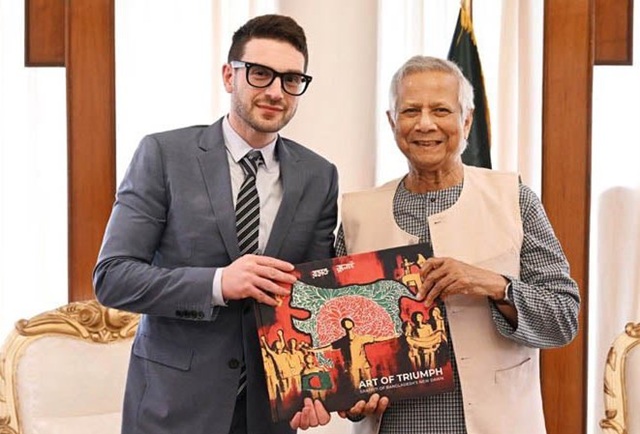
Alexander Soros, the son of billionaire financier George Soros, yesterday, met with Nobel laureate Muhammad Yunus, calling him a “champion of human rights” and a longtime friend of the Open Society Foundations. Soros highlighted that Bangladesh is at a “crucial time of transition,” hinting at the political shifts taking place both domestically and globally. This moment of transition may have been a reference to potential changes in the U.S. government, especially with the arrival of Donald Trump, who could push for greater accountability regarding Bangladesh’s troubling record on human rights, particularly the violent treatment of Hindus.
Muhammad Yunus, best known for his work with microfinance through the Grameen Bank, has long been a controversial figure in Bangladesh. His recent meeting with Alexander Soros is seen by some as a signal of his influence within the U.S. establishment. There are growing concerns about Yunus’s ties to Western powers and the role he might play in Bangladesh’s political future. Recently declassified WikiLeaks documents reveal more about Yunus’s connections to the U.S. government. A memo from the U.S. Consulate General in Kolkata, dated February 13, 2007, showed Yunus expressing a strong desire to engage in Bangladesh’s political landscape. At the time, Yunus was reportedly supportive of the caretaker government’s decision to declare a state of emergency, arguing that it had averted civil war. His public discontent with the ruling Awami League, led by Prime Minister Sheikh Hasina, and his expressed interest in undermining Hasina’s political image raised eyebrows both in Bangladesh and abroad.
Yunus’s actions suggest that he may not just be a passive observer of Bangladesh’s political situation, but an active participant, potentially working in alignment with foreign interests, notably the U.S. “Deep State.” Critics of Yunus view his support for the U.S. and its foreign policies as evidence that he could be positioned as a figurehead in a future transitional government—one that might align more closely with Western geopolitical goals.
The geopolitical stakes in Bangladesh are immense. Strategically located at the apex of the Bay of Bengal, Bangladesh plays a crucial role in the regional security dynamics of South Asia. Its proximity to key players like India and China makes it a hotbed of competing interests. India, in particular, has a vested interest in ensuring that Bangladesh remains stable and friendly to its interests, as the country shares a long border with India’s northeast and has historically been a source of anti-Indian sentiment. The United States, with its pro-democracy rhetoric, is also keen on maintaining influence in the region, and as a result, Bangladesh has increasingly become a battleground for political intervention by external powers.
This foreign involvement could be viewed in the context of strategic thinkers like Zbigniew Brzezinski, who emphasized the importance of Ukraine in global geopolitics. By swapping Ukraine for Bangladesh, and Russia for India, a startling new perspective emerges. Brzezinski’s assertion that Ukraine is a key geopolitical pivot for Eurasia mirrors the importance of Bangladesh to the security of South Asia and India’s northeastern region. For India, Bangladesh’s strategic location and the sentiments within its government and military are crucial to maintaining stability in the region. India’s interests in Bangladesh have only deepened in recent years, as it seeks to ensure a government in Dhaka that is friendly to its own national security concerns.
Bangladesh’s future appears to be at a significant crossroads. With external pressures mounting and internal political tensions rising, the role of figures like Yunus and their connections to Western powers may shape the country’s political trajectory. While Yunus continues to present himself as a champion of social change, his ties to the U.S. and the Open Society Foundations suggest that his influence could go far beyond microfinance and human rights, potentially impacting the larger political dynamics of the country. For India, this moment could mark a critical inflection point in the region’s stability. As Bangladesh moves through this “crucial time,” its political future will undoubtedly have wide-ranging implications, not just for the country itself, but for the balance of power in South Asia and beyond.