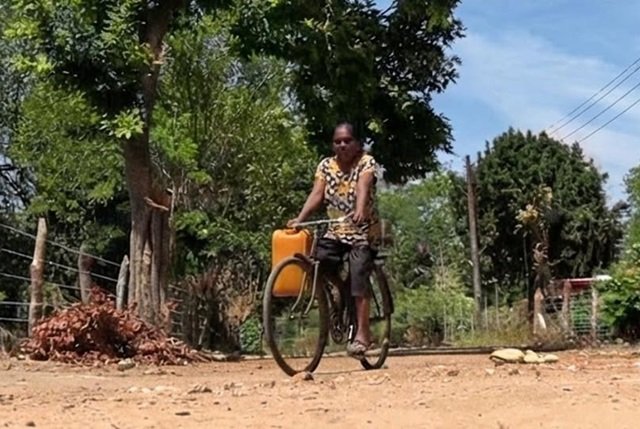
For Nilmini and her neighbours in Kolakanawadi village in Welikanda, a drink of water has become something that must be obtained through a daily struggle. What for many people remains an ordinary necessity, available by simply turning on a household tap, now determines the rhythm of life for families living through one of Sri Lanka’s prolonged dry periods.
Before the morning sun becomes intense, residents set out with cans and barrels tied to bicycles, travelling several kilometres to reach water sources. By late afternoon, they may still be waiting in queues near a water pipe. Work, children’s education and household responsibilities are increasingly organised around the availability of a single basic resource: water.
In Kolakanawadi, wells have dried up. Even newly dug wells have failed to produce water as the drought has intensified. Cooking, washing utensils and maintaining even basic standards of hygiene have become difficult. The situation is not confined to one village. Across several parts of the island, prolonged dry weather has caused drinking-water sources to disappear.
“How are we supposed to live like this? There isn’t even a drop of water to go to the toilet,” one resident of Kolakanawadi said, describing the desperation created by the shortage.
Another woman described the daily effort required to obtain enough water. “We have to go two or three kilometres to collect water. Because there is not enough water to cook, bathe and wash pots, we collect everything and wash it all at once,” she said.
The scale of the crisis extends far beyond individual households. According to reports issued by the Disaster Management Centre, 84,545 people from 26,457 families across 25 Divisional Secretariat divisions in seven districts have been severely affected by the prevailing dry weather.
As the number of affected people continues to increase, steps have already been taken to distribute drinking water by bowser to 75,734 people from 24,144 families across 22 Divisional Secretariat divisions in six districts. Monaragala has recorded the largest number of people receiving such supplies, with 35,639 people from 11,074 families affected. Batticaloa has reported 28,253 people affected, followed by Ampara with 8,847 and Polonnaruwa with 2,646.
The drought is also exacting a heavy cost from agriculture. According to data from the Ministry of Agriculture, 37,101 acres of paddy land across Sri Lanka have been completely destroyed, leaving 32,967 farmers in difficulty.
Kurunegala has suffered the greatest damage, with 19,388 acres destroyed and more than 22,000 farmers affected. More than 10,000 acres in the Udawalawa area have also been affected, while approximately another 8,000 acres of paddy and other crops in Monaragala, Polonnaruwa, Hambantota, Anuradhapura and Ampara have been destroyed, leaving around 7,000 farmers in difficulty.
The effects have extended to livestock. The dry conditions have contributed to shortages of animal feed, severely affecting dairy farming in Anuradhapura and Polonnaruwa. Daily milk production from a cow has fallen rapidly from seven to eight litres to just one to two litres.
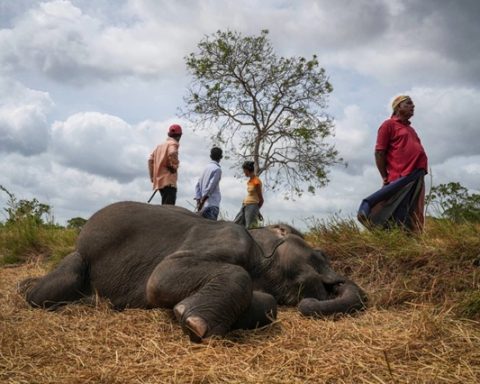
Wildlife is also being forced to contend with the consequences of shrinking water sources. Elephant herds in Somawathiya National Park are moving towards Janaranjana Wewa in search of water. Thirst is pushing animals beyond forest areas, exposing them to hunters, while fish deaths have been reported in reservoirs that are drying up. The wider wildlife population is facing a serious threat to its survival.
Sri Lanka currently produces approximately 2.8 million cubic metres of water a day, with around 24 per cent coming from major reservoirs and the remainder from rivers and other water sources. But prolonged dry weather is rapidly reducing available water capacity.
According to L.S. Suriyabandara, Director of the Hydrology and Disaster Management Division of the Irrigation Department, the effective water capacity of the country’s 74 major reservoirs had fallen to around 36 per cent by August 23-24.
Major reservoirs in the wet zone have remained comparatively stable, but some reservoirs in Hambantota, Batticaloa, Monaragala, Mannar and Trincomalee have fallen below 30 per cent capacity. In Anuradhapura, the effective storage of Manankattiya Reservoir was reported at 1.5 per cent; Muruthawela in Hambantota at 1.6 per cent; Ethimale in Monaragala at 5.4 per cent; and Rottikulam in Ampara at 8.1 per cent.
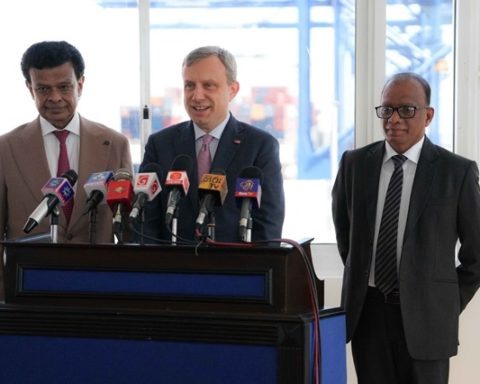
Chandana Bandara, Chairman of the National Water Supply and Drainage Board, said the most severe impact on the national water-supply system was currently being felt in Batticaloa and Monaragala. In Monaragala, the water-supply system does not cover the affected areas. As an immediate response, the Board has begun work to restore groundwater sources.
“We have identified groundwater sources in the Monaragala district. Accordingly, we are working to clean about 65 tube wells and bring them back to normal operating condition,” Bandara said.
The shortage is also forcing authorities to consider how much water can be allocated to the coming cultivation season. At a pre-season meeting, it was decided that Maha cultivation under the Kantale Irrigation Scheme would begin on October 10. Nearly 24,000 acres of paddy land have been prepared for cultivation under the project.
P.G. Ratnasiri, Resident Project Manager of Kantale, said water management would be critical to the success of the season. “We have decided to complete cultivation by November 5. Kantale is the last reservoir in the Mahaweli system and the water has to travel more than 50 kilometres to reach here. Our main objective is to manage the available water efficiently and ensure a successful cultivation season,” he said.
Weather experts predict that people affected by the shortage will receive some relief by October. Until then, however, the statistics continue to translate into a daily reality measured not only in reservoir levels and damaged farmland, but in kilometres travelled by bicycle, empty containers carried along dusty roads and hours spent waiting for a turn at a water source.
For Nilmini and others living through the drought, water is no longer simply something found beside the kitchen tap. It has become the resource around which an entire day must be organised. The full consequences of the drought will ultimately depend on how long the dry conditions persist and how the country’s remaining water is managed in the months ahead.