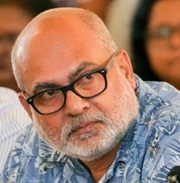
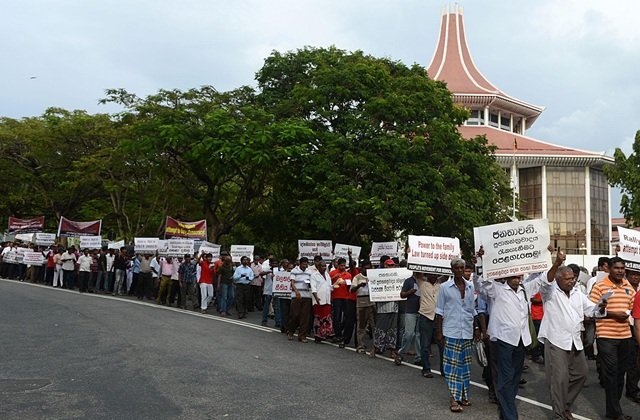
Just hours before the NPP Cabinet formally approved the controversial constitutional amendment, the Bar Association of Sri Lanka (BASL) received an unexpected boost when Lal Wijenayake, a member of both the NPP Leadership Council and Executive Council, publicly declared that neither body had approved the proposal. Defying a party directive to remain silent, the veteran LSSP politician said he felt compelled to set the record straight, strengthening the BASL’s position ahead of its General Assembly on 29 July at its Colombo Secretariat. As tensions mount between the executive and the judiciary, the BASL, led by President Rajeev Amarasuriya, Deputy President Rienzie Arsecularatne, PC, and a representative Bar Council and Executive Committee drawn from across the country, has emerged at the forefront of opposition to the proposed amendment.
The ruling National People’s Power (NPP) government last Friday (24 July), with its steamroller majority in Parliament, easily crushed a no-faith motion moved against Justice and National Integration Minister Harshana Nanayakkara over the Negombo Prison fiasco, for which he verbally accepted responsibility, but refused to resign. But that overwhelming numerical success may prove to be yet another Pyrrhic victory for the ruling junta when all things are considered
The Samagi Jana Balawegaya (SJB)-led Opposition moved the no-faith motion, alleging that Attorney-at-Law Nanayakkara should take the responsibility for the two-day Negombo Prison riot, on 5 and 6 July, that claimed the lives of 22 inmates – all suspects – and 10 prison officers.
Of the 159 NPPers, 152 MPs voted against the no-faith motion, while for the Opposition, which brought in the motion, 36 voted in favour. There were no abstentions. Thirty-seven MPs were not present. The outcome of Friday’s vote was a foregone conclusion. No matter what, the NPP wouldn’t have broken ranks over the Negombo Prison riot.
The SJB-led move failed to make an impact on the NPP parliamentary group. The Opposition suffered a sure defeat and the whole exercise seemed an utterly futile attempt against the government. The SJB shouldn’t even consider moving a no-confidence, targeting a Minister, as the NPP, whatever the disagreements within the parliamentary group, wouldn’t wobble, whatever the issue is. That is not too hard to understand. Whatever the issue, ruling political parties always defended whoever is targeted by no-faith motions.
The no-confidence motion against Energy Minister Kumara Jayakody was defeated on 10 April, 2026. Unlike the Negombo Prison controversy, the SJB-led action dealt with the first major case of alleged corruption, involving a NPP Minister, but 153 votes were cast against the motion, while only 49 votes were cast in favor. That particular vote took place close on the heels of the National Audit Office (NAO) finding fault with the Energy Ministry over the awarding of a mega tender for the supply of coal for 2025/2026 season. The NPP absolutely had no qualms in defending their National List man who received the vital Cabinet portfolio, in spite of him being under investigation by the Commission to Investigate Allegations of Bribery or Corruption (CIABOC) over a previous scam during the Yahapalana administration (2015-2019).
The Opposition suffered the second anticipated defeat in Parliament the day after former President and UNP leader Ranil Wickremesinghe and SJB leader formally met at the Opposition Leader’s Office, No 30, Sir Marcus Fernando Mawatha, Colombo 7, to reach consensus on a common stand against the government’s move to extend the retirement age of the superior court judges.
The SJB parliamentary group consists of 40 members, whereas the UNP is not represented in the current Parliament. The only person elected on the UNP ticket is a representative of the CWC. Among those who attended the politically important gathering were former PM Dinesh Gunawardena, SLPP National Organiser Namal Rajapaksa, MP, Convener of the Joint Opposition Prof. G. L. Peiris, SLFP Chairman Nimal Siripala de Silva, SLMC leader Rauff Hakeem, SJB General Secretary Ranjith Madduma Bandara, Sarvajana Balaya (SB) leader Dilith Jayaweera, MP, former Minister Tiran Alles, Tamil Progressive Alliance leader Mano Ganesan, CWC leader Jeewan Thondaman, National Union of Workers leader Palani Digambaram, and SJB Chairman Kabir Hashim, MP.
Tamil National People\s Front (TNPF) leader Gajendrakumar Ponnambalam joined the gathering, though the main northern party Illankai Thamil Arasu Kadchi (ITAK) skipped it. Opposition party leaders discussed ways and means of building up pressure against the government, both in and outside Parliament. However, that wouldn’t be an easy task as sharp differences remain among them in the absence of a common political strategy. Both the SJB and the UNP sought to exploit the situation to their advantage while the SLPP asserted that the former called the 23 July meeting at the Opposition Leader’s Office, following an intervention made by Namal Rajapaksa.
But, heavy defeat in Parliament, on the following day, proved, or rather, reminded them, that the formidable NPP parliamentary group remained united. Let me remind you of the composition of the current Parliament: NPP 159, SJB 40, ITAK 8, New Democratic Front (NDF) 5, SLPP 3, SLMC 3, SB 1, UNP 1, Democratic Tamil National Alliance (DTNA) 1, All Ceylon Tamil Congress (ACTC) 1, All Ceylon Makkal Congress (ACMC) 1, Jaffna – Independent Group 17 (IND17-10) 1 and the Sri Lanka Labour Party (SLLP) 1.
A disputed constitutional amendment
The issue at hand is whether the NPP would give up its move to bring in an amendment to increase the retirement ages of the judges of the Supreme Court and the Court of Appeal. The top NPP leadership seems hell-bent on going ahead with it, regardless of vigorous campaign against it, led by the Bar Association of Sri Lanka (BASL).
The premier legal professional body and apex organisation representing Attorneys-at-Law, in the ‘land like no other,’ the BASL, under the leadership of Rajeev Amarasuriya, relentlessly attacked the NPP move. Perhaps, the NPP may not have anticipated such a furious response from the BASL and the possibility of the Opposition, whatever its shortcomings, reaching a consensus on this vexed issue.
A person close to Wickremesinghe quoted the UNP leader as having declared, at the Opposition meeting, that all should be happy they got together as a result of President Anura Kumara Dissanayake’s actions. But, the Opposition shouldn’t disregard that a cohesive political strategy cannot be solely based on thwarting the NPP’s draconian move. And, on the other hand, many, including those who exercised their franchise at the national elections held in 2024, are baffled as to why the NPP risked public condemnation to retain the services of Preethi Padman Surasena, the 49th Chief Justice. Surasena succeeded Murdhu Fernando on 27 July, 2025.
The BASL is obviously very keen to keep its distance from the joint Opposition campaign against the proposed constitutional amendment. The BASL realises the acute danger in mixing with the Opposition, previously accused of interfering with the judiciary, or turning a blind eye to what was happening.
But, the NPP armed with a staggering 2/3 majority, in Parliament, pursues its own despicable strategy. The NPP’s top leadership showed its hand when lawmaker Asitha Niroshana Egoda Vithana attacked BASL President Rajeev Amarasuriya. No ordinary MP would have taken on the BASL without the blessings of the top party leadership. In fact, that attack had been orchestrated by the NPP in line with its overall strategy to undermine the growing opposition to the move.
The BASL, too, would never have expected the NPP move to introduce the constitutional amendment meant to extend the retirement ages of the superior court judges. In fact, the BASL, at the onset of the controversy, seemed caught off guard by the NPP bid. Similarly, the NPP appeared to have underestimated the BASL’s resolve and unwavering commitment to the independence of the judiciary, the administration of justice and the rule of law.
Having vigorously defended the judiciary when it was in the opposition, the JVP/NPP drew widespread condemnation when, at the behest of its top leadership, Colombo District lawmaker Vithana alleged, in Parliament, that Attorney-at-Law Amarasuriya had reached consensus with SJB leader Sajith Premadasa regarding an opportunity for him to contest the Western Province PC polls as the SJB’s Chief Ministerial candidate. The lawmaker confidently claimed that Amarasuriya led the campaign against the NPP move in return for the opportunity to contest next PC polls. A claim promptly denied by the BASL. The NPP should accept the BASL challenge and direct the MP concerned to repeat the accusation outside Parliament, thereby depriving himself of parliamentary privilege so that the BASL can challenge him.
Previous cases
During the JVP/NPP campaigns, in the run-up to the presidential and parliamentary polls in 2024, their leader Anura Kumara Dissanayake questioned the accountability and responsibility of a political party defending one of its own facing a no-confidence motion. Dissanayake addressed the issue as a member of Parliament and subsequently as the President.
Dissanayake referred to the no-confidence motion moved against Ravi Karunanayake, in 2017, over the Treasury bond scams, perpetrated in 2025 February, and 2016 March. The second case was the no-confidence motion moved against Keheliya Rambukwella, in late 2023, over unprecedented corruption allegations, relating to health sector procurement. Both no-faith motions were comfortably defeated by the Yahapalana and Wickremesinghe-Rajapaksa governments, respectively.
In the run-up to parliamentary election, Dissanayake pointed out the absurdity in Parliament of defending a wrongdoer at the expense of the truth and accountability. Asserting that the Parliament shouldn’t, under any circumstances, defend wrongdoers, Dissanayake built a strong case for a Parliament dominated by the NPP. Having comfortably won the presidential election, though he couldn’t secure 50% plus vote, Dissanayake declared that there was no need for an Opposition in the Parliament. He wanted the electorate to fill Parliament with only NPPers.
The electorate responded positively to Dissanayake’s call. The voters dealt the Opposition a massive defeat. While the NPP secured a staggering 159 seats, including 18 National List slots, the SJB was reduced to 40 seats. The SJB, at its first election in 2020 August. following the split from the UNP, secured 54 seats. Unfortunately, the NPP obviously failed to live up to public expectations and ended up in an embarrassing situation. The circumstances under which NPP’s first Speaker of Parliament Asoka Ranwala had to resign in December 2024, over allegations regarding the authenticity of his academic qualifications.
In spite of an initial attempt to defend Ranwala, the NPP quickly got him to resign, amidst accusations he misled the public and government officials by claiming to possess a doctorate from Japan’s Waseda University, and a degree in chemical engineering from the University of Moratuwa. Neither of which he has proved to date.
His successor Dr. Jagath Wickremaratne, too, has been involved in a damaging fight with Deputy Secretary General of Parliament and Chief of Staff Chaminda Kularatne, with the latter lodging a complaint with the Commission to Investigate Allegations of Bribery or Corruption (CIABOC).
The controversial releasing of 323 red-flagged containers, and two containers carrying ‘ice,’ regardless of prior warning, devastating coal scam, embezzlement of NDB funds to the tune of Rs 13.2 bn and theft of USD 2.5 mn from the Treasury ruined the NPP’s image.
Then there had been several other instances, such as double payments made to ‘Aswesuma’ beneficiaries that raised questions over the NPP’s competence, but the battle over the decision to introduce a constitutional amendment to facilitate political projects may backfire. The ongoing confrontation between the NPP and the BASL can cause irreparable damage to the ruling party. Approving proposed constitutional amendment seems child’s play for the ruling party but that may backfire.
Obviously the NPP misjudged the BASL’s reaction. Under Amarasuriya’s able leadership, BASL battled the government while keeping a clear distance from the Opposition that made a desperate bid to take advantage of the situation. But, the presence of those who conspired and impeached Chief Justice Dr. Shirani Bandaranayake among the grouping against Dissanayake’s constitutional amendment, make a mockery of the whole exercise. The way Wickremesinghe tried to put off Local Government polls on the false pretext of not having funds required to conduct the election during his presidency. The UNP leader caused himself immense harm when he engaged in a foolish attempts to put off the scheduled Presidential election and also extend the term of office of the then Attorney General Sanjay Rajaratnam. Wickremesinghe’s administration also harassed the Election Commission in a bid to compel the independent body to abide by the government strategy.
NPP bid to justify move on judges
The government sought to justify the new constitutional amendment, underscoring the massive case backlog. That argument was overplayed, both in and outside Parliament, in the wake of the Negombo Prison riots. A disgraceful attempt was made to cover up the incidents that claimed the lives of 22 suspects. The government also conveniently forgot its continuing failure to fill the existing vacancies in the Supreme Court and the Court of Appeal for over six months.
The Opposition has alleged that the whole operation was meant to retain the services of Chief Justice Preethi Padman Surasena, who received the appointment in late July 2025.
The government’s proposal, as publicly reported, would amend constitutional retirement ages as follows: Supreme Court judges: from 65 to 67, Court of Appeal judges: from 63 to 65.
It would be pertinent to mention that the government has allowed vacancies in superior courts. The Supreme Court bench should number 16, but only 12 judges currently sit, whereas the Court of Appeal should have 19 but has 15 at the moment. These vacancies have not been filled promptly, indicating executive inaction rather than a shortage of suitable candidates. SLMC leader Rauff Hakeem, a couple of months ago, attacked the government and the President over the existence of so many vacancies. He also valiantly exposed the unwarranted attack on the BASL President.
The lawyers’ grouping that backed the NPP at the national elections remains silent. The NPP found itself in an unenviable situation with hardly any real public support for its position on a new constitutional amendment. Although the government failed to secure support of any recognised body of lawyers or civil society organisations, with both local and international groups having expressed deep concern over the move.
The Gampaha Lawyers’ Association is the latest to declare its opposition. In a letter signed by the association’s President Chandima Wijerathna and its Secretary Sudharshini Rathnayake, the group requested the President to reaffirm the commitment of his administration to uphold the independence of the judiciary, the separation of powers and the rule of law.
The Association, in its letter dated 22 July, in line with the overall stand taken by the BASL, also requested the President to (a) reconsider the move to introduce constitutional amendment to extend the retirement age of superior court judges (b) subject whatever reforms in the judicial sector to consultations with the relevant stakeholders, including the BASL and (c) fill all existing vacancies in the superior courts.
Instead of addressing the concerns of the BASL and others opposed to the move, the government sought to neutralise the growing opposition by alleging a political deal between Premadasa and Amarasuriya. Unsubstantiated allegation pertaining to Amarasuriya’s candidature as SJB Western province chief ministerial contestant reminded the writer of President Wickremesinghe directing wild accusations against former BASL President Saliya Pieris, PC.
Wickremesinghe declared in Parliament, in late November 2023, that Pieris wanted to become Prime Minister during the troubled 2022 period. By claiming that Peiris intended to do so before 9 May 2009, when violence erupted, following the Temple Trees goon attack on the Galle Face protesters, Wickremesinghe indicated that he was to be deprived of the opportunity to succeed Mahinda Rajapaksa.
Pointing out that Wickremesinghe made these false remarks under cover of parliamentary immunity, Pieris declared, in a Facebook post: “I am compelled to say that unlike politicians of his ilk, I have never placed personal ambitions above the needs of the country. I have never sacrificed my principles for personal gain or for the greed of office.”
But the then BASL was also blind to the wider foreign hatched plot to oust Rajapaksas and to replace them with JVP bogus Marxists and anti-Indian actors backed by the West to the hilt.
“The BASL proposals, made in May 2022, were never about individuals. They were made after careful thought by its Executive Committee and approved by the Bar Council. The legal community made these proposals with the intention of proposing a solution to Sri Lanka’s political and governance crisis with the interests of Sri Lanka and its people in mind,” Pieris emphasised. Peiris deserves the credit for hitting back hard at Wickremesinghe.