


by Eric
Paul Kengor’s American Pontiff: Pope Leo XIV and His Plan to Heal the Church is an unusual hybrid of rapid-response biography, ecclesiastical commentary, and ideological intervention. Written in the immediate aftermath of Robert Francis Prevost’s election to the papacy, the book seeks to interpret not only the life of the first American pope but also the turbulent legacy of his predecessor. Kengor’s narrative is animated by a clear thesis: that the papacy of Pope Francis left the Catholic Church in a state of disarray and that Leo XIV may represent the restoration of doctrinal clarity and institutional stability. The author frames this diagnosis starkly from the outset, recalling Francis’s own admission that he wished to “make a mess of things” (p. x). For Kengor, that phrase becomes both interpretive key and indictment, a symbolic shorthand for what he portrays as a chaotic and ideologically fraught pontificate. Yet while the book aspires to the posture of sober historical analysis, it is equally driven by a polemical energy that invites scrutiny.
The opening chapters establish the book’s interpretive scaffolding by juxtaposing the Francis era with the long historical resilience of the papacy. Kengor invokes the famous anecdote of Napoleon threatening the Church, to which Pope Pius VII supposedly responded: “Oh my little man, you think you’re going to succeed in accomplishing what centuries of priests and bishops have tried and failed to do?” (p. 11). The implication is clear: the Church has survived far worse than contemporary controversies. Yet the rhetorical deployment of such historical parallels also reveals the author’s broader project, which is less a neutral biography than a narrative of crisis and recovery. Francis’s critics are given generous space, including the testimony of Archbishop Carlo Maria Viganò, who claimed that under Francis “no one ever knew what was going through his head” (p. 14). The effect is cumulative: Kengor constructs a portrait of a papacy characterised by unpredictability, ideological conflict, and administrative disruption.
To his credit, Kengor complicates the popular caricature of Francis as a straightforward liberal reformer. The book repeatedly highlights statements by the Argentine pontiff that clash with progressive expectations. Francis insisted that gay men should not enter seminaries, even while acknowledging they could be “good boys” (p. 16), denounced what he called “gender ideology” as “demonic” (p. 17), and sharply rejected same-sex marriage proposals, declaring that they were “not marriage” but merely “an association” (p. 17). Likewise, he shocked some admirers by comparing abortion to Nazi eugenics (pp. 17–18). These examples allow Kengor to argue that Francis was misunderstood by both supporters and critics. Yet the narrative simultaneously suggests that such statements coexisted with a broader atmosphere of confusion. Francis’s denunciation of “rigid” Catholics as modern “Pharisees” and “whitened sepulchres” (p. 25) is presented as emblematic of a style of leadership that deepened internal divisions rather than healing them.
The book becomes more overtly polemical when discussing institutional governance under Francis. Kengor recounts episodes such as the removal of Cardinal Raymond Burke’s salary and the increase of his Vatican rent, a move the author describes as “a crude move” that struck observers by its “meanness” (p. 50). Similarly, Francis’s expansion of the conclave electorate is presented as evidence of a centralising tendency that critics labelled the work of a “dictator pope” (p. 45). Whether one agrees with these characterisations or not, they reveal the interpretive lens through which Kengor reads the recent history of the Church. The Francis papacy becomes a narrative of institutional drift and ideological confrontation, culminating in what Cardinal George Pell reportedly called “a catastrophe” and a “toxic nightmare” (p. 21). Such judgements are not merely quoted; they are tacitly endorsed by the structure of the argument itself.
Against this backdrop of perceived turmoil, the election of Robert Francis Prevost appears in Kengor’s telling almost providential. The author delights in the dramatic reversal that produced the first American pope, describing the announcement with the exuberant Latin formula “Habemus papam” and emphasising the shock of an “American pontiff” (p. x). Prevost’s rise is presented as both improbable and symbolically charged. Even commentators who expected a break with Francis did not anticipate an American candidate, yet the conclave quickly coalesced around him. According to reports cited in the book, the first ballot produced a three-way race in which Prevost was already competitive, and by the fourth ballot he had “secured more than 100 ballots” (pp. 115, 121). The speed of the consensus becomes part of the narrative logic: the cardinals, weary of conflict, sought a stabilising figure.
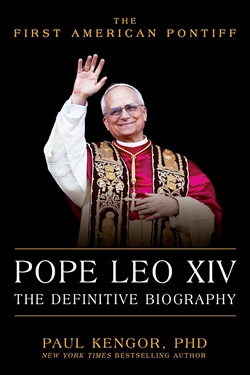
Kengor’s portrait of Prevost is deliberately restrained compared with his depiction of Francis. The future Leo XIV emerges as a cautious and discreet figure, notable less for public statements than for pastoral experience. Indeed, the author emphasises that Prevost left “not a long public track record,” suggesting that his “taciturn nature—call it prudence” may have been precisely why he was chosen (p. 69). This framing transforms silence into virtue. In contrast to the unpredictable style attributed to Francis, Prevost appears as the quiet administrator, the missionary bishop who spent years in Peru and avoided ideological theatrics. The author repeatedly stresses this contrast, even noting that Prevost had privately admitted that he and Bergoglio “weren’t always in agreement” (pp. 183–184).
The biographical sections of the book are among its most engaging. Kengor traces Prevost’s Chicago upbringing, his missionary years in Latin America, and the steady accumulation of responsibilities that eventually brought him to Rome. Anecdotes reinforce the narrative of early vocation: classmates allegedly nicknamed him “holy” (p. 142), and a neighbour reportedly predicted when he was a child that he would become the first American pope (p. 131). Such stories verge on hagiography, yet they also serve a narrative purpose. They transform the improbable election of Leo XIV into the fulfilment of a long, almost providential trajectory.
Yet the book’s interpretive ambition extends beyond biography. Kengor situates the new pope within the intellectual tradition of Leo XIII, particularly the encyclical Rerum Novarum. The choice of the name Leo XIV becomes an ideological signal, linking the new pontificate to a tradition that emphasises the dignity of labour and the inviolability of private property. The encyclical famously warned that socialist proposals to abolish private ownership would “rob the lawful possessor” and create “utter confusion in the community” (p. 205). By foregrounding this tradition, Kengor suggests that Leo XIV may guide the Church toward a clearer engagement with social and economic questions.
At the same time, the book occasionally reveals tensions within its own narrative. Kengor praises Prevost’s discretion and reluctance to engage in ideological conflict, yet the biography itself is saturated with ideological interpretations. The author repeatedly frames ecclesiastical debates in terms that mirror contemporary political polarisation. Even the discussion of media reactions to Leo XIV’s election emphasises culture-war dynamics, describing critics as more interested in “ideology than theology” (p. 98). This rhetorical move raises a paradox: the book criticises politicisation within the Church while simultaneously interpreting events through a strongly political lens.
The concluding chapters reflect a cautious optimism about the future. Leo XIV’s early words from the balcony of St Peter’s—“Peace be with all of you”—are presented as a symbol of a new pastoral tone (p. 245). In his first homily, the pope reportedly prayed that he might “disappear so that Christ remains” (pp. 241–242). Such language allows Kengor to close the narrative on a note of hopeful restraint. Even so, the author acknowledges that the future remains uncertain. Francis’s papacy, he concedes, initially inspired similar optimism before disappointing many observers.
What ultimately emerges from American Pontiff is not simply a biography of Leo XIV but a contested interpretation of the recent history of the Catholic Church. Kengor’s argument is provocative precisely because it refuses neutrality. The book invites readers to consider whether the Francis era represented creative reform or destabilising experimentation, and whether the election of Leo XIV signals a return to equilibrium. Whether one accepts Kengor’s conclusions or not, his narrative underscores the enduring reality that the papacy remains both a spiritual office and a global institution whose leadership reverberates far beyond the walls of the Vatican. In that sense, the author’s central question—whether the new pope can guide a divided Church toward unity—remains as open as the history he seeks to interpret.









