



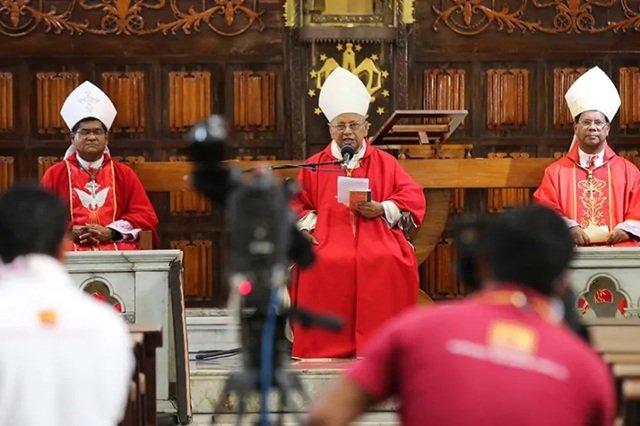
Start with what he said, because he said it first, before anyone made him.
His counsel stood in the Court of Appeal and told the bench that some people ask why the Cardinal has come before this court. And then he answered his own question. He is here, the lawyer said, on behalf of the victims of the Easter Sunday attacks.
Good. A fair answer to a fair question.
Now let us test it.
Take away the robes. Take away the moral weight of the office. Look at the paper he filed.
The Archbishop of Colombo has gone to a court and asked it to dismiss another man’s challenge to his own imprisonment.
Not to bring evidence. Not to speak for a grieving family in a civil claim. To ask the court to refuse to look. To refuse even to ask whether Suresh Sallay is being held within the law.
Read it again. The framing is built to stop you seeing it.
Sallay’s petition asks one thing. Is my detention lawful. The Cardinal’s petition asks the court to throw that question out, on the ground that answering it would get in the way of the investigation.
Sit with the shape of that.
A man charged with nothing asks a court whether his cell is lawful. And the most powerful churchman in the country arrives to argue the court should not answer.
That is not standing with the victims. The victims of Easter Sunday gain nothing from a suspect held unlawfully. If he is held unlawfully. And the only way anyone learns the answer is the very hearing the Cardinal is working to shut down.
So hold his stated reason in one hand. Hold his filed petition in the other. They do not match.
Now the harder part. The part a journalist cannot walk past.
The Cardinal’s petition told the court, under oath, that Sallay was serving in the State Intelligence Service when the attacks happened.
He was not.
Sallay took charge of the State Intelligence Service in December 2019. Three weeks after Gotabaya Rajapaksa won the presidency. Eight months after the bombs.
This is not a matter of opinion. It is not contested by anyone who has read the record. In the years the attacks were planned, Sallay was posted abroad. Malaysia. Out of the country and out of the chair.
Understand why this is not a small thing.
The whole case for the word mastermind needs Sallay’s hands on the controls of the intelligence machine when the plot was built. Put him in the director’s chair on that Easter morning and he has motive, means, and command. Put him where he actually was, in another country, outside the structure entirely, and the case has nothing left to stand on.
The Cardinal’s sworn petition chose the version that is useful. Not the version that is true.
A man can be forgiven a genuine error. But when you walk into a court to keep another man locked in a cell, and the sworn foundation of your case puts him in a seat he did not occupy at the hour of the crime, you have given up the right to be believed when you say you came only for the truth.
You came for a result.
His lawyer told the court the Cardinal had not sought to influence the investigation.
Set that sentence against the record and watch it fall apart.
In September 2023, within days of the Channel 4 broadcast, the Cardinal stood in public and demanded that every official named in that programme be stripped of their post. He called for Sallay to resign that day. He has called, over and over, for the whole investigation to be reopened, rebuilt, handed to foreigners.
And now he is inside the court, filing paper to shape the detention itself.
That is a man reaching for every lever there is. The political lever. The public lever. And now the lever of the bench.
There is no shame in a bishop fighting for his murdered people. That is his calling. That is his right, and he has earned the standing to use it.
The shame is telling the court he is not doing the thing he is plainly doing.
You cannot ask a court to dismiss a man’s petition and say in the same breath that you are not trying to shape his fate. The petition is the influence. There is no gap between the two. They are the same act.
On the tenth of August, Sallay’s counsel put the cleanest form of it to the bench. Criminal investigations, he said, must stay free of political and religious influence.
Another party went further. Appearing for a nationalist movement, senior counsel told the court the investigation had been opened at the request of the Catholic Church.
Leave that last claim where it belongs, as an allegation, unproven, made by an opponent. But the principle underneath it does not need proving, and it is the exact principle the Cardinal’s own conduct breaks.
A criminal case is legitimate for one reason only. Because it answers to the evidence and to nothing else. Not to a government. Not to a movement. Not to a church, however deep the wound that church has carried.
The moment the name of the person demanding the arrest counts for more than the proof behind it, the thing has stopped being justice. It has become something wearing the clothes of justice.
The Cardinal has every right to grieve. Every right to demand answers. He does not have the right to place himself between a citizen and a court.
And the fact that his cause moves us makes it more dangerous, not less. Sympathy is the thing that carries an improper act past the guard. Nobody stops the man they feel sorry for. That is exactly how the wrong thing gets through.
Look, in the end, at who is arguing what.
The Attorney General’s own counsel asked the court to dismiss every intervening petition. The Cardinal’s along with the rest. On precedent.
When the state’s own lawyer tells the court these interventions do not belong in the case, the Cardinal might pause and ask himself why his presence needs so much defending.
Let me be exact about what this is, and what it is not.
It is not a claim that the Cardinal is wrong to want accountability for two hundred and sixty dead. He is right to want it. This country owes him for the peace he held on a day it could have burned. The relief he secured for the bereaved and the maimed was real, and it stands, and nothing here touches it.
Here is what is in question. One thing.
A man charged with nothing, driven to a hunger strike in a cell he calls hell, has asked a court whether his imprisonment is lawful. And the Archbishop of Colombo has gone to that same court to argue the question should go unanswered. On a sworn premise that is false.
Grief explains the impulse. It does not licence the act.
The measure of the Cardinal’s cause was never how hard he could press it.
It was whether he could still tell the difference between seeking justice and standing in its way.
On the evidence of his own petition, he cannot.









The Cardinal should NEVER be allowed to interfere in the investigative process. This was clearly a failure by the Government. Sri Lanka is a BUDDHIST Country and the Catholic Church , although allowed to grieve, should NEVER, EVER be allowed to interfere in this manner. The Cardinal has yet to explain WHY HE DID NOT CELEBRATE MASS AT THE KOCHIKADE CHURCH ON THE FATEFUL DAY.. WHY INDEED ?????