Ad Conclave
The death of Pope Francis on 21 April 2025 at the age of 88 marked the end of a pontificate defined by pastoral humility, doctrinal contemplation, and administrative reform. His twelve-year tenure leaves behind a complex yet enduring legacy of ecclesial engagement, global moral advocacy, and internal institutional restructuring. As such, the ensuing Conclave takes on heightened significance—not only as a spiritual exercise but as a deliberation on the future trajectory of Roman Catholicism in an increasingly pluralistic and fragmented world.
At Pope Francos’ passing, cardinals under the age of eighty were summoned from every corner of the globe to participate in the Conclave that will elect a successor to Poe Francis . They have been sequestered in the Domus Sanctae Marthae within the Vatican, and the Sistine Chapel will be closed to all others. Communications have been cut off. The electors will swear oaths of secrecy, and under threat of excommunication, they will begin a process that is at once a spiritual discernment and a legal ritual. It is within this tension that the essence of papal succession lies.
Until the Conclave commences the Vatican will enter Sede Vacante—a period where the Holy See is without a pontiff and all ordinary functions of the papacy are suspended. The Camerlengo will take charge of the day-to-day temporal governance, and preparations for the Conclave will commence.
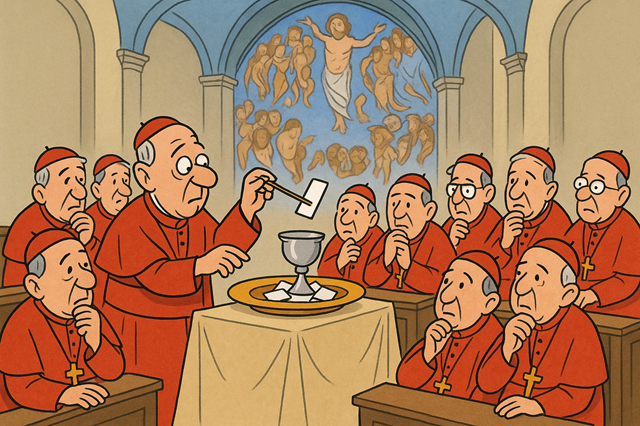
The procedures to follow are precise. The cardinals will meet in General Congregations to discuss the state of the Church and prepare for the election. Then the voting will begin: ballots inscribed by hand, folded, and placed on a plate before being slid into a chalice placed on the altar beneath Michelangelo’s fresco of the Last Judgment. The symbolism is overwhelming. Here, amid depictions of divine reckoning, men must discern whom among them should be God’s Vicar on Earth. The votes will be counted aloud; if no two-thirds majority is reached, the ballots are burned with a chemical additive producing black smoke. When a Pope is chosen, white smoke emerges—habemus papam.
The Holy See has declared 7 May 2025 as the date of entrance into Conclave. The term “Conclave”, derived from the Latin cum clave—“with a key”—aptly denotes this physical and symbolic sequestration, reinforcing the autonomous and divinely oriented nature of the decision to follow.
On the morning of 7th May, the cardinal electors—those members of the Sacred College under the canonical age of 80—will gather for the celebration of the Missa Pro Eligendo Papa, the Mass for the Election of the Pope. This liturgical act, held within the grandeur of St. Peter’s Basilica, serves as a formal invocation of divine guidance, acknowledging that the choice of pontiff transcends human preference and rests upon spiritual discernment.
Following the Eucharistic celebration, the cardinals will enter the Sistine Chapel, invoking the ancient formula extra omnes, meaning “all others, out.” At this point, the doors will be sealed, and the electors will be secluded from the external world, in accordance with the prescriptions of Universi Dominici Gregis, the apostolic constitution promulgated by Pope John Paul II.
What is the Conclave?
The Conclave, in its historical, traditional, and spiritual dimensions, constitutes one of the most solemn and sacrosanct processes in the life of the Roman Catholic Church. It is not merely an election, nor can it be reduced to a procedural appointment akin to the selection of a civil head of state. Rather, it is a profound ecclesiastical convocation, a ritual of sublime consequence that represents the convergence of divine invocation, apostolic succession, and canonical fidelity—crafted over centuries through prayer, persecution, perseverance, and papal reform. This gathering, steeped in centuries of canonical authority and theological gravity, is not merely a clerical assembly—it is a sacrosanct convocation wherein the successor to the Chair of Saint Peter shall be chosen to shepherd the universal Church, which today embraces over 1.4 billion faithful across continents and cultures.
Historically, the Conclave emerges from a lineage of episcopal discernment that is rooted in the foundational moment of the Petrine commission. When Christ declared to Simon, “You are Peter, and on this rock I will build my Church,” He set forth a divine mandate for perpetual leadership. The Conclave, therefore, is the institutional mechanism through which this apostolic lineage is preserved—ensuring the continuity of the See of Peter through the unbroken laying on of hands, extending from antiquity to modernity. The gathering of cardinals to elect the Bishop of Rome finds precedent in ecclesial history dating back to the early centuries of the Church, evolving from acclamations by the Roman clergy and laity to the formalized, secretive, and juridically governed process we now recognize under Universi Dominici Gregis.
Traditionally, the Conclave embodies the Church’s quest for sanctity through solemnity. Its customs—developed over centuries—speak to a theological anthropology that views the election of a pontiff not as a pursuit of power, but as a discernment of pastoral servanthood. The cardinals, garbed in crimson to signify their readiness to suffer for the faith, enter the Sistine Chapel and invoke the extra omnes command, symbolically and literally closing off the world to focus solely on the divine. Within this seclusion, the electors engage in a rite shaped by Gregorian discipline, Tridentine rigor, and Second Vatican Council inclusivity. The voting rituals, the oaths of secrecy, the burning of ballots with chemicals to signal black or white smoke—all point to an institutional liturgy wherein the human act of voting is offered up to the Spirit as a plea for divine guidance.
Spiritually, the Conclave is a moment of ecclesial kenosis—a self-emptying—wherein the Church, in its deepest humility, seeks the will of God rather than the desires of men. It is a retreat into sacred time, where the cardinal electors become instruments of a higher providence, mindful of the global burden they bear. Their task is not to elect a Pope for Rome alone, nor for any single nation, but for the entirety of Christendom. The new pontiff, once chosen, is not merely a successor to Peter in juridical terms; he becomes Servus Servorum Dei—the Servant of the Servants of God—entrusted with teaching, sanctifying, and governing the faithful.
In essence, the Conclave is a fusion of divine mystery and ecclesiastical responsibility. It reflects the Church’s understanding of leadership as both vocation and sacrifice. It is a timeless expression of unity in diversity—cardinals from disparate cultures, ideologies, and continents gathered in one purpose: to listen, to pray, and to choose, not by ambition, but by discernment. Thus, the Conclave is not merely a chapter in ecclesial history, but a reaffirmation of the Church’s fidelity to the Spirit, echoing the words of the Acts of the Apostles: “It seemed good to the Holy Spirit and to us.”
Constitution and Procedure
There are currently 135 cardinals eligible to vote; however, due to health-related withdrawals by Cardinals Antonio Cañizares Llovera and Vinko Puljić, and the recusal of Cardinal Giovanni Angelo Becciu—whose privileges were curtailed by Pope Francis in 2020 amid a financial scandal—the number of expected electors stands at 132. This means that a successful candidate must secure no fewer than 89 votes to fulfill the two-thirds requirement. The voting procedure will begin with a single ballot on the first day, followed by two ballots each morning and afternoon in subsequent days until the threshold is met.
After each ballot, the result will be signaled to the faithful through the ancient medium of smoke—fumata nera (black smoke) denoting an inconclusive vote, and fumata bianca (white smoke) signifying that a Pope has been elected. This visual liturgical language, though simple in form, speaks volumes to the millions who wait with bated breath for confirmation of new spiritual leadership.
Historically, while most Conclaves have occurred in Rome—specifically within the Vatican—there have been instances where political and logistical imperatives have relocated the process. Notable exceptions include Viterbo, Perugia, and Venice in Italy; as well as Konstanz in Germany and Lyon in France. These historical anomalies serve to remind us that though the Church is eternal in essence, it remains susceptible to the temporal pressures of history.
It is worth noting that canon law does not require the Pope to be a cardinal. However, tradition has strongly favored such appointments. The last pontiff chosen from outside the College of Cardinals was Urban VI in 1378, then the Archbishop of Bari. The modern era has witnessed a diversification of papal origin—John Paul II of Poland in 1978, Benedict XVI of Germany in 2005, and Francis of Argentina in 2013—each marking a departure from the historically predominant Italian papacy. Earlier papal elections saw the ascension of men from Spain, Syria, and the Netherlands, demonstrating that the See of Peter, while Roman in foundation, is catholic in scope.
As for the duration of the Conclave, it remains uncertain and open-ended. History records both brevity and protraction. Pope Julius II was elected within hours in 1503, while Pope Gregory X’s election in the 13th century took an extraordinary 1006 days—nearly three years—prompting subsequent reforms to expedite the process. In recent times, the Church has seen greater efficiency: Pope Pius XII was elected on the third ballot in 1939; Benedict XVI on the fourth in 2005; and Francis I on the fifth in 2013.
As the cardinals prepare to enter the Sistine Chapel, their deliberations will transcend geopolitics and ideology, seeking to anoint not merely a leader, but a servant of divine will. The process—mystical to some, juridical to others—is in essence both. It represents an intersection of tradition and transformation, of continuity and change. In electing the next Supreme Pontiff, the College of Cardinals will not merely be selecting a man—they will be affirming a vision for the future of the Church in an age marked by complexity, contestation, and profound moral need.
CONCLAVE -The Book
The machinations of governance, whether temporal or spiritual, are not merely acts of policy or persuasion; they are invariably manifestations of power cloaked in legitimacy. In Robert Harris’s Conclave, the author skillfully penetrates the austere, secretive world of papal election—one of the oldest continuous institutions of global governance—by dramatizing the selection of a successor to Saint Peter in the aftermath of a pontiff’s death. This work, though fictional, resonates deeply with the epistemological architecture of procedural legitimacy and the teleological tension between divine mandate and human frailty.
The Conclave is not simply a religious ritual. It is an institution governed by the Apostolic Constitution Universi Dominici Gregis, a legal text which, while steeped in theology, also operates within a procedural matrix that would rival most democratic elections in complexity and symbolic authority. Harris’ narrative recognizes this, framing the election of the Pope as not merely the choice of a spiritual shepherd, but as the assertion of institutional continuity within the epistemic framework of divine election—a paradox wherein men choose a man whom they claim is chosen by God.
In the character of Cardinal Lomeli, Harris crafts a protagonist of extraordinary depth. A man of conscience, compassion, and canonical rigor, Lomeli is both observer and participant in the unfolding drama. Through him, Harris explores the internal dissonance of the electors—princes of the Church who must suspend ambition in the pursuit of spiritual discernment. Yet, as is often the case in institutions marked by both opacity and reverence, ambition does not yield easily to humility. Harris does not so much satirize the cardinals as he humanizes them. They are not caricatures of ecclesiastical corruption; rather, they are exemplars of institutional humanity—embodying the duality of serving both God and political interest.
One of the most compelling features of Conclave is its unwavering adherence to procedural authenticity. The locking of the Sistine Chapel, the burning of ballots, the nuances of vote-counting—all these reflect a near-liturgical reverence for process. In this respect, the novel becomes a fictionalized treatise on governance, not dissimilar to the Vienna Convention on the Law of Treaties, where legitimacy is secured not solely through moral rectitude but through procedural compliance. The secret ballot, the absolute majority, the oath of secrecy—all of these mechanisms are legalistic instruments by which sacred authority is distilled through institutional design. In the words of legal philosophy, one could say the Conclave embodies both jus divinum and jus humanum—divine right and human law.
This bifurcation is best exemplified in the climactic revelation of the identity of the final candidate elected to the papacy. Without disclosing the plot’s ultimate surprise to the uninitiated reader, it can be said that Harris’s twist is not mere sensationalism. It is a brilliant interrogation of identity, legitimacy, and institutional tradition. In doing so, Harris mirrors the jurisprudential concerns surrounding the persona ficta of legal entities: how much of the legitimacy of a figurehead resides in who they are, versus the office they assume?
Moreover, the novel invites epistemological reflection on the nature of authority. Is the Pope elected because the cardinals believe him to be God’s choice, or does their consensus make him God’s choice? This question is not unlike debates within constitutional law regarding judicial supremacy and legislative primacy. The notion of ex cathedra—that the Pope is infallible when speaking officially on faith and morals—finds its fictional parallel in Harris’s portrayal of the Conclave: the moment a man dons the white cassock, he transcends fallibility by the ritual consensus of his peers. This transformation is symbolic and institutional, echoing the idea that law, too, transforms the individual once one assumes an office under its jurisdiction.
Further, Harris’s work is an exploration of the human condition under extreme institutional pressure. The cardinals, secluded, stripped of outside influence, are left with only their consciences, their political calculations, and their personal rivalries. In this respect, Conclave is reminiscent of international negotiations in aviation diplomacy—where the actors are ostensibly serving the common good, but the trajectory of consensus is shaped as much by personal conviction as by national interest. The role of Lomeli is akin to a Chairman of the Council of ICAO: a neutral arbiter wrestling with the duty of procedure, the responsibility of moral leadership, and the chaos of competing worldviews.
Thematically, Conclave is a meditation on secrecy and transparency. The election of a Pope is secret by design, premised on the assumption that only through concealment can true discernment emerge. But Harris raises the question: can transparency be a greater virtue? In a world besieged by populism, autocracy, and institutional distrust, Harris’s papal thriller interrogates whether sacred secrecy is compatible with modern ideals of accountability. This question holds particular relevance in air law, where transparency in safety investigations, bilateral negotiations, and passenger rights is paramount. As in the Conclave, so in aviation: the integrity of the system depends not only on its outcomes but also on its processes.
Robert Harris, through Conclave, has thus offered more than a suspenseful narrative. He has presented a profound reflection on the interplay between institution and individual, between law and spirit, and between the seen and the unseen. In a world where legitimacy is increasingly contested—be it in the papacy, the judiciary, or multilateral diplomacy—the novel is a reminder that behind every rule lies the human hand that crafts it, and behind every decision, the moral soul that must live with it.
Conclave is not merely a novel of ecclesiastical suspense. It is a juridical allegory. A theological drama. And a philosophical inquiry into the nature of authority. As with all great literature, its relevance exceeds its setting, reaching into every forum where humans gather under the banner of order to discern truth amidst uncertainty.
My Take
The prospect of electing a successor to Pope Francis is no longer a matter of distant contingency but of present speculation, shrouded in ritual and governed by the strictures of ecclesiastical jurisprudence.
As the world awaits the next pontiff, the lessons embedded in Conclave gain prescient relevance. Harris, though a novelist, brings the reader to an understanding of how the election of the Bishop of Rome is more than a spiritual act; it is a codified process embedded in canonical law and the Apostolic Constitution Universi Dominici Gregis..
Pope Francis, through his appointments, significantly reshaped the College of Cardinals. He elevated cardinals from the peripheries—Asia, Africa, Latin America—thereby expanding the geographical and theological diversity of the electorate. The forthcoming Conclave, therefore, will be less Eurocentric than any in recent history. This diversity may bring with it a more vibrant debate about the future direction of the Church: whether to consolidate Francis’s reformist agenda or to restore a more traditionalist approach. This is precisely the underlying question in Harris’s narrative: is the papacy an instrument of change or a bastion of continuity?
This ontological question of identity within the institutional framework resonates beyond religion. It reflects a jurisprudential dilemma common in treaty interpretation. Does the spirit of a law or institution evolve with its leaders, or is it anchored in immutable principles? In the Conclave, this question becomes not academic but urgent. The cardinals, though called to pray and discern, are also required to judge—to measure the charisma, theological acumen, administrative capacity, and spiritual authenticity of their peers. Such discernment is not unlike judicial appointment in constitutional democracies. It is about finding not merely the competent but the divinely—or politically—ordained.
These questions matter—not only to Catholics but to all who believe in governance, legitimacy, and leadership. The Conclave, like the UN Assembly or the United Nations Security Council, is a forum where the stakes are universal. But unlike those secular bodies, the Conclave claims divine endorsement. This claim imposes an extraordinary epistemic burden. It is not enough that the next Pope be competent; he must be sanctified.
The world will watch not merely for a puff of white smoke, but for a sign—of continuity or change, of restoration or reform. Fiction and fact will blur, as they always do in matters of power and conscience. But unlike in Harris’s novel, the name called out in the Sistine Chapel will not be a literary device. It will be the name of a man upon whose shoulders rests the weight of two millennia, the hopes of over a billion souls, and the future of a Church navigating the stormy waters of modernity. The question is not whether he will be ready, but whether we will be.