by Eric
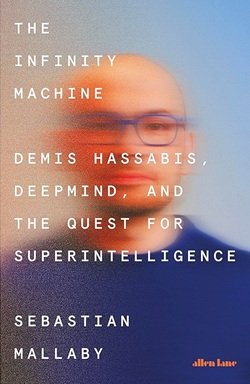
Sebastian Mallaby’s The Infinity Machine: Demis Hassabis, DeepMind, and the Quest for Superintelligence is an ambitious, at times unsettling, attempt to narrate the making of a technological epoch through the figure of Demis Hassabis. It is not merely a corporate biography or a history of artificial intelligence, but a text that repeatedly gestures toward metaphysics, eschatology, and the psychology of obsession. From its opening claim that “artificial intelligence heralds a transformation more profound than anything since Homo sapiens acquired the capacity for abstract thought” (p. xiii), the book stakes out a maximalist thesis that borders on civilisational prophecy. Mallaby’s narrative proceeds as if the stakes are not simply economic or technological but existential, even theological. This inflationary framing is both the book’s animating force and its central weakness: it captures the self-understanding of its protagonists with fidelity, yet risks reproducing their grandiosity without sufficient critical distance.
The text’s most provocative move is to situate Hassabis’s project within a quasi-religious horizon. Mallaby writes that Hassabis “wanted nothing less than to build an omniscient machine…that would occupy, effectively, that position in the cosmos that religious believers once ascribed to an all-powerful divinity” (p. xv). This formulation is not merely rhetorical flourish; it recurs in various guises throughout the book, reinforced by the testimony of insiders who describe AGI as “really finding God’s algorithm” (p. 73). Such language invites a reading of contemporary AI development as a secularised theology, with engineers as unwitting priests of a new epistemic order. Yet Mallaby hesitates to interrogate this analogy rigorously. Instead, he oscillates between fascination and unease, leaving the reader to wonder whether this “religious aspect” is a metaphor, a motivation, or a latent pathology within the field.
The ethical ambivalence of scientific discovery is foregrounded early through a juxtaposition of voices. Geoffrey Hinton’s admission that “the prospect of discovery is too sweet” (p. xvii) sits alongside J. Robert Oppenheimer’s chilling maxim that one should pursue what is “technically sweet” and worry about consequences later (p. xvii). Mallaby sharpens this into a pointed question: “Is this what drives scientists to pursue technology that threatens to upend society?” (p. xvii). The book repeatedly returns to this tension between curiosity and responsibility, yet it rarely resolves it. Instead, it presents a gallery of actors who are acutely aware of the risks they are creating but proceed regardless, invoking a familiar narrative of technological inevitability. The comparison to Oppenheimer is explicit—“he could not control its use. Perhaps this is the privilege and fate of all history’s great scientists” (p. xxi)—but the analogy remains under-theorised. Is AGI truly comparable to nuclear weapons, or does the analogy obscure more than it reveals?
Mallaby’s portrait of Hassabis is built around an almost pathological intensity. From childhood, he is depicted as possessing “astonishing, incredible determination” (p. 2), with “only 100 percent” effort ever available to him (p. 3). The anecdote of the young Hassabis believing he must push himself “to the point just before death” to know he has done his best (p. 6) reads less like precocious ambition than a blueprint for burnout. Mallaby does not shy away from the costs of such extremity—“Demis is killing himself” (p. 42)—yet he ultimately frames this drive as necessary, even admirable, within the context of world-changing innovation. The narrative thus reproduces a familiar Silicon Valley mythology in which personal excess is transmuted into collective progress, raising the question of whether the book critiques or perpetuates this ideology.
The intellectual foundations of Hassabis’s thinking are presented as both eclectic and reductive. His claim that “information is the fundamental unit” of the universe (p. 28) and that DeepMind is pursuing “a meta-solution to any problem” (p. 29) encapsulates a computational worldview that collapses diverse domains into a single epistemic framework. Mallaby traces this back to Hassabis’s rejection of symbolic AI—“first order logic…was nonsense” (p. 25-26)—and his embrace of learning systems. Yet the book rarely pauses to question whether this informational monism is philosophically defensible. If everything is reducible to patterns and data, what becomes of meaning, embodiment, or social context? The narrative treats these questions as either solved or irrelevant, mirroring the assumptions of its subject.
There is, however, a subtle counterpoint in the depiction of Hassabis’s own doubts and revisions. His later admission that reading “all of Wikipedia” would not suffice to “understand how the physics of the world works” (p. 214) suggests a belated recognition of the limits of data-driven approaches. Similarly, his acknowledgment that “you can’t be Nostradamus every time” (p. 218) introduces a note of epistemic humility that sits uneasily with earlier claims of inevitability. Mallaby uses these moments to complicate the narrative of linear progress, but they also expose a deeper instability in the field’s self-conception: the oscillation between overconfidence and uncertainty.
The corporate dimension of the story is rendered with a journalist’s eye for intrigue and conflict. The founding of DeepMind is framed as both a heroic quest and a high-stakes gamble, with investors oscillating between scepticism—“complete BS” (p. 86)—and messianic belief—“Demis’s destiny” (p. 75). The eventual sale to Google is presented as a pragmatic compromise: “I’ll go to Google. I’ll get a shitload of computers and then I’ll solve intelligence” (p. 129). Yet this decision raises unresolved questions about power and governance. Elon Musk’s warning that “we can’t have a giant corporation control AGI” (p. 136) is juxtaposed with assurances that safety mechanisms will be built in, even as Hassabis later concedes that “safety isn’t about governance structures” (p. 255). The tension between centralisation and control remains one of the book’s most troubling undercurrents.
Mallaby is particularly effective in capturing the epistemic shock of breakthroughs such as AlphaGo. The description of the system learning “something completely different” for each game (p. 109) and producing moves that humans could not understand (p. 161) conveys a genuine sense of rupture. Fan Hui’s reflection that “the world is so much bigger than I thought before” (p. 160) serves as a microcosm of the broader cognitive dislocation induced by AI. Yet even here, the narrative slips into a celebratory mode, emphasising the beauty and novelty of machine intelligence while downplaying its opacity. If systems are “in control” but not understood (p. 161), what does this imply for accountability?
The ethical and political implications of AI are addressed most explicitly in the later chapters, though often in a fragmented manner. Hassabis’s proposal for a council of “the hundred wisest people” (p. 168) evokes Plato’s philosopher-kings, but the practicality of such a body is left unexamined. Similarly, the idea of a “new human right to AI assistance” (p. 380) gestures toward a radically transformed social contract without specifying its institutional basis. Mallaby presents these visions as indicative of the field’s ambition, yet they also reveal a striking lack of concrete political thinking. The future is imagined in grand abstractions, while the mechanisms of governance remain vague.
The book’s treatment of existential risk is perhaps its most controversial aspect. On one side are figures like Hinton, who warn that “we’re toast” (p. 317), and Bengio, who suggests that introducing more powerful entities could mean “we are cooked” (p. 320). On the other are sceptics who dismiss such concerns as “scaremongering” (p. 320) or even cult-like thinking (p. 321). Mallaby does not adjudicate decisively between these positions, instead presenting them as part of an ongoing debate. Hassabis himself adopts a cautious agnosticism: “we don’t know how dangerous this stuff is” (p. 327). This refusal to take a firm stance may be intellectually honest, but it also risks appearing evasive in the face of high stakes.
One of the book’s most striking themes is the tension between science and power. Hassabis insists that his motivations are “scientific” rather than political (p. 308), and that “power is not…an interest in and of itself” (p. 384-385). Yet the narrative repeatedly undermines this claim. The race dynamics described as “wartime” (p. 307), the ambition “to overtake” rivals (p. 286), and the portrayal of AGI as “infinitely bigger than a company” (p. 385) all point to a landscape in which power is inescapable. Mallaby captures this contradiction without fully resolving it, leaving the reader to question whether the distinction between knowledge and power is sustainable in this context.
The portrayal of the GPT era introduces another layer of complexity. Hassabis’s initial dismissal of language models as “poor regurgitation” (p. 285) followed by his recognition that GPT-3 was “clearly not like that” (p. 285) illustrates the unpredictability of technological trajectories. Ilya Sutskever’s claim that predicting “the next token” could “solve intelligence” (p. 207) challenges DeepMind’s emphasis on reinforcement learning, suggesting a rival paradigm. Mallaby uses this divergence to highlight the contingency of AI development, yet he also frames it as part of a broader convergence toward AGI. The question remains whether these approaches are complementary or fundamentally at odds.
The closing sections of the book return to the theme of inevitability, albeit in a more ambivalent register. Hassabis describes AGI as “humanity-sized” (p. 385) and envisions building a “Large Hadron Collider in space” to understand reality (p. 387). At the same time, he confesses that the current moment feels “paradoxical” and that the “mad rush” may lead to mistakes (p. 396-397). This oscillation between confidence and anxiety encapsulates the book’s overall tone. Mallaby does not resolve this tension, instead presenting it as an inherent feature of the technological frontier.
The Infinity Machine is as much a document of belief as it is of analysis. It captures a community that sees itself on the brink of transforming the human condition, driven by a mixture of curiosity, ambition, and fear. Mallaby’s achievement lies in rendering this world with clarity and immediacy, allowing its protagonists to speak in their own voices. Yet this fidelity comes at a cost. By remaining so close to his subjects, he sometimes reproduces their assumptions rather than interrogating them. The result is a book that is both illuminating and disquieting: a window into a future that is being built with extraordinary confidence and profound uncertainty.