Editorial
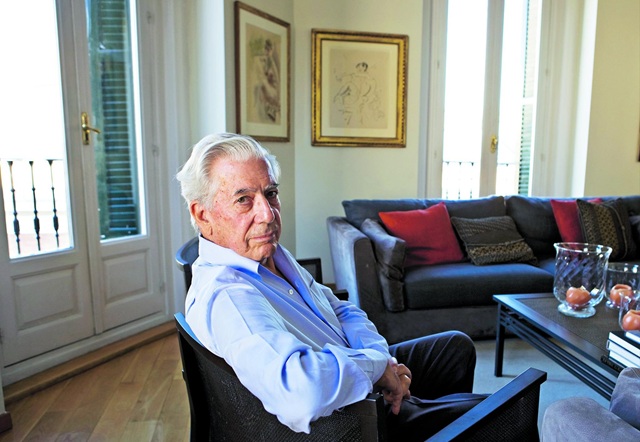
The passing of Mario Vargas Llosa, the Peruvian literary colossus, at the venerable age of 89, marks not merely the extinction of a singular intellect but the irrevocable dimming of a brilliant constellation in the firmament of global literature. Llosa, Nobel Laureate, public intellectual, political provocateur, and indefatigable chronicler of human frailty, leaves behind a legacy both capacious and combustible. In an age increasingly hostile to nuance, he remained, till the very end, a firebrand of ambiguity, a scribe unafraid of the incendiary, the impolitic, and the ideologically treacherous.
From the fecund ground of Latin America’s twentieth-century political turmoils, Llosa excavated the raw ore of his narratives. His debut novel, “La ciudad y los perros” (The Time of the Hero), did not merely challenge Peru’s militaristic status quo but exploded it, eliciting public book-burnings from the very military school that served as its model. “The novel,” he once said, “is born of disobedience, of the refusal to accept the world as it is.” This obdurate nonconformity suffused his corpus, from the sinuous digressions of “Conversación en La Catedral” to the quasi-Biblical grandeur of “La guerra del fin del mundo” (The War of the End of the World). His prose, rich in psychological excavation and political portent, resists facile categorisation. He was a stylist of exquisite control, yet his narratives often descended into the grotesque, the chaotic, the unspeakably real.
Yet what truly scandalised and galvanised was not his style but his stance. A one-time acolyte of Fidel Castro who metamorphosed into a trenchant critic of all totalitarianisms, Llosa’s ideological volte-face was not mere revisionism but a philosophical evolution. “All ideologies are seductive in youth,” he reflected, “but maturity is the recognition of their insufficiencies.” In 1990, he ran for the presidency of Peru on a platform of liberal economics and democratic reforms, only to be vanquished by Alberto Fujimori’s populist chicanery. Llosa’s electoral defeat was literature’s gain. The novelist returned to his art with renewed vigour, now emboldened by the full arc of disillusionment.
To read Llosa is to confront power in its most protean guises: institutional, sexual, spiritual. In “La fiesta del chivo” (The Feast of the Goat), he anatomised the Dominican Republic’s despotism under Trujillo with forensic horror. The novel does not offer redemption but revelation; it does not moralise but unmasks. In his own words: “I do not write to preach. I write to understand.”
Less acknowledged, perhaps, is his talent for subversive comedy and autofictional whimsy. In “La tía Julia y el escribidor” (Aunt Julia and the Scriptwriter), he transmutes a scandalous affair with his older aunt into metafictional mirth. That he married the woman in question only amplifies the novel’s vertiginous intimacy. Later, after divorcing Julia, he married his cousin Patricia Llosa, to whom he remained wed for half a century—a biographical detail that critics, perhaps prudishly, often elide.
Nor was his life devoid of literary melodrama. In a now-mythic confrontation, Llosa delivered a black eye to fellow Boom luminary Gabriel García Márquez on the steps of a Mexican cinema in 1976. The cause of the fracas remains shrouded in speculation—ideological divergence, personal betrayal, or both. What endures is the metaphor: two titans of magical realism and political realism, colliding with tragicomic force.
His oeuvre, spanning over six decades, resists reduction, as does the man himself. While his early works seethed with Marxist disquiet, his later essays and public addresses became manifestos for classical liberalism. He excoriated not only Latin American caudillismo but also European complacency. In his 2010 Nobel Lecture, titled “In Praise of Reading and Fiction,” he declared: “Without literature, we would live imprisoned in the immediacy of our experiences, and that would be a suffocating imprisonment.” He championed fiction not as escapism but as epistemology, a means to traverse alien consciousnesses and moral terrains.
His final years were no less illustrious. In 2023, he became the first Spanish-language author inducted into the Académie Française, a resounding nod to his transcontinental gravitas. And even as age gnawed at his physical vitality, he remained irrepressibly polemical. He condemned authoritarianism in Venezuela, denounced cultural relativism, and castigated the infantilisation of intellectual life. “We live in a time,” he warned, “when indignation replaces thought.”
The audacity of Vargas Llosa lay not merely in his words but in his willingness to inhabit contradiction. He was that rarest of anomalies: a literary modernist who believed in the Enlightenment, a man of letters who dared to enter the agora of electoral politics, a Latin American iconoclast who wrote with the psychological granularity of a European realist. His lexicon, erudite and expansive, was a rebuke to the linguistic anomie of contemporary discourse. Even his detractors conceded his rhetorical elegance, his unflinching commitment to veracity, however unpalatable.
To mourn Mario Vargas Llosa is to contend with an oeuvre that never sought comfort or consensus. His fiction punctured pieties; his essays unravelled ideological orthodoxies. He believed, above all, in the dangerous freedom of the individual imagination. That belief, articulated through a life of narrative audacity and civic engagement, is his indelible bequest.
In the chiaroscuro of contemporary literature, where moral clarity often veers into dogma and aesthetic innovation capitulates to political utility, Vargas Llosa’s voice endures as both an irritant and a lodestar. As he once wrote, “What we call civilisation is fragile, precarious. Literature is one of its pillars.”
Now that pillar stands unmanned but unbroken, towering still.