Bangladesh emerged in 1971 with the promise of democracy, equality, and self‑determination. The 1972 Constitution enshrined those ideals, and the first general election in 1973 handed Sheikh Mujibur Rahman’s Awami League an overwhelming mandate. Yet the optimism of liberation faded quickly. Mujib’s 1975 decision to establish BAKSAL (Bangladesh Krishak Sramik Awami League), a one‑party system, collapsed political pluralism almost overnight. His assassination that August plunged the country into a vortex of coups, counter‑coups, and military dominance. For many Bangladeshis, the hard‑won dream of self‑rule had curdled into a sobering truth: independence did not guarantee democracy. “We fought for freedom, not for silence,” recalled one student activist, capturing the disillusionment that swept the nation.
The next fifteen years entrenched authoritarian rule. General Ziaur Rahman revived multiparty politics and founded the BNP, but his governance remained centralised and coercive. His successor, H. M. Ershad, deepened polarisation and suppressed dissent, eroding public faith in the ballot box. Yet the 1990 mass uprising—driven by students, civil society, and opposition parties—proved that the democratic impulse remained alive. Ershad’s resignation briefly rekindled hope that Bangladesh might reclaim the participatory politics envisioned at its birth.
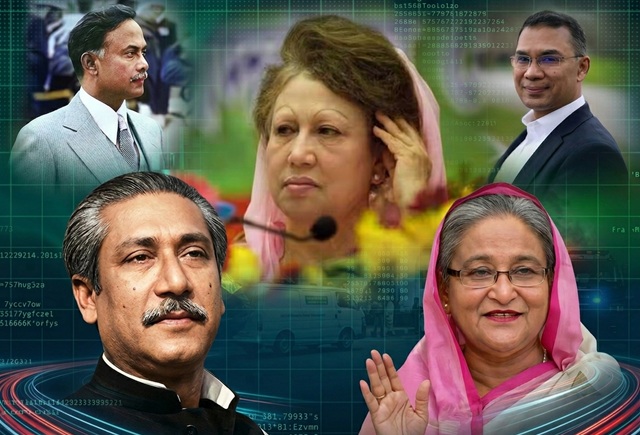
Instead, democracy became hostage to the long, bruising rivalry between Khaleda Zia and Sheikh Hasina. Their duel—personal, ideological, and unrelenting—turned elections into battlegrounds rather than mechanisms of peaceful political competition. The caretaker government system introduced in 1996 offered a temporary buffer, but mistrust ran too deep. From 2001 to 2014, alternating governments weaponised state institutions, hardened partisan lines, and normalised street violence as a political tool.
The abolition of the caretaker system in 2011 marked a decisive rupture. The 2014 election, boycotted by the BNP, saw turnout collapse to 40.04%, exposing a crisis of legitimacy. The 2018 polls, despite an official turnout of 80.20%, were overshadowed by allegations of vote rigging and intimidation. By 2024, turnout had again plunged to 40%, reinforcing the perception that elections had become hollow rituals devoid of real choice. Cynicism among ordinary citizens deepened.
Sheikh Hasina’s dramatic resignation in 2024 amid student‑led protests was hailed by some as a democratic correction and dismissed by others as externally fuelled unrest. The appointment of Nobel laureate Muhammad Yunus as interim Chief Advisor triggered a turbulent interregnum. Statues of Mujib were vandalised, his Dhanmondi house demolished, Awami League offices torched, and decades of political symbolism erased in a frenzy that resembled score‑settling rather than democratic renewal. Civil society leaders who once championed peaceful dissent watched in alarm. “This is not democracy, this is destruction,” lamented one rights activist. Yunus’s subsequent decision to ban the Awami League under anti‑terrorism laws stunned the nation, disenfranchising millions and undermining the principle of inclusive politics.
The February 2026 election—conducted under the interim administration—recorded a turnout of 59.44% and delivered a landslide victory to the BNP. A month has now passed since the new government assumed office, led by Prime Minister Tarique Rahman. His administration faces a defining test: reintegrating the Awami League into the democratic fold, restoring political pluralism, and preventing the country from sliding into a new cycle of exclusion. Meanwhile, Jamaat‑e‑Islami’s re‑emergence as the principal opposition force signals a potential ideological shift away from the secular, pluralist values that anchored the liberation struggle.
Technical reforms such as biometric voter registration improved administrative efficiency but did little to reverse deeper democratic backsliding. For decades, opposition parties were subjected to surveillance, legal harassment, and systematic criminalisation. Elections were compromised through intimidation, partisan policing, and administrative manipulation. Media freedom contracted under pervasive censorship, while civil society organisations faced regulatory constraints that weakened their oversight role. Minority communities remained disproportionately exposed to violence, discrimination, and political exclusion, with minimal representation in party leadership. These patterns steadily narrowed electoral democracy into an elite‑driven contest, increasingly detached from the inclusive principles of popular sovereignty.
Bangladesh’s history repeatedly demonstrates that democracy cannot survive when the ballot is controlled, the opposition delegitimised, and minorities pushed to the margins. The erosion of democratic norms was not sudden but cumulative—an accretion of practices that hollowed out institutions while preserving the façade of electoral politics.
Yet the spirit of liberation endures. Bangladeshis have shown time and again that they will not surrender their democratic aspirations. The challenge now is to transform elections from procedural exercises into genuine expressions of popular will. As one civil society leader reflected, “We are bruised, but not broken. If our voices are silenced, we will shout louder. If our votes are stolen, we will demand them back.” That cry, echoing across generations, is both a reminder and a warning. Bangladesh may be scarred by anarchy and suffocated by autocracy, but it remains, at its core, a country of hope. “Democracy is not dead in Bangladesh—it is waiting to be reborn,” declared an activist. Whether its leaders will honour that hope or betray it once again will determine the nation’s next chapter.