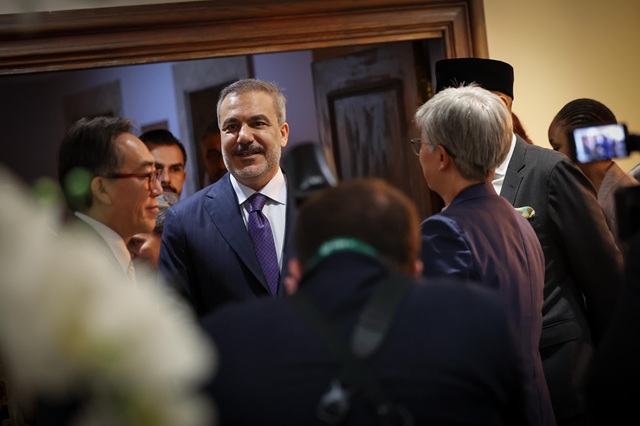
Hakan Fidan, Turkey’s foreign minister and former intelligence chief, is emerging as a key architect of Ankara’s evolving global strategy. In a rare interview, Fidan revealed Turkey’s willingness to participate in a post-NATO European security framework, signaling a shift in Ankara’s diplomatic approach amid growing uncertainty over the alliance’s future.
Fidan, a close confidant of President Recep Tayyip Erdoğan, has been instrumental in shaping Turkey’s foreign and security policies for over a decade. His involvement in Syria’s ongoing transformation, including the ousting of Bashar al-Assad and the rise of Ahmed al-Sharaa, underscores Ankara’s deep-rooted influence in the region. Fidan’s December visit to Damascus marked a stark contrast to his failed 2011 attempt to mediate with Assad. This time, he was warmly welcomed, reflecting Turkey’s dominance in post-Assad Syria.
His tenure as head of Turkey’s intelligence agency (MIT) from 2010 to 2023 saw him navigating complex relationships with Russia, Iran, and NATO allies. Despite Turkey’s friction with the West over its interventions in Syria and Libya, Fidan maintained credibility among Western intelligence circles. However, Ankara’s growing assertiveness—backing Syrian rebel factions and countering Kurdish militants—continues to fuel tensions, particularly with Washington.
In an interview with the Financial Times, Fidan addressed concerns over NATO’s future, stating that Europe must prepare for a security structure independent of the United States. “The genie is out of the bottle,” he remarked, warning that future US administrations might further reduce American commitments to European defense.
Turkey’s role in Syria remains one of Fidan’s primary challenges. While Ankara did not officially back Hayat Tahrir al-Sham (HTS), a former al-Qaeda affiliate, experts suggest Turkish intelligence has long influenced the group’s decisions. Fidan has denied prior knowledge of HTS’s offensive that led to Assad’s fall, though Turkey’s military presence in Idlib remains a key factor in maintaining stability.
Another pressing concern is the fate of the Syrian Democratic Forces (SDF), a Kurdish-led militia that Turkey views as a terrorist organization due to its links to the Kurdistan Workers’ Party (PKK). Fidan has repeatedly called for the SDF’s disbandment, warning of renewed Turkish military action if Kurdish militants remain in northern Syria. Turkey is also proposing a regional coalition to combat ISIS as an alternative to US-led efforts, potentially taking over SDF-controlled camps and prisons.