
by Nil
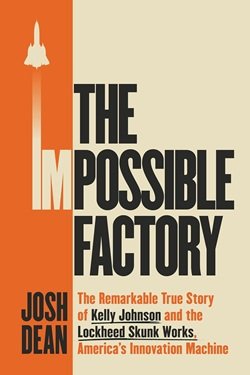
The Impossible Factory constructs a powerful and at times troubling mythology of technological genius centred on Kelly Johnson and the Skunk Works enterprise. Rather than a conventional biography, the book operates as a sustained argument about how innovation is produced, insisting that breakthrough engineering depends less on institutional procedure than on radical autonomy, secrecy, and decisively hierarchical leadership. It is, in effect, a polemic against bureaucratic modernity disguised as organisational history. Yet what gives the text its intellectual force also produces its central tension: a near-total romanticisation of exceptional individuals and a corresponding distrust of collective systems that, for all their inefficiencies, exist precisely to regulate risk, distribute accountability, and moderate the excesses of unchecked authority.
From the outset, the book frames bureaucracy not as a neutral administrative form but as a structural impediment to invention. Johnson’s famous indictment of committee-driven design captures this worldview with blunt clarity: “We’re into an era where a committee designs the airplane. You never do anything totally stupid, you never do anything totally bright. You get an average wrong answer. And very expensive.” The epistemological claim here is striking: collective intelligence is not merely inefficient but actively distorting, producing mediocrity as a systemic outcome. Innovation, by contrast, is imagined as a deviation from consensus rather than its refinement. Yet this dichotomy is never fully justified. The possibility that bureaucratic systems might encode safety, ethical restraint, or long-term stability is largely absent from the narrative’s evaluative framework.
Secrecy plays a similarly foundational role in the book’s ideological architecture. Johnson’s assertion that “If I can talk about it, it’s obsolete” elevates concealment into a principle of technological survival, positioning knowledge as something that loses value once circulated. The logic is competitive and geopolitical: superiority depends upon informational asymmetry. This is reinforced by his counterintuitive claim that “If you stamp secret on something, you’re just asking for someone to try to read it,” which reframes secrecy as both protective mechanism and provocation. Yet the ethical implications of this model are only partially examined. What is left underexplored is how secrecy, while enabling rapid prototyping and strategic advantage, simultaneously weakens democratic oversight and normalises institutional opacity in publicly funded projects.
The book’s treatment of technological history is most provocative when it confronts uncomfortable continuities in engineering knowledge across ideological divides. The admission that “The Germans had a more efficient power plant, with an axial flow jet engine instead of a centrifugal compressor” disrupts any simplistic moralisation of wartime innovation. Similarly, reflections on strategic error in Nazi aviation policy—“If Hitler hadn’t been so stupid to say they must be bombers, they could have taken our B-17s and B-24s out of the sky”—foreground technical contingency over moral clarity. While these observations are historically defensible, their accumulation risks producing a form of technological relativism in which engineering excellence is analytically separated from the political regimes that enable it.
Nowhere is the book’s tension between admiration and unease more visible than in its portrayal of Skunk Works organisational culture. The celebrated ethos of extreme pressure and relentless performance is captured in the remark, “If you didn’t get fired at least once a day you weren’t working.” This is not presented as dysfunction but as productive intensity, a necessary condition for extraordinary output. Yet such a framing raises immediate questions about labour ethics, psychological strain, and the normalisation of adversarial management as a precondition for creativity. The narrative largely accepts this culture as given, offering limited interrogation of its human cost or its transferability beyond the exceptional conditions of Cold War military production.
Technological achievement itself is rendered in almost aesthetic terms. The SR-71 Blackbird, in particular, is described as “a piece of artwork,” a phrase that shifts the aircraft from the domain of military hardware into that of aesthetic object. This aestheticisation is reinforced by descriptions of extreme engineering constraints and material instability, including the visceral complaint: “This goddamn titanium is causing premature aging. I’m not talking about on parts. I’m talking about on me.” Here, innovation is not simply intellectual labour but embodied suffering, a fusion of human endurance and material resistance. Yet the celebration of this struggle risks obscuring the asymmetry between heroic narrative and the structural systems that demand such sacrifice.
The book is at its most self-reflexive when it acknowledges uncertainty and error. Johnson’s warning that “Don’t try to predict anything in this silly business beyond five years in the future because you invariably will be totally wrong” introduces a rare epistemic humility that sits uneasily alongside the text’s broader confidence in decisive leadership. Similarly, admissions of failure—“The XFV-1 was the only airplane we ever built which we were afraid to fly ourselves”—temporarily destabilise the myth of infallibility. These moments suggest that innovation is not a linear expression of genius but a negotiated process of risk, correction, and survivable failure.
Yet the dominant narrative remains committed to the figure of the singular visionary. The Skunk Works model is repeatedly grounded in the necessity of concentrated authority, a model implicitly validated by retrospective success. This is perhaps most clearly articulated in the afterword’s suggestion that effective innovation requires “a single person clearly and commandingly in charge. Someone smart, broadly capable… and fearless.” The implication is that complexity demands not distributed cognition but intensified hierarchy. What remains insufficiently examined is whether such a model is sustainable—or even desirable—in contexts where technological systems are no longer bounded, experimental prototypes but deeply integrated infrastructures with wide social consequences.
The book’s political valence becomes especially pronounced in its depiction of the Pentagon and defence bureaucracy. References to “McNamara’s crew of eggheads” crystallise a broader antagonism between engineering culture and administrative oversight. Bureaucracy is repeatedly cast as alien to the logic of invention, a parasitic layer that obscures rather than enables technical progress. Yet this framing risks flattening the distinction between inefficient oversight and necessary regulation. The claim that excessive reporting structures can inflate costs to absurd levels is persuasive, but the conclusion that such structures are inherently destructive is less convincingly argued.
At the same time, the narrative is strengthened by its willingness to confront contradiction within Johnson’s own worldview. His surprising prioritisation of agricultural engineering—“The crop duster is the plane of the future”—undercuts the otherwise militarised orientation of the Skunk Works mythology. Similarly, his acknowledgement of the unpredictability of technological futures destabilises any attempt to read his legacy as purely deterministic. Innovation, in this light, appears less as mastery of uncertainty than as continuous adaptation within it.
What ultimately emerges from The Impossible Factory is not a coherent philosophy of innovation but a contested field of competing claims: between secrecy and accountability, hierarchy and collaboration, speed and deliberation, genius and infrastructure. The book is most persuasive when it exposes the fragility of its own premises. Even its most iconic assertions are marked by tension, as when technological bravura is repeatedly shadowed by organisational risk and moral ambiguity. The Skunk Works is simultaneously presented as a model of efficiency and an anomaly dependent upon extraordinary conditions unlikely to be replicated elsewhere.
In this sense, the most enduring question raised by the text is not whether bureaucracy inhibits innovation, but whether innovation can ever be meaningfully separated from the bureaucratic, institutional, and geopolitical systems that make it possible. The figure of Kelly Johnson may stand as a symbol of engineering audacity, but the systems that enabled his success complicate any attempt to reduce innovation to individual genius alone. The Impossible Factory thus ends up undermining its own myth: in celebrating the possibility of rule-breaking creativity, it inadvertently reveals how deeply such creativity is entangled with the very structures it claims to transcend.