When the Rafah Crossing between Egypt and Gaza reopened last week after months of closure, it was presented as a cautious humanitarian step under the second phase of a cease-fire framework. But for the small number of Palestinians allowed to pass through, the journey back to Gaza has proven anything but simple. Eyewitness accounts, visual documentation and satellite imagery cited by Haaretz reveal that what should be a brief 15-kilometer trip can stretch into a day-long passage marked by interrogations, multiple authorities, and encounters with armed groups.
According to European monitors stationed at the crossing, only 284 people had been permitted to transit as of Sunday, roughly split between those entering Gaza and those leaving for Egypt. The limited flow underscores the tightly controlled nature of the reopening, which involves at least six different actors: Egyptian authorities, the Palestinian Authority, European Union observers, Israeli forces, the United Nations, and a local militia known as Abu Shabab that operates in coordination with Israel.
For returnees, the process begins far from the border itself. Palestinians are instructed by diplomatic representatives to assemble overnight in the Egyptian coastal city of El-Arish, where buses depart in the early hours toward Rafah. Many travelers describe starting their journey in darkness, uncertain how long it will take or whether they will ultimately be allowed through.
Sabah al-Raqab, a 41-year-old returnee, recounted leaving her lodgings at 2 A.M. to catch a bus an hour later, reaching the Egyptian terminal by morning. There, she said, passengers underwent initial checks and then waited for hours before the Palestinian side opened to process passports. Such delays, travelers say, are routine rather than exceptional.
Once across the Egyptian-controlled area, returnees enter a fenced corridor topped with barbed wire designed to separate incoming and outgoing traffic. The Gaza side of the crossing is formally managed by Palestinian Authority personnel under the supervision of the European Union Border Assistance Mission, known as EUBAM Rafah. Israeli soldiers are not physically present at this stage, but strict screening measures remain in place, including facial recognition checks and tight restrictions on personal belongings.
Travelers are allowed to bring only one bag containing clothes and documents, a single mobile phone, and a limited amount of cash equivalent to about $650. Liquids are prohibited. After this inspection, passengers board buses to continue northward along Salah al-Din Road, the main artery running through southern Gaza.
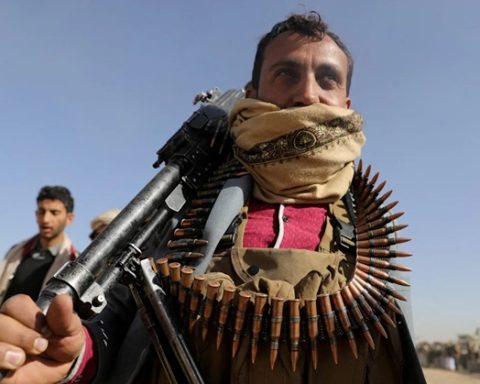
Before reaching Israeli military positions, however, they encounter a controversial layer of authority: the Abu Shabab militia, a Palestinian armed group operating with Israeli backing. Cooperation between Israeli forces and this militia has drawn criticism, including from some within Israel’s own security establishment. A defense source confirmed to Haaretz that members of the militia have been present along the route escorting returnees.
Eyewitness testimonies and video evidence suggest that some returnees were subjected to searches, intimidation, and in certain cases physical restraints by militiamen. The United Nations Office for Human Rights has collected accounts alleging that individuals were handcuffed, blindfolded, or threatened during these encounters, and that personal belongings and money were sometimes taken.
Issan al-Dahini, identified as the militia’s leader, publicly called on returnees to join his ranks in Israeli-controlled areas near Rafah, an appeal that has heightened concerns about coercion and the blurring of civilian and armed authority in the corridor.
After this stage, travelers are transferred to an Israeli military checkpoint at an intersection known to the army as Nekaz Regavim, located near a road constructed during the war. Here, according to numerous testimonies, waits can stretch for hours. Individuals describe being held in fenced compounds under surveillance while undergoing identity verification and questioning.
Ismat Saafi, a 48-year-old woman with chronic health conditions, said she spent three hours in the screening zone, unable to move easily because of high blood pressure and heart problems. She described being separated with family members in an enclosed area surrounded by cameras and razor wire while interrogations took place nearby. Other returnees reported hearing detainees crying during questioning or seeing elderly travelers restrained.
A UN report issued earlier this month documented similar allegations, describing what it called degrading interrogations, invasive searches, and denial of access to medical care or bathroom facilities. Some returnees also claimed they were offered money to abandon plans to reenter Gaza or to provide information to Israeli authorities, assertions that have intensified scrutiny of the process.
Israeli human rights organizations Gisha and Adalah have appealed to senior officials, urging them to halt what they describe as harassment of civilians attempting to return home. In their legal filing, attorneys argued that the procedures appear designed not only for security screening but also to discourage Palestinians from reentering Gaza altogether, potentially violating international legal obligations guaranteeing the right to return to one’s country.
After clearing the Israeli checkpoint, travelers board buses again, this time accompanied by staff from the United Nations Development Program. The convoy crosses the so-called Yellow Line separating Israeli- and Hamas-controlled zones and heads toward Nasser Hospital in Khan Yunis, which functions as the final reception point. There, scenes of emotional reunions are often mixed with appeals from residents urging others not to leave Gaza despite the hardships.
The reopening of Rafah has also highlighted the imbalance between those seeking to return and those desperate to leave. The World Health Organization estimates that around 18,500 people, including thousands of children, are waiting to exit Gaza for medical treatment, yet only a fraction have been allowed through since operations resumed.
For many families, the partial reopening has not resolved displacement but instead created new forms of uncertainty. Some remain divided across borders, with parents separated from children or spouses stranded in different countries. “Thousands are living with the hope of returning,” one resident told Palestinian media, describing families fractured by months of war and restricted movement.
The Israeli military, responding to Haaretz’s inquiries, denied allegations of abuse, stating that security forces conduct identity checks against approved lists and carry out inspections in accordance with established procedures. Officials said baggage policies and security measures had been communicated in advance. The military did not directly address claims regarding the involvement of the Abu Shabab militia.
As the cease-fire framework attempts to stabilize conditions, the Rafah crossing has become a microcosm of Gaza’s broader reality: a landscape shaped by overlapping authorities, deep mistrust, and competing narratives of security and humanitarian need. For the few allowed to traverse it, the journey home is no longer measured in kilometers, but in hours of scrutiny and uncertainty along a road that remains as politically fraught as it is physically short.