Editorial
“Believe me, I will do better. Trust me. I am your new messiah. See no evil, hear no evil, speak no evil.” Sounds familiar? Very Gandhi-esque, isn’t it? History has heard this language before. Political leaders rarely announce themselves as threats to democracy. They arrive as its rescuers. They promise renewal, discipline, honesty, efficiency and a new beginning. They ask citizens to trust them first and question them later. Some of the most damaging political transformations have begun not with an open declaration against democratic institutions, but with reassuring promises to reform, strengthen and modernise them.
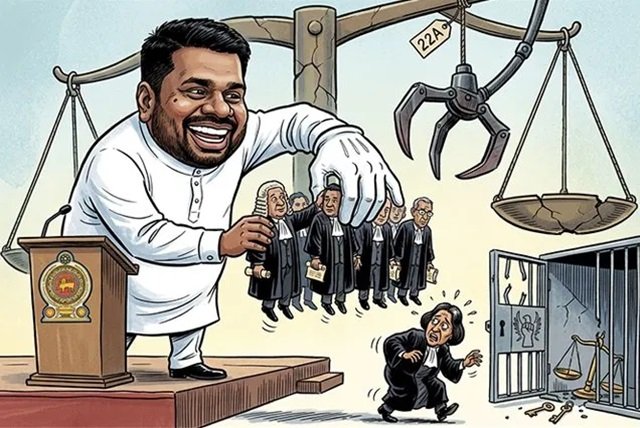
That is why Sri Lanka’s proposed 22nd Amendment deserves far greater scrutiny than a technical argument over whether Supreme Court judges should retire at 65 or 67. The country is struggling with economic hardship, institutional weaknesses, corruption allegations, public-health pressures and growing cybercrime. Against that background, the political priority of changing the retirement rules of the country’s highest judges invites a blunt question. Why now? What problem is this reform actually intended to solve, and who benefits immediately from the change? Is this what the promised “new renaissance” is supposed to look like?
The Government has a legitimate argument. Sri Lanka’s courts face a serious backlog, and retaining experienced judges could contribute to continuity and judicial capacity. There is nothing inherently undemocratic about a retirement age of 67. Several established democracies allow judges to remain in office well beyond that age. The issue, therefore, is not the number itself. It is the constitutional architecture surrounding that number. A retirement rule determines who remains on the highest courts, who leaves them and when the composition of those courts changes. Once such a rule is altered for judges already serving, it becomes more than an administrative question. It becomes a question of institutional power.
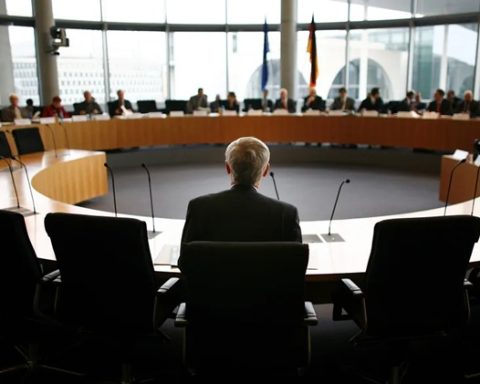
That question becomes particularly serious when the person presiding over the Supreme Court bench examining the constitutional challenges is the Chief Justice who could potentially benefit from the proposed extension. This does not prove bias. It does not prove political interference. It does not prove a conspiracy. But constitutional democracy cannot depend solely on the assumption that every participant is personally beyond reproach. Judicial independence requires structural safeguards as well as personal integrity. It also requires public confidence. When a judge may have a direct institutional or personal interest in legislation being challenged before the court, the public is entitled to ask whether recusal should have been considered and whether the reasons for rejecting it are sufficiently persuasive.
The composition of the bench raises a further question. Reports supplied for this debate allege that several senior Supreme Court judges were not included and that a larger bench had initially been considered. Those allegations require independent verification and should not be presented as established facts. Nevertheless, they raise a legitimate constitutional question. By what objective principles are judges selected to determine a dispute of this importance? The answer should be sufficiently clear to prevent the Government, the legal profession and the public from reasonably suspecting that institutional preferences influenced the selection.
International experience shows why these questions deserve serious attention. Poland’s attempt to alter the retirement age of Supreme Court judges, including judges already serving, became a major judicial-independence dispute. The Court of Justice of the European Union held that the principle of the irremovability of judges is a vital element of judicial independence. Hungary experienced similar controversy when changes to judicial retirement arrangements affected the composition of its judiciary. Argentina’s enlargement of the Supreme Court under Carlos Menem produced what critics described as an “automatic majority” favourable to the Government. Venezuela’s expansion of its Supreme Court later became one of the clearest examples of institutional restructuring weakening a court’s ability to act as an effective check on executive power. Sri Lanka is not Poland, Hungary, Argentina or Venezuela, and 22A is not equivalent to those episodes. Their lesson is more precise. Judicial independence can be weakened through apparently technical institutional changes long before anyone formally abolishes a court.
Sri Lanka has its own historical warning. The removal of Chief Justice Shirani Bandaranayake demonstrated how quickly a dispute involving one senior judge can become a national confrontation over the separation of powers. Those who defended judicial independence then should defend it now, regardless of which political party occupies the Government benches. Judicial independence cannot be a principle invoked only when political opponents are accused of threatening it. It must remain a principle when the Government is popular, when its intentions appear honourable and when its supporters believe that its reforms are necessary.
If 22A is genuinely designed to strengthen justice, the Government should have no difficulty explaining why the existing retirement ages are inadequate, why the reform should apply to sitting judges, whether any sitting judge receives an immediate benefit and what safeguards will prevent a future government from manipulating judicial tenure for its own purposes. These are not hostile questions. They are the minimum questions a constitutional democracy should ask before changing the rules governing its highest courts.
Sri Lanka has spent decades learning that institutions are easier to weaken than to rebuild. Governments are temporary. Presidents leave office. Parliamentary majorities disappear. Constitutional precedents remain. The people who ultimately finance the state through taxation also have a legitimate interest in the integrity of the institutions maintained in their name, including the judiciary and the public officials who serve within it. Judicial independence is not a privilege granted to judges. It is a protection extended to citizens who may one day need a court to stand between them and the power of the state.
The Supreme Court must therefore treat 22A as more than a dispute over retirement ages. It is a test of whether institutional safeguards can withstand political convenience. The Government must demonstrate that its reform strengthens the judiciary rather than merely extending tenure. The Court must demonstrate that its constitutional determination is reached through a process capable of commanding public confidence. Neither side can demand trust as a substitute for safeguards.
Sri Lanka does not need another political messiah promising that everything will be better. It needs institutions strong enough to say no when necessary, including to those who promise to save the country. The real test of 22A is not whether the Government can change the retirement age. It is whether, after changing it, Sri Lanka’s judiciary remains sufficiently independent to tell the Government no.