by Durga
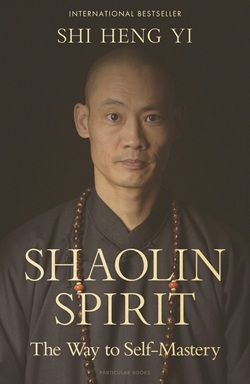
In recent years, the global market for spiritual self-improvement literature has been crowded with books promising resilience, clarity and self-mastery. Into this crowded field enters Shi Heng Yi’s Shaolin Spirit: The Way to Self-Mastery, a text that seeks to fuse Buddhist philosophy, martial arts training and contemporary self-help discourse into a unified path of personal transformation. The book presents itself not merely as a guide to physical practice but as an invitation into an entire worldview, one grounded in the centuries-old traditions of the Shaolin monastery. Yet what emerges from the pages is a curious hybrid: part spiritual manual, part lifestyle manifesto, and part motivational literature. Its ambitions are considerable, and its claims often sweeping, but the work oscillates between genuine philosophical insight and the rhetorical simplicity typical of modern self-development writing.
Shi Heng Yi frames the book as an attempt to open readers to a new perspective on their own lives. Early in the text he declares that his aim is “to give you a perspective on your life that enables you to see yourself as you really are” (p. 15). This formulation is strikingly ambitious, positioning the book as a tool for existential revelation rather than mere practical instruction. Throughout the introduction, the author deploys a series of probing questions directed at the reader—questions about sleep, relationships, employment and fulfilment—before concluding that “most people have lost track of how they’re really doing” (p. 16). Such rhetorical strategies echo the diagnostic style of contemporary self-help literature, where the reader is first persuaded of a hidden deficiency before being guided towards a remedy. Yet Shi Heng Yi frames this crisis not as a psychological or economic problem but as a spiritual one: modern life has severed the connection between body, mind and awareness.
The central philosophical claim of Shaolin Spirit is that authentic self-mastery arises from the integration of physical discipline and mental cultivation. The author repeatedly emphasises that martial practice is inseparable from spiritual development. “Anyone who practises kung fu but ignores… Buddhism will never fulfil their true potential,” he writes, insisting that the martial tradition is fundamentally rooted in Buddhist thought (p. 137). The ideal practitioner must therefore combine physical prowess with moral character, aspiring to the paradoxical image of “fighting like a demon but with the heart of a Buddha” (p. 138). This formulation captures the book’s most compelling idea: that the cultivation of power must be balanced by ethical restraint. At its best, the text reads as a defence of martial arts as a form of moral education, where discipline and humility temper the pursuit of strength.
Yet the philosophical architecture underpinning this argument often remains surprisingly thin. The author frequently gestures towards foundational Buddhist concepts—the Four Noble Truths, the Eightfold Path, the cultivation of awareness—but rarely subjects them to sustained interpretation. Instead, these teachings function largely as legitimising references, anchoring the Shaolin system in a venerable spiritual lineage. The reader is told that the monastery’s original mission involved “the translation, preservation and communication of Buddhist knowledge” (p. 210), but the intellectual substance of that knowledge is only lightly explored. As a result, the book sometimes reads less like a meditation on Buddhist philosophy than a motivational reinterpretation of it.
This tension becomes particularly visible in the text’s treatment of discipline and self-control. The Shaolin path, Shi Heng Yi insists, requires rigorous commitment: students at the temple train “six to eight hours’ training per day” (p. 62). Yet for the ordinary reader, the practice is scaled down to brief exercises and daily routines. The author emphasises perseverance as the cornerstone of development, declaring that “members of the Shaolin temple never stop working on themselves” (p. 63). Such statements highlight the moral seriousness of the Shaolin tradition, but they also risk drifting into the familiar language of productivity culture, where constant self-improvement becomes an unquestioned ideal. The book occasionally hints at this paradox without confronting it directly: the path to liberation from ego and desire appears strikingly similar to the relentless optimisation demanded by modern capitalist life.
One of the book’s more interesting conceptual claims concerns the relationship between freedom and discipline. In a passage that sharply reverses conventional assumptions, Shi Heng Yi asks the reader whether freedom means “following your impulses or mastering your impulses” (p. 154). His answer is unequivocal: “Only once you have disciplined your mind does true freedom begin” (p. 154). This argument echoes classical Stoic and Buddhist ideas about self-control, suggesting that liberation emerges not from unlimited choice but from the capacity to regulate desire. The insight is philosophically persuasive, yet the text tends to present it as an obvious truth rather than a contested proposition. Readers are invited to accept the premise without fully exploring its ethical implications.
The book’s narrative strategy further complicates its intellectual ambitions. Much of the text alternates between autobiographical reflection, philosophical commentary and detailed descriptions of training exercises. Shi Heng Yi recounts his own path into the Shaolin tradition, recalling how encounters with masters and teachers shaped his outlook. These personal episodes lend the book a certain authenticity, but they also reinforce a hierarchical structure in which knowledge flows from master to student. Indeed, the author openly celebrates the authority of the teacher, observing that disciples “trust their master” and accept instruction even when its purpose is not immediately clear (p. 95). In an era suspicious of unquestioned authority, this emphasis on obedience and faith may strike some readers as unsettling.
Perhaps the most provocative element of Shaolin Spirit lies in its implicit critique of modernity. The text repeatedly contrasts the restless consumerism of contemporary life with the structured discipline of the Shaolin community. Modern individuals, the author suggests, are trapped by a “monkey mind” that jumps from impulse to impulse, ordering goods online, satisfying desires instantly and rarely cultivating restraint (p. 83). The Shaolin path, by contrast, imposes boundaries and routines designed to counteract this mental fragmentation. While this critique resonates with broader cultural anxieties about digital distraction and instant gratification, the book sometimes simplifies the problem by presenting ancient discipline as a universal remedy.
Yet to dismiss the work as merely another self-help manual would be unfair. At moments, the author articulates a genuinely subtle philosophy of embodiment. He argues that modern people have “barely developed the relationship between mind and body” and must therefore learn to cultivate it systematically (p. 168). Martial training becomes a laboratory for exploring perception itself. Through repeated practice, the practitioner learns to sense the body more precisely, to regulate breath and awareness, and ultimately to experience the unity of physical and mental processes. Such passages offer a compelling corrective to the abstract intellectualism that often dominates philosophical discourse.
Still, the book’s ultimate promise—that disciplined training can reveal an authentic self—remains open to debate. The author repeatedly insists that the Shaolin spirit leads individuals closer to their “authentic self” (p. 12), yet this notion of authenticity is never clearly defined. Is the authentic self a pre-existing essence waiting to be uncovered, or is it something gradually constructed through practice? The text seems to oscillate between both interpretations, leaving the concept intriguingly unresolved.
In the end, Shaolin Spirit occupies an ambiguous position between spiritual treatise and motivational guide. Its rhetoric of perseverance, humility and discipline draws heavily on the moral vocabulary of Buddhist and martial traditions, yet it is packaged in a form designed for the contemporary self-development market. This hybridity is both the book’s strength and its weakness. On the one hand, it introduces readers to valuable philosophical ideas about awareness, discipline and embodied practice. On the other, it risks reducing those ideas to inspirational slogans.
What makes the book ultimately compelling is not its originality—many of its themes echo ancient teachings—but the intensity with which it presents them. Shi Heng Yi repeatedly reminds readers that mastery cannot be granted by any teacher or book. “The master shows you the path, but you have to walk it yourself” (p. 247). The statement captures the paradox at the heart of the text: a manual that insists the true journey cannot be transmitted through manuals. Whether readers accept the Shaolin path or remain sceptical of its promises, Shaolin Spirit succeeds in provoking reflection on a question that modern culture often avoids: what, exactly, does it mean to master oneself?