The economies of the Persian Gulf are facing an unprecedented shock as the prolonged disruption of the Strait of Hormuz pushes some of the world’s largest oil-exporting nations toward financial crisis. Countries that built their wealth and state stability on uninterrupted fossil fuel exports are now confronting collapsing revenues, shrinking reserves, and mounting pressure to secure emergency alternatives for moving crude and gas out of the region. According to reporting by El País, the combination of military escalation and maritime restrictions linked to the conflict involving Iran, Israel, and the United States has created the most severe economic emergency the Gulf has experienced in decades.
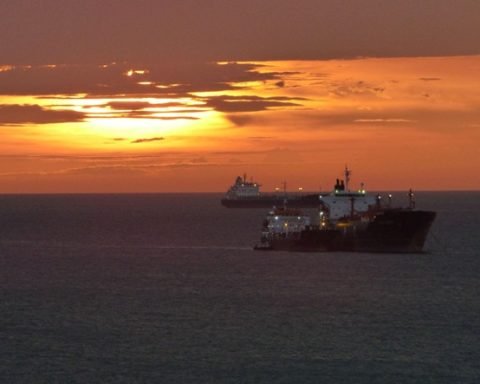
The Strait of Hormuz, through which a significant share of the world’s oil supply normally passes, has become both a military flashpoint and an economic choke point. The near paralysis of exports has reduced shipments from several Gulf states to levels not seen in many years, forcing governments to seek emergency logistical solutions while simultaneously relying on financial and diplomatic support from the same United States whose involvement in the regional conflict has intensified instability.
Iran, already burdened by sanctions and wartime destruction, has been among the hardest hit. Beyond the collapse in maritime exports, Tehran faces soaring military expenditures and reconstruction costs from sustained bombing campaigns. In response, Iranian authorities have turned to a rail corridor opened in 2025 that allows some crude shipments to reach China overland. The route, first highlighted by The Wall Street Journal, reportedly shortens delivery times compared with maritime transport through Hormuz. Yet the railway’s capacity remains far too limited to compensate for the scale of Iran’s lost seaborne exports, allowing only a fraction of normal production to reach foreign buyers.
Saudi Arabia, the region’s largest oil producer, possesses more substantial alternatives but still faces major limitations. The kingdom relies heavily on the East-West Pipeline, also known as Petroline, which was originally constructed during the Iran-Iraq War of the 1980s to bypass Gulf vulnerabilities. The pipeline transports crude from the eastern oil hub of Abqaiq to the Red Sea port of Yanbu, theoretically allowing exports to continue without crossing Hormuz. Although the pipeline’s capacity was expanded to seven million barrels per day in 2019, current flows remain significantly below Saudi Arabia’s prewar production levels, which exceeded ten million barrels daily.
Even this alternative route carries growing risks. Saudi Arabia’s attempt to redirect more exports toward the Red Sea potentially exposes shipments to another geopolitical bottleneck: the Bab el-Mandeb Strait near Yemen. Houthi forces allied with Iran have repeatedly threatened maritime traffic in the area, creating fears that exporters could simply exchange one vulnerable route for another. Analysts warn that Gulf energy infrastructure is increasingly trapped between overlapping zones of instability.
The United Arab Emirates has also attempted to adapt by rerouting products overland to ports on the Gulf of Oman, beyond Hormuz’s immediate reach. Fertilizers and kerosene, both increasingly scarce in global markets, are now being transported by road in an effort to maintain exports to Asia and Europe. Iraq has similarly begun moving some oil by truck into Syria, though experts describe these efforts as emergency stopgaps rather than sustainable solutions.
The Emirates do possess an important strategic asset: a pipeline terminating at the port of Fujairah on the Gulf of Oman. However, the infrastructure itself has come under repeated attack during the conflict, highlighting the fragility of even supposedly secure alternatives. Iranian military statements have further increased anxiety by publicly identifying Fujairah as part of a strategic zone under Iranian influence near Hormuz.
Energy specialists argue that these workarounds cannot realistically replace maritime shipping capacity. Gonzalo Escribano, director of the Energy and Climate Program at the Elcano Royal Institute, described current strategies as little more than temporary patches. Rail and truck transport, he noted, were never designed to handle the enormous volumes associated with crude oil exports and are substantially more expensive than pipelines or tankers. Similar concerns have been echoed by Gulf energy analysts, who warn that the economics of these alternatives make them unsustainable over long periods.
Among Gulf states, Bahrain and Kuwait appear particularly vulnerable. Neither country possesses pipelines capable of bypassing Hormuz, leaving them almost entirely dependent on maritime routes now severely disrupted. Kuwait’s oil exports reportedly fell close to zero during April, devastating a national economy overwhelmingly dependent on hydrocarbon revenue. Bahrain faces additional complications due to its already elevated public debt, limiting its ability to finance large-scale infrastructure projects or absorb prolonged revenue losses.
Iraq occupies a more complex position. Although significantly poorer than several neighboring Gulf monarchies, it does possess limited overland export capacity through an existing pipeline system. Yet this infrastructure handles only a small fraction of Iraq’s normal output. Before the closure of Hormuz, Iraq exported more than 3.5 million barrels per day, primarily through southern terminals near Basra. Without access to those routes and lacking adequate storage capacity, the country has been forced to slash production dramatically, reducing output to levels its domestic refineries can absorb internally.
The consequences for Baghdad are particularly severe because approximately 90 percent of Iraq’s national budget depends directly on oil revenues. In response, Iraqi authorities have announced plans to construct a new pipeline linking Basra with Haditha, eventually connecting exports toward Syria and Turkey. The project, estimated at $1.5 billion, could eventually transport up to 2.5 million barrels per day. But with completion expected to take at least two years, it offers no immediate relief from the current crisis.
Efforts to revive older infrastructure have also encountered major obstacles. Plans to restore a dormant pipeline connecting Kirkuk in Iraq to Baniyas in Syria remain technically and financially daunting after decades of war and neglect. Large sections of the system have been inactive since the 2003 US invasion of Iraq, and many pumping stations were destroyed during subsequent conflicts across both countries.
Despite these immense challenges, some producers have benefited partially from soaring oil prices. With crude now trading above $100 per barrel, countries still able to export even limited quantities are offsetting part of their losses through higher revenues per shipment. Saudi Arabia, in particular, may weather the crisis better than smaller Gulf economies because of its remaining export flexibility and financial reserves.
Still, the broader outlook for the region remains deeply uncertain. El País reports that governments across the Gulf are now urgently reconsidering long-term infrastructure strategy, including expanding pipelines, increasing Red Sea operations, and accelerating railway connectivity projects once planned for the next decade. Yet even if those projects proceed, they underscore a larger reality: the Gulf’s economic model remains dangerously dependent on narrow maritime corridors vulnerable to geopolitical conflict.
The blockade of Hormuz has therefore become more than a temporary disruption. It has exposed the structural fragility of energy systems that underpin not only Gulf prosperity but also global economic stability. As the crisis deepens, the world’s energy heartland is discovering how quickly strategic geography can become an existential liability.