


by A Special Defence Correspondent
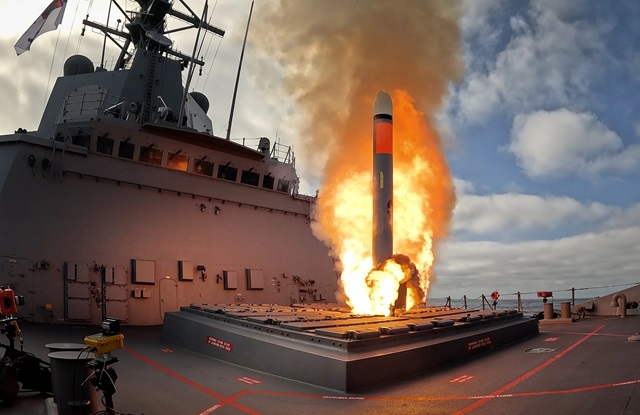
The debate over supplying Ukraine with Tomahawk cruise missiles is not simply about weapons; it is about strategic leverage, deterrence, and the limits of Western resolve. Ukrainian President Volodymyr Zelensky reportedly raised the request during a recent meeting with President Trump. The missiles, with ranges up to 2,500 kilometers and warheads approaching half a ton, would allow Ukraine to strike deep into Russian territory—airfields, depots, and command centers—far beyond the reach of its current arsenal of drones and shorter-range missiles.
Retired Australian Army Major General Mick Ryan frames this request as a move toward parity rather than escalation. Russia has deployed long-range missiles like the 3M14 Kalibr, Kh-555, and Kh-101 throughout the conflict. Tomahawks would give Ukraine a credible ability to retaliate in kind and disrupt Russian logistics and industrial capacity. This is not an abstract “escalation”; it is a question of operational symmetry in a conflict dominated by precision strikes and attritional warfare.
The operational environment reinforces the argument for long-range strike. Russia continues to rely on massed aerial attacks and conventional ground offensives that are costly and slow. Its strikes against Ukrainian cities and infrastructure show tactical reach but lack strategic effect. Ukrainian forces, meanwhile, have developed an effective counterstrike ecosystem: drones, anti-drone systems, and hybrid munitions impose disproportionate losses on Russian units while limiting collateral damage. Supplying Tomahawks would multiply these effects, allowing Ukraine to shape the battlefield rather than merely respond to Russian moves.
Politically, the question is equally charged. Vice President J.D. Vance emphasized that Trump will make the final decision, while European allies may act as intermediaries in transferring the missiles. This approach signals a shift in burden-sharing, placing responsibility on Europe while maintaining U.S. influence. The decision will reflect not only the commitment to Ukrainian defense but also the credibility of the broader Western alliance in deterring Russian aggression.
Strategically, Tomahawks offer more than tactical utility. They create a dilemma for Moscow: any continued offensive against Ukraine now carries the risk of sustained, precise counterstrikes against critical infrastructure inside Russia. Fuel depots, transportation hubs, and munitions production sites could all be threatened, directly affecting Russia’s ability to sustain operations. Ryan notes that such strikes have already begun shaping Russian calculations, as evidenced by fuel rationing and disruptions to logistics.
Concerns about escalation are real but often overstated. Russia has been conducting long-range strikes from the outset, including hundreds of cruise missile attacks on Ukraine’s cities and infrastructure. Denying Ukraine similar capabilities does not prevent escalation; it preserves asymmetry that favors Russia and prolongs the conflict. True deterrence requires credible threat of consequence, and Tomahawks provide that leverage without introducing new technology into the equation.
The decision also has broader implications. Russia continues to collaborate with China on airborne operations and military technology, while China presses Taiwan through regular incursions and new weapon testing. Ukraine’s ability to extend its operational reach has strategic signaling value: it demonstrates that Western support is not symbolic but tangible, and that attacks on allies carry measurable costs.
In effect, the Tomahawk decision tests the coherence of Western strategy. It asks whether the U.S. and its allies are willing to match Russian capabilities in a conflict of attrition, or whether they will continue providing incremental aid while leaving Ukraine exposed to a technically superior opponent. The calculus is stark: provide long-range strike and shape the conflict on Kyiv’s terms, or limit support and risk ceding strategic initiative.
The war in Ukraine has shown that operational ingenuity, precise strike capability, and strategic planning can offset numerical or technological advantages. Tomahawks would amplify Ukraine’s strengths, creating a force multiplier that changes Russian calculations and enhances deterrence. The choice is not abstract; it defines the boundaries of Western resolve, the credibility of NATO, and the operational autonomy of Ukraine itself.
For policymakers, the message is clear: in modern warfare, restraint is not always prudent, and inaction carries consequences as real as action. Providing Tomahawks does not escalate the conflict—it legitimizes a strategic equilibrium and signals that continued aggression will be met with effective, proportionate, and persistent response.









