Sri Lanka will decide when and how to develop Jaffna International Airport and Kankesanthurai Port even if India provides financial assistance for the projects, Transport Minister Bimal Rathnayake has said in Jaffna, asserting that the government will retain the final say over development decisions.
Mr. Rathnayake, minister of transport and highways and the governing National People’s Power’s chief coordinator for the Northern Province, made the remarks at a recent news conference in Jaffna after being asked why the two projects had not advanced despite Indian funding. His position has drawn criticism from Tamil commentators, who have accused him of obstructing development in the north.
“As a government, we are concerned about development,” Mr. Rathnayake said. “But it is the government that will decide what development should be undertaken and where.”
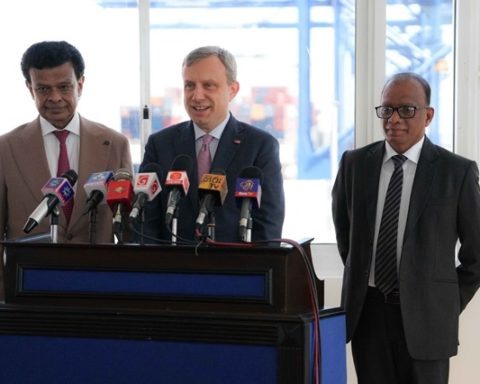
The news conference was held at the National People’s Power office in Jaffna. Ramalingam Chandrasekar, the minister of fisheries, aquatic and ocean resources, and Karunainathan Ilankumaran, a member of Parliament, also attended.
Mr. Rathnayake said India had provided some money for the airport, but not enough to complete the proposed work, meaning Sri Lanka would have to borrow the balance. India, by contrast, has said it will bear the full cost of the proposed development of Kankesanthurai harbour.
He defended the government’s cautious approach by pointing to Mattala Rajapaksa International Airport in southern Sri Lanka as an example of the consequences of major infrastructure projects undertaken without adequate planning. Previous governments, he said, had left the state carrying substantial losses there.
Critics of the comparison argue that Palaly and Kankesanthurai have fundamentally different histories and economic purposes. Mattala was built from scratch at a cost of about $248 million around projected demand that did not materialise. Sri Lanka’s auditor general found that, against an expectation of one million passengers a year, the airport handled only 321,577 passengers over six years and had accumulated net losses of 39.4 billion rupees by the end of 2024.
Palaly, by contrast, is a Second World War-era airfield that has already been developed to serve a regional market. India first helped rehabilitate its infrastructure under an agreement dating to 2005, while scheduled Jaffna-Chennai flights have operated since 2019, apart from a pandemic interruption.
Kankesanthurai likewise has an established history as a commercial port, having operated since 1950. Located 56 nautical miles from India’s coast, it already anchors a functioning passenger link with Nagapattinam. Supporters of its development argue that its geographical position could allow suitable cargo from southern India to reach northern Sri Lanka directly rather than entering through Colombo and travelling hundreds of kilometres north by road along the A9.
The same argument applies to Palaly, where expanded direct connections with Indian cities could allow tourists, business travellers and members of the Sri Lankan Tamil diaspora to reach the north without first travelling through Colombo. Supporters say the two gateways could reduce the north’s economic dependence on Colombo and strengthen Jaffna’s position as a regional destination.
One Jaffna-based economist, speaking anonymously, described the issue in political terms, alleging that direct economic links with India could be viewed negatively by those opposed to greater economic independence for the north. The economist described Mr. Rathnayake as having “a racist mindset” and said a developed Kankesanthurai and Palaly would give the north direct economic links with India instead of requiring economic activity to pass through Colombo.
The financing history of Kankesanthurai has also become central to the debate. India initially agreed to finance the final stages of rehabilitation through a $45.27 million line of credit under an agreement signed in January 2018. After revised estimates pushed the cost beyond that financing and the project stalled, India agreed in 2024 to convert the project into a grant of about $65 million.
According to Indian sources familiar with the project who spoke to Jaffna Monitor, New Delhi remains prepared to accommodate reasonable cost increases arising from delays and revised estimates. Indian officials have presented the assistance as grant-funded support intended to turn Kankesanthurai into a fully functioning commercial port.
Mr. Rathnayake previously oversaw ports and civil aviation before being removed from that portfolio and given other responsibilities. Members of the Janatha Vimukthi Peramuna, the party at the core of the governing coalition, told Jaffna Monitor that the change was linked to what they called his inherently anti-Tamil positions and resistance to the development of Palaly and Kankesanthurai. One party member described his outlook as “inherently anti-Tamil and anti-India”.
Mr. Rathnayake rejected the criticism and gave no timetable for further development of either project.
“Our government will not undertake development that results in such losses,” he said. “Regardless of who provides the funding for development, the final decision will be taken by the government.”
For some in Jaffna, however, that assertion raises a wider question about the government’s relationship with Indian assistance. “If the government is so insistent that it alone decides how development money is spent,” said Vivekanathan, a Jaffna resident, “why does it keep going to India for help whenever it faces financial difficulties?”