


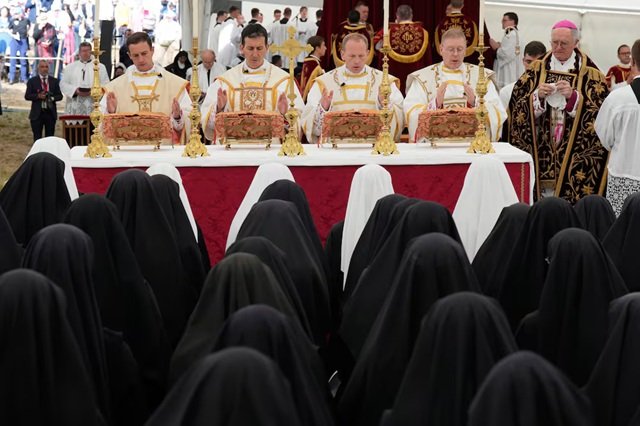
A long-running confrontation between the Vatican and one of the Catholic Church’s most traditionalist movements entered a new phase on Wednesday when the Society of Saint Pius X, commonly known as the Lefebvrists, ordained four bishops without papal approval, triggering automatic excommunication under church law.
The ceremony, held outdoors in Ècône, Switzerland, marked a renewed break between the group and the Roman Catholic Church. According to reporting by El País, the Vatican and Pope had warned the organization the previous day that carrying out the ordinations without authorization would result in a penalty known as latae sententiae, meaning the excommunication takes effect automatically without requiring a separate declaration.
The Holy See was expected to issue a statement explaining the consequences of the action, but the ordinations themselves represented the latest chapter in a conflict that has lasted for decades over authority, tradition and the reforms introduced by the Second Vatican Council.
The Society of Saint Pius X had already been separated from full communion with Rome since 1988, when its founder, French Archbishop Marcel Lefebvre, consecrated four bishops without permission from Pope John Paul II. Those actions resulted in excommunications, including that of Spanish bishop Alfonso de Galarreta, one of the four originally ordained.
In 2009, Pope Benedict XVI lifted the excommunications in an attempt to reopen dialogue with the group. The reconciliation effort did not lead to a lasting agreement, and years later the organization returned to the issue of episcopal succession as only two of the original four bishops remained alive. This time, it was Galarreta who presided over the ceremony that produced four new bishops for the movement.
The Lefebvrists trace their origins to Marcel Lefebvre, who founded the Society of Saint Pius X in 1970 as a response to what he and his supporters considered unacceptable changes within the Catholic Church. Their opposition centered on the reforms and documents of the Second Vatican Council, the major church gathering held between 1962 and 1965 that reshaped Catholic practices and relations with the modern world.
Among the changes most rejected by the movement was the introduction of local languages during Mass instead of Latin and the celebration of the liturgy facing the congregation rather than with the priest facing away from worshippers. The group also opposed other reforms, including increased dialogue with other religions, greater involvement of lay Catholics and changes in the Church’s historical relationship with Judaism.
The movement maintains that subsequent popes have moved away from traditional Catholic teaching. Cardinal Gerhard Müller, former prefect of the Vatican’s Congregation for the Doctrine of the Faith under Benedict XVI, has criticized the group’s approach, saying its members remain focused on their ideology.
Despite remaining outside the mainstream of the Church, the Society of Saint Pius X has maintained an international presence. The organization operates in 70 countries and includes 733 priests, 264 seminarians, 145 brothers and 250 nuns, according to figures cited in the reporting.
In recent years, the group has gained renewed attention as conservative and traditionalist movements within Catholicism have become more active in opposition to certain positions associated with Pope Francis. With the arrival of Pope Leo XIV, the fraternity had hoped for a possible opening, but the latest confrontation showed that disagreements over authority and tradition remain unresolved.
The ordination ceremony began at 9 a.m. at an altar placed beneath a canopy in front of an open field filled with supporters. Organizers estimated that around 15,000 people attended the event, which the group described as a historic day and a celebration.
The four newly ordained bishops were Pascal Schreiber of Switzerland, Michael Goldade of the United States, and Michel Poinsinet de Sivry and Marc Hanappier of France.
Before the ceremony, the superior general of the Society of Saint Pius X, Italian priest Davide Pagliarani, released a letter addressed to Pope Leo XIV in response to the pontiff’s appeal for the group to reconsider its decision. Instead, Pagliarani urged the pope to rethink his own position.
In the letter, he insisted that the fraternity did not wish to separate itself from the Catholic Church but claimed it sought to serve the Church in a special way during what it described as a period of difficulty. He argued that the organization’s situation was similar to that of 1988, when it was declared schismatic, but suggested that continued dialogue between the Vatican and the group demonstrated that relations were not completely broken.
Pagliarani’s defense became more forceful during the ceremony itself. In a statement read before the ordinations, he argued that any punishment or censorship imposed on the action would lack validity. He accused Church authorities since the Second Vatican Council of adopting positions contrary to what the group considers sacred tradition.
The Society of Saint Pius X leader said the group believed it had a duty to proceed with the consecration of bishops committed to what it described as sound tradition and the permanent teaching of the Church. He presented the decision as a sacrifice made in defense of the faith, saying members were prepared to accept being treated as rebels while continuing to claim loyalty to the Church.
The Mass was celebrated in Latin, reflecting one of the movement’s central traditions, while Pagliarani delivered his homily in French. During the address, he continued to defend the legitimacy of the ordinations, describing the action as necessary to preserve what the group views as authentic Catholic teaching.
The Vatican has maintained that bishops cannot be consecrated without papal authorization, a principle at the center of the dispute since 1988. The latest ceremony in Ècône has revived that unresolved conflict, placing the Society of Saint Pius X once again at the center of debate over the boundaries of obedience, tradition and authority within the Catholic Church.









