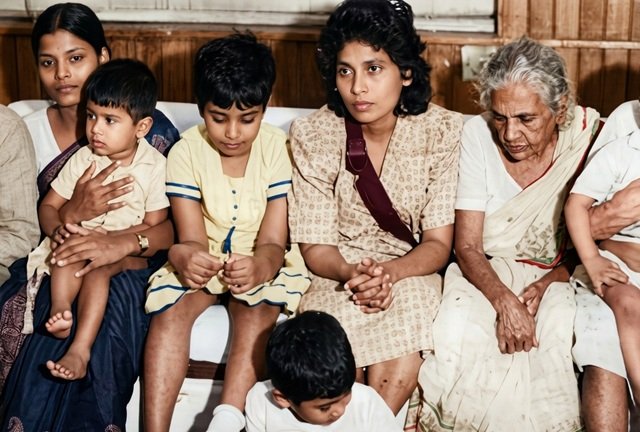
Today marks 55 years since the 1971 People’s Uprising. This year’s April Heroes’ Day falls at a time when the JVP government is engaged in a strenuous effort to fulfill the lofty aspirations of the young people led by Rohana Wijeweera, who were martyred, imprisoned, and subjected to various forms of torture and suffering during the April struggle.
Presented here is a portion of the statement made in court by Kusuma Buddhikorala, a young woman who led the April struggle in the Deniyaya area, when she was brought before the Criminal Justice Commission as the main suspect in the Deniyaya police attack case.
Mr. Chairman and Commissioners, the main charges leveled against us by the government prosecution are conspiracy to criminally intimidate the Government of Sri Lanka under Section 115, and waging war against the Government of Her Majesty Queen Elizabeth II of Great Britain under Section 114. We are not the first, either in this country or in the world, to face such accusations. Similar charges were brought against the heroes Keppetipola, Madugalle, and Ellepola, who led the rebellion against British imperialists in 1818, as well as against Gongalegoda Banda and Puranappu in 1848.
On numerous occasions, the bourgeoisie has leveled such charges against communists around the world. We do not forget that the Persian ruling class brought the same accusations against Karl Marx and his associates during the Cologne Trial of 1852. Just as charges are being brought today against the Janatha Vimukthi Peramuna, they were once brought against the Communist Party. The 1972 Criminal Justice Commission trial in Sri Lanka differs from past anti-communist trials only in the country where it is held, the names of those in the dock, and the names of the judges. In essence, each of these trials has been used by capitalist ruling classes to slander and defame Marxist revolutionaries.
Commissioners, I have now had four months of experience observing how justice is administered here. The experiences of Comrade Rohana Wijeweera and several of our comrades in the main April Struggle case remind me strongly of past anti-communist trials. It is clear to me that the purpose of this trial is to imprison us in order to secure the dominance of the capitalist class in our motherland and to consolidate its economic and political power.
If it is not considered a conspiracy when dominant classes form capitalist political parties such as the United National Party and the Sri Lanka Freedom Party to protect their interests, then how can it be called a conspiracy when the proletariat organizes itself to free itself from oppression? I firmly state that we were working to provide class consciousness to the people through a Marxist-Leninist analysis. Are we conspirators simply because we reveal the truth to the public?
Mr. Chairman, I have no desire to hide the fact that I joined the JVP according to my conscience and acted in accordance with its responsibilities. I am a young woman who, like many others, was oppressed by the policies of previous governments. We come from poor backgrounds. After completing my schooling, I had no means of supporting my parents. The future for young people like us appeared uncertain and unclear.
I had no admiration for the previous UNP government. By the mid-1970s, there was widespread enthusiasm for elections across the country. However, the UNP government of 1965–1970 had significantly increased the cost of living, and the prices of essential goods had risen sharply. Without our knowledge, our country had effectively been mortgaged to the World Bank. At the same time, the previous coalition government, which included leftist parties, had left the people disillusioned. We came to understand that both major political forces represented different faces of the same system.
After sitting for my senior examination, I went to Batayaya to work temporarily as a postal clerk. While studying at the Roman Catholic School in Deniyaya, I became acquainted with a friend named Wimaladasa, who first introduced me to the movement. After attending an initial discussion, I decided to dedicate my life to the liberation of the oppressed. I participated in political classes and gradually understood the ideology of the JVP.
As I became more involved, we began hearing reports that our comrades were being arrested across the country and subjected to torture. Several comrades from our own village were arrested by the Deniyaya police. For safety, active members were relocated to other areas. Newspapers reported that Comrade Wijeweera had been arrested in Hambantota on May 12, 1970.
In the Matara district, a severe crackdown took place in areas such as Waralla, Gandara, Weligama, Mawarala, and Akuressa. Youths were arrested on mere suspicion, beaten, and presented before authorities. Entire villages were raided, and many young people were detained.
During this period, Parliament was dissolved and a general election was announced. We believed that a change in government might ease repression and lead to the release of political prisoners. In the 1970 election, many supported the Samagi Peramuna led by Sirimavo Bandaranaike, which ultimately came to power. However, even before assuming full authority, the new government began arresting our comrades and obstructing our activities.
On July 9, 1970, Comrade Wijeweera was released by the Nuwara Eliya court. Shortly thereafter, he delivered a lecture titled “CIA People” at Vidyodaya University. In that speech, he stated that if the new government genuinely moved toward socialism, it would receive support. He warned, however, that the real threat to the government would come from right-wing forces, not from us.
Despite this, the government labeled the JVP a reactionary organization and called for its suppression. Nevertheless, large numbers of people attended our public meetings, including a major rally held in Matara.
Although I remained an ordinary member in Deniyaya, I continued my work at the post office. One day, I was invited to attend a special discussion for women. During that session, a speaker addressed the sociological role of women and explained how systems of exploitation had historically oppressed them. I came to understand that women had long been reduced to subordinate roles under feudal and capitalist systems. This realization inspired me to take an active role in the struggle for liberation.
As arrests intensified, the situation became increasingly tense. In March 1971, we learned that Comrade Wijeweera had been arrested again. By early April, Deniyaya was in chaos. Curfews were imposed, police patrols increased, and people were driven out of towns. Eventually, supplies ran out, and people struggled even to obtain basic necessities.
By late April, violence escalated dramatically. Helicopters flew overhead, dropping bombs and firing at villages. People fled in panic. Many sought refuge in the Sinharaja forest. My mother, sister, and I were among those who fled. In the confusion, we were separated, and for a time I feared I had lost them forever. Eventually, we reunited deep in the forest.
On June 29, 1971, a day I will never forget, we were in a desperate condition due to hunger and relentless rain. At dawn, the army surrounded us and opened fire. Many were too weak to escape. I witnessed comrades lying wounded and dying before me. Twenty men and eight women were captured, beaten, and dragged to the city before being handed over to the police.
From that point onward, we endured immense suffering in custody. I cannot adequately describe the isolation and despair of being confined alone in a desolate cell, cut off from all human contact. Many women who wished to testify about the injustices they suffered were never given the opportunity. The only evidence presented against me is a statement allegedly obtained under torture, lacking even a signature and filled with falsehoods.
As a Marxist-Leninist revolutionary, I declare before this court that we love our people deeply and remain committed to fulfilling our social and economic responsibilities toward them. Whatever punishment is imposed upon us, I will not regret my actions. I will defend my revolutionary convictions until death.
The voices of those who sacrificed their lives continue to echo: do not turn back, but fight until a better world is achieved. Inspired by their courage, we continue along the path of struggle, a path marked by sacrifice and hope.
You may imprison us while the true conspirators—those who are corrupt, violent, and oppressive—remain free. The capitalists may claim a temporary victory, but the final victory belongs to the oppressed people.
Long live the socialist revolution.