


Ownership of Trincomalee Port was highly contested by the Dutch, French, and British as a gateway to the Bay of Bengal during the 1700s and 1800s. The famous seafarer Vice Admiral Horatio Nelson, as a midshipman (trainee naval officer) on board HMS Seahorse in 1775, wrote in his journal: “Trincomalee is the finest natural harbour in the world.”
What Lord Nelson realized as a midshipman was the immense strategic, natural, and commercial value of the port, considered one of the deepest natural harbours in the world.
Vice Admiral Sir Edward Hughes (British Royal Navy) and Vice Admiral Bailli de Suffren (French Navy) fought sea battles to take control of Trincomalee from 25 August to 3 September 1782.
French forces attempted to capture Trincomalee on 30 August 1782 for supremacy over the eastern coasts of India and Ceylon (Sri Lanka), prompting the Royal Navy to come into action. Although both fleets suffered heavy casualties (British: 51 killed, 283 wounded; French: 82 killed, 255 wounded), no ships were lost.
The British captured Trincomalee on 31 August 1795 from the Dutch after taking over Fort Ostenburg.
It is interesting to note that Admiral Lord Nelson and Trincomalee share a special connection: one of the ships built after Nelson’s death in 1805 was named HMS Trincomalee, constructed in 1812. HMS Trincomalee is still preserved today as part of the National Museum of the Royal Navy in Hartlepool, England.
The US national anthem, “The Star-Spangled Banner,” was written by Francis Scott Key on 14 September 1814 aboard a truce ship at Baltimore Harbor, Maryland, USA. It is pertinent to note that the Sri Lanka Navy’s recent addition, ex-US Coast Guard ship Decisive (P 628), began its 14,775-nautical-mile journey—the longest by a Sri Lanka Navy ship—from Baltimore to Colombo/Trincomalee, as explained in my previous article.
Trincomalee remained under British control for a long period. Their fleet was stationed there, and the British developed Trincomalee into a major ship repair and logistical facility. Large warships such as aircraft carriers, destroyers, and frigates were stationed at Trincomalee.
During the 1930s, the British realized the need for an energy storage facility between the oil fields of Saudi Arabia/the Arabian Gulf and the Far East. They designed and built a massive oil storage facility at Trincomalee. The word “huge” is appropriate: they constructed 100 tanks, each capable of holding 10,000 metric tons of oil. In total, one million metric tons (one billion liters) of storage capacity was commissioned by 1935. According to their estimates at the time, this was sufficient to run their fleet for more than six months. These reserves, in military terms, are known as “strategic oil reserves.” Every country maintains such reserves—except Sri Lanka. Even India stores part of its strategic oil reserves at Trincomalee through the Indian Oil Company.
The construction of these tanks was a major engineering project—an engineering marvel of the 1930s.
Four-inch-thick, high-quality Manchester steel was used to build the tanks, with each plate hand-riveted. They were designed so that if one tank caught fire, it would not spread to others. Pipelines connect all tanks, allowing them to be isolated or interconnected. The tank farm is divided into two sections: the lower tanks (39), located closer to the sea and the oiling jetty, and the upper tanks (61), situated on a hillock. The lower tanks were protected by thick concrete walls to guard against enemy raids. A large pump house with powerful pumps was installed to transfer oil to the upper tanks.
All this was accomplished nearly 100 years ago.
However, as the advance of the Imperial Japanese Army in Asia and German forces in Europe was halted by Allied forces in 1944–45, and World War II ended sooner than expected following the US atomic bombing of Japan, the full capacity of these tanks was never utilized.
Nevertheless, the British understood the importance of Trincomalee Harbour.
After gaining independence in 1948, Sri Lanka signed a defence pact with Britain, allowing them to maintain control of Trincomalee Harbour, the oil tank farm, and China Bay airfield.
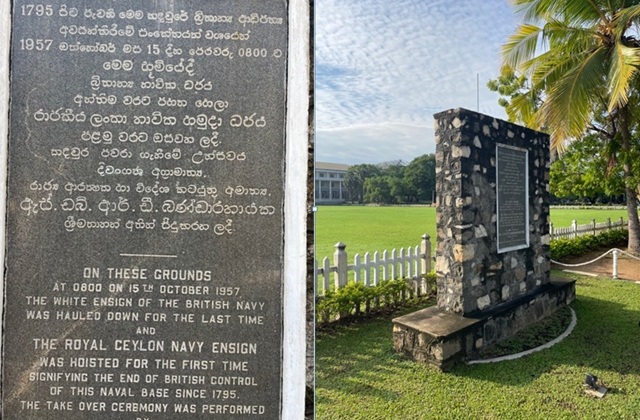
On 15 October 1957, the British handed over Trincomalee Port to Ceylon (Sri Lanka). Prime Minister S. W. R. D. Bandaranaike was the chief guest at the ceremony, and a Royal Ceylon Navy guard of honour, commanded by Lieutenant Basil Gunasekara, proudly presented the salute. After many years, the Royal Navy ensign was lowered at the Trincomalee Naval Base and replaced with the Royal Ceylon Navy flag. A plaque near the base commemorates this historic occasion. The British finally left Sri Lanka after nearly 162 years (1795–1957).
In the 1987 Indo–Sri Lanka Accord, Sri Lanka agreed to jointly develop the Trincomalee oil tank farm with the Indian government. Subsequently, 14 lower tanks were allocated to the Indian Oil Company, while 24 were assigned to the Ceylon Petroleum Corporation (CPC).
In January 2022, the remaining 61 upper tanks were allocated to a CPC–IOC joint venture (51:49 shareholding). The Managing Director of CPC was appointed Chairman, and the CEO of Lanka IOC became the Managing Director. Initially, Rs. 100 million (51 million from CPC and 49 million from IOC) was allocated for renovation and development. A feasibility study was conducted by a renowned international company.
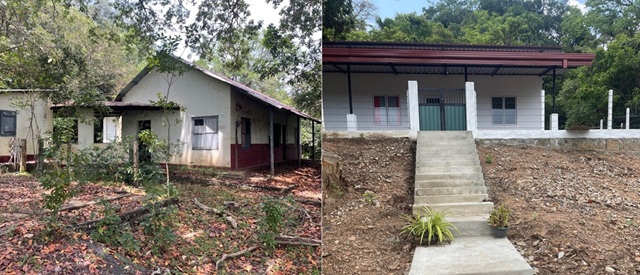
I served voluntarily (without pay or allowances) as Chairman of Trincomalee Petroleum Terminals Ltd (TPTL) for six months in 2023. It was a fascinating experience to work in Trincomalee, where I spent most of my naval career.
This tank farm is a gold mine that our country has neither fully realized nor properly utilized. Current global conditions prove that what the British envisioned nearly 100 years ago remains valid today.
According to my information, Lanka IOC uses all its tanks and even conducts offshore bunkering operations. They have built two additional tanks and now operate 16 fully functional tanks.
In contrast, CPC’s 24 tanks are largely unused, except for three that have been leased to Prima Flour Mills Ltd for freshwater storage.
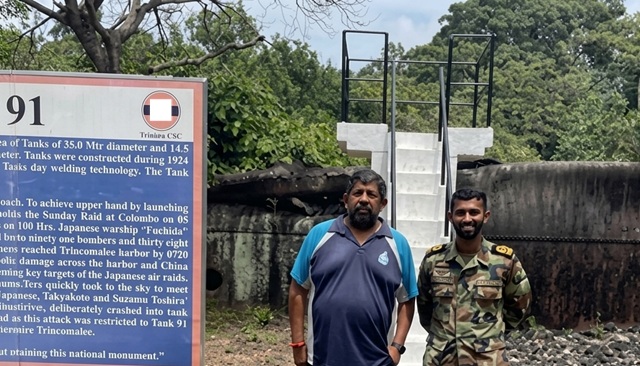
Renovation of the upper tank farm is progressing very slowly. Of the 61 tanks, Tank No. 91 was destroyed during World War II due to Japanese bombing. Interestingly, there is no Tank No. 99 (perhaps the British considered it unlucky); instead, there is a Tank No. 101. Tank No. 102 is partially constructed at the top of the hillock—indicating that there were plans to expand beyond 100 tanks.
The election manifesto of the National People’s Power (NPP), led by President Anura Kumara Dissanayake, clearly states that the Trincomalee oil tank farm will be renovated with the support of a friendly foreign country.
At least now, we must begin without further delay. As a former Chief of Naval Staff of India once told me: “Ravi, you are sitting on a gold mine at Trincomalee without realizing its value.”
How true!











