The report portrays a moment in Washington shaped not only by the approaching 250th anniversary celebrations of the United States but also by a president whose presence has become inseparable from the event itself. Rather than a restrained national commemoration, preparations in the capital are marked by political tension and cultural withdrawals. Several musicians scheduled to perform at major festivities in Washington, D. C. reportedly cancelled their appearances after the events were perceived as increasingly politicized. What was intended as a broadly celebratory national milestone has instead become intertwined with the political identity of the sitting president.
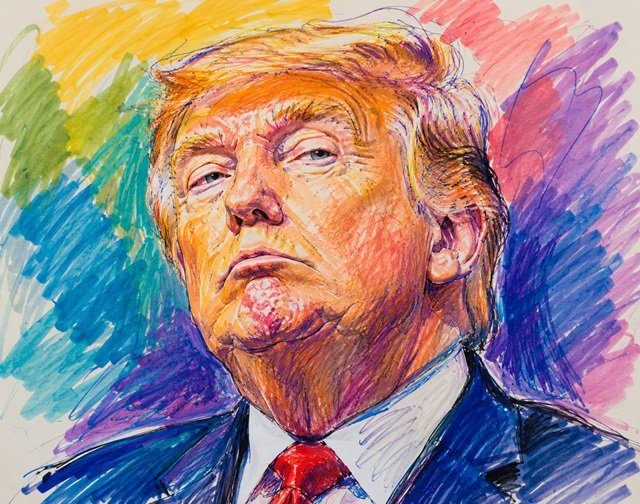
Donald Trump, according to the Die Zeit account, responded to the cancellations on Truth Social by dismissing the departing performers as “drittklassig,” or second-rate, and suggesting that their absence would create space for his own participation. He indicated that he might deliver a major address during the celebrations, reinforcing the sense that the event is evolving into a platform for presidential self-staging rather than a shared national observance.
In parallel, preparations for his 80th birthday are described in strikingly theatrical terms. On the grounds of the White House, a temporary MMA fighting arena has been erected, where bouts involving physical combat between men are scheduled to take place. The imagery, as presented in the report, evokes a spectacle reminiscent of imperial pageantry, with comparisons drawn to Roman emperors presiding over arenas of controlled violence. The staging is presented as part of a broader tendency to convert political space into curated performance.
The Die Zeit report further details how the president’s presence has been extended across the federal landscape. Large banners bearing his image are displayed on government buildings in the capital, including institutions traditionally expected to maintain distance from the executive branch, such as the Department of Justice. Simultaneously, discussions have emerged about altering U.S. currency, with plans to place Trump’s signature on one-hundred-dollar bills instead of the current Treasury signature. Proposals for a 250-dollar bill have also been circulated, despite longstanding legal restrictions against depicting living individuals on currency, prompting legislative efforts among allies to create exceptions.
The symbolic reach extends beyond paper money. The U.S. Mint has begun issuing gold coins featuring Trump’s likeness, while his face is also set to appear on national park passes. Earlier efforts to attach his name to cultural institutions, including the Kennedy Center for the Performing Arts, were halted following judicial intervention. Nonetheless, reports cited by Die Zeit suggest that naming major transport hubs such as Penn Station in New York or Washington’s Dulles Airport after Trump remains under consideration.
At the same time, physical transformations in the capital underscore the scale of proposed changes. The East Wing of the White House was demolished to make room for a large ballroom, while plans are outlined for a 76-meter “Arc de Trump” and a promenade behind the Lincoln Memorial. Even where naming has not yet been finalized, the report notes, the direction of symbolic expansion appears consistent: a capital increasingly reshaped around presidential identity.
This branding extends into commercial and technological spheres. The Die Zeit article describes “Trump Accounts” designed as investment vehicles for children, “TrumpRx,” a platform aimed at helping users access discounted medication, and a “Trump Gold Card” offering a high-cost visa option for wealthy foreign nationals, which was later halted by a court. A branded smartphone, the T1, has also been introduced. Meanwhile, the Trump Organization, led by his sons, has reportedly filed trademark applications for merchandise tied to “Trump 250,” including apparel, bags, bottles, and sports goods.
These developments unfold against a backdrop of political strain. The report notes that Trump’s approval ratings have been weak in recent months, partly in connection with ongoing tensions surrounding the Iran war, rising costs, and public frustration over foreign policy entanglements. Within the Republican Party, concerns have surfaced about how the party will perform in upcoming midterm elections under his leadership, even as the president continues to expand his personal visibility across institutional and cultural domains.
At the core of the Die Zeit analysis lies the framing of Trump’s political identity as one built around continuous self-reference. The phrase “Ich, ich, ich” captures a governing style in which political action and personal brand merge. The report links this to Trump’s long-standing practice of presenting himself as a brand, visible in the prominent “TRUMP” lettering on his properties, and argues that this approach now extends directly into state institutions.
This stands in contrast to foundational ideas in American political thought. The article recalls the intentions of the country’s founders, who explicitly rejected the concept of monarchical rule when establishing the presidency. Historical references to figures such as Ronald Reagan are used to underscore an earlier ideal of the president as a servant of the people rather than its embodiment. Reagan’s 1985 inauguration address is cited as reaffirming the notion that governmental power derives from the governed, not from the leader himself.
The Die Zeit report situates Trump’s approach within a broader interpretive framework discussed by historians and political scientists. Ruth Ben-Ghiat, a historian at New York University, is cited as arguing that personality cults often intensify during periods of political difficulty for leaders. Michael Beschloss, a U.S. historian, is referenced as suggesting that constant visibility can itself be a form of power amplification, reinforcing the perception of authority through omnipresence.
The article also describes how supporters within the administration contribute to this dynamic. Cabinet meetings are frequently broadcast, allowing public audiences to observe extended praise from senior officials. Figures such as Secretary of State Marco Rubio and Defense Secretary Pete Hegseth are noted for their strong public affirmations of the president. Treasury officials have also defended the idea of placing Trump’s signature on currency, describing it as fitting and deserved.
Among the more striking symbols highlighted is a 4.5-meter gold statue of Trump, titled “Don Colossus,” installed at a golf resort in Florida and funded by cryptocurrency investors. The president reportedly contacted supporters following its unveiling, reinforcing the intertwining of personal image, financial backing, and political spectacle. The statue is presented alongside references to earlier ambitions to be memorialized on Mount Rushmore, situating it within a broader continuum of monumental self-representation.
In historical perspective, the article contrasts this development with earlier American presidents whose commemorations were typically established posthumously, such as Abraham Lincoln or John F. Kennedy, and with George Washington, who is portrayed as embodying deliberate restraint and a rejection of monarchical trappings. Washington’s preference for the title “President of the United States,” rather than exalted alternatives debated at the Constitutional Convention, is invoked as a foundational counterpoint to contemporary practices.
As the narrative closes, it emphasizes a presidency increasingly fused with personal symbolism and visibility, where political authority and individual identity are tightly interwoven. Many of the physical and architectural changes described may prove difficult to reverse once completed, while other elements—names on buildings, banners, and commercial branding—could be more easily removed in future political cycles. Even so, the trajectory outlined suggests a lasting shift in how the presidency is visually and symbolically represented, with Donald Trump’s personal image occupying an increasingly central place in the public presentation of American political life as the country moves toward its 250th anniversary.