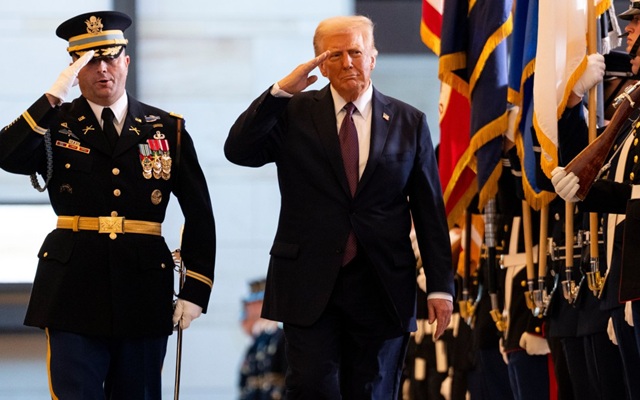
In a sweeping overhaul of U.S. military policies, President Donald Trump signed a series of executive orders on Monday aimed at dismantling diversity, equity, and inclusion (DEI) initiatives within the armed forces. The executive actions mark a significant shift in military priorities, as Trump seeks to reinstate what he described as “traditional military standards” and eliminate what he perceives as divisive and unproductive programs.
One of the most significant changes introduced by the president is an immediate ban on “discriminatory race or sex-based preferences” across all branches of the U.S. military, including the Department of Defense and the Department of Homeland Security. Trump’s executive orders also call for an end to federal DEI programs, which have been designed to increase participation from minority and underrepresented groups in the military and other government workplaces.
Trump has long criticized these initiatives, claiming that they often foster discrimination rather than promoting true inclusion. He referred to DEI programs as “dangerous, demeaning, and immoral,” and argued that they undermine military readiness and effectiveness.
In a related move, the administration recently put all federal DEI staff on leave pending a review and fired the highest-ranking woman in the military over her focus on diversity measures. An email system has also been set up to encourage government employees to report colleagues who promote DEI ideology.
Additionally, Trump’s executive orders address military personnel’s use of pronouns and gender identity, with a directive to ban the use of “invented and identification-based pronouns” in the armed forces. The orders also introduce restrictions on the use of military facilities, stipulating that service members must use gender-segregated sleeping, changing, and bathing areas based on biological sex.
The draft of the order indicates that medical gender transitions may be seen as incompatible with military readiness. It suggests that service members undergoing gender transition may not be physically capable of meeting the military’s stringent standards. Though the specifics remain unclear, the order could effectively prohibit transgender individuals from serving in the military. Previous estimates suggested as many as 15,500 transgender service members could be affected.
In another major move, Trump signed an order reinstating military personnel who had been discharged for refusing the COVID-19 vaccine. Around 8,000 service members were expelled due to vaccine mandates, and only a small fraction of them had been reinstated prior to Trump’s return to the White House. Trump characterized the discharges as “unjust” and vowed to restore those affected.
In his inaugural address, Secretary of Defense Pete Hegseth, a key figure in the administration’s military reform, emphasized that the U.S. military would focus on “lethality, readiness, and war fighting,” with training designed to ensure that troops are prepared to meet national security challenges.
Hegseth, who has taken over leadership at the Pentagon, also voiced support for Trump’s vision, stating that the priority will be ensuring military personnel are physically and mentally equipped to face threats, rather than focusing on identity politics or social policies.
Further bolstering national defense priorities, President Trump signed an executive order to initiate the development of a next-generation missile defense system, drawing inspiration from Israel’s Iron Dome. The U.S. defense system aims to counter ballistic, hypersonic, and cruise missile threats—described by the White House as a “catastrophic threat.”
While the concept of an “Iron Dome” for the U.S. has been met with skepticism from defense experts—who caution about the enormous costs and logistical challenges of such a system—Trump’s order directs the development of an advanced missile defense shield to protect American territory.
As the Trump administration rolls out these controversial policies, it is clear that military and defense strategies will take a sharp turn under the new executive direction. How these orders will impact military recruitment, readiness, and international relations remains to be seen.