President Donald Trump authorized a stealth airstrike against Iran’s nuclear facilities just two days after publicly stating he would decide “within the next two weeks” whether to take military action. According to an extensive Axios report citing multiple senior officials, the statement was a strategic smokescreen meant to obscure a mission already in motion.
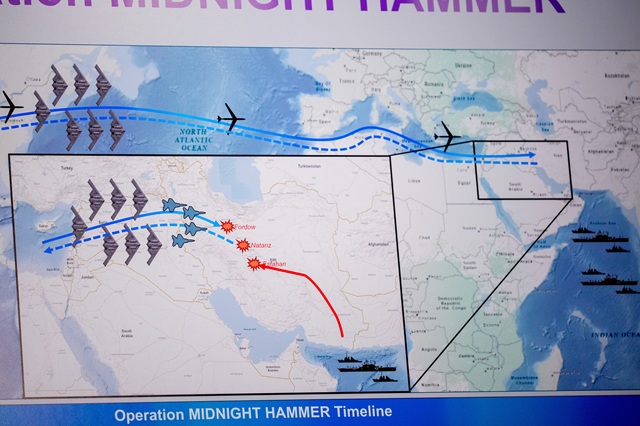
The operation — codenamed Operation Midnight Hammer — was the most significant U.S. strike on Iranian territory since the Islamic Republic’s founding in 1979. It involved a fleet of B-2 stealth bombers that penetrated Iranian airspace undetected and struck key elements of Iran’s nuclear infrastructure.
A Calculated “Headfake”
“It was a headfake,” one Trump adviser told Axios. “He knew the media couldn’t resist amplifying it. He knew the Iranians might think he was bluffing. Well, everyone was wrong.”
Trump’s team described the move as part of a tightly controlled effort to keep Iran, the media, and even much of Washington off-balance. Despite the president’s public musings about diplomacy, the Pentagon was already preparing for what would become the largest B-2 operation in U.S. history.
Senior officials told Axios that Trump wanted to maintain the appearance of being open to negotiations while the military plan advanced. “He knew what he wanted to do. And he knows he can’t look eager for war,” said another adviser. “So all the folks in MAGA urging restraint gave him some space.”
Final Decision Made Behind Closed Doors
Trump gave Defense Secretary Pete Hegseth the final green light late Friday, and within hours, the bombers were in the air. While some aircraft flew westward as decoys, the real strike group headed east toward Iran. On Saturday, as the bombers approached the point of no return, Trump—still at his golf club in Bedminster—authorized full radio silence and boarded Air Force One to return to Washington and monitor the strikes from the Situation Room.
Axios reports that Trump’s comments about waiting “two weeks” were made after the strike decision had already been finalized. “This wasn’t a Pentagon operation. This was a Donald Trump operation,” a senior official emphasized, crediting the former president with micromanaging both the PR rollout and operational details.
Diplomacy Hopes Derailed
In the days leading up to the strike, Trump had hoped to broker a last-minute meeting with Iranian leaders, possibly in Istanbul, coordinated with Turkish President Recep Tayyip Erdoğan. Vice President J.D. Vance and White House envoy Steve Witkoff were preparing to travel, but the plan fell through as Iranian Supreme Leader Ali Khamenei reportedly went into hiding and security risks from Israeli airstrikes made talks impossible.
Once it was clear diplomacy had stalled, Trump moved forward.
Aftermath and Messaging
Shortly after the bombs fell, Witkoff sent a message to Iranian Foreign Minister Abbas Araghchi, clarifying that the strike was limited and not intended as a move toward regime change. The message, Axios reports, underscored the U.S.’s desire for Iran to return to the negotiating table.
Senior Trump officials, including Vance and Hegseth, reinforced this message publicly on Sunday, calling on Iran to resume talks and emphasizing that Washington’s goals remain focused on curbing nuclear threats — not toppling the regime.
Context and Catalyst
Axios notes that the decision to strike came after intelligence shared by the CIA and Israeli counterparts suggested Iran had accelerated aspects of its nuclear program. A critical IAEA report added further urgency, and Israel’s earlier dismantling of Iranian air defenses provided a narrow operational window.
Despite the heavy military response, Trump allies insist the former president remains open to a new deal. “Trump still wants a deal with Iran — and wanted one before the bombers took off,” an adviser told Axios. “Once the B-2s were radio silent, it was too late. But the phones are open now.”