The fragile diplomatic process between the United States and Iran has entered a prolonged period of uncertainty, with negotiations over a permanent peace agreement increasingly overshadowed by disputes over strategic leverage, maritime control and sanctions relief. According to an assessment by The Soufan Center, both governments remain committed to an uneasy truce established through a June memorandum of understanding, but widening differences over the future shape of relations have stalled progress toward a lasting settlement.
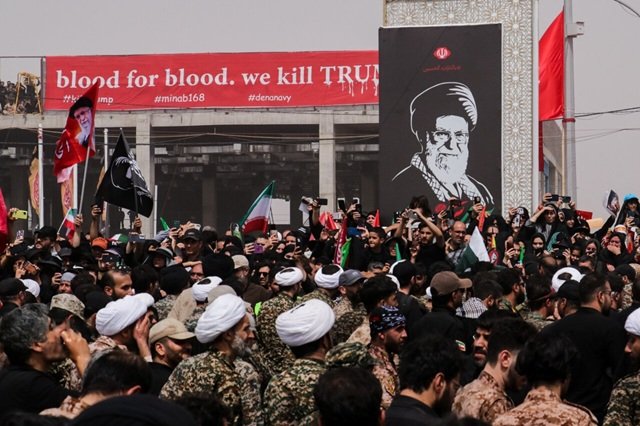
The impasse comes as Iranian leaders preside over week-long funeral ceremonies for Supreme Leader Ayatollah Ali Khamenei, who was killed on the opening day of Operation Epic Fury on February 28. The delayed burial, postponed until active fighting between Iranian, American and Israeli forces had subsided, has become a major political event designed to demonstrate continuity and resilience following months of conflict and domestic unrest.
Large crowds have attended the ceremonies alongside senior officials representing Iran’s political establishment. The public display of unity follows reports that influential commanders within the Islamic Revolutionary Guard Corps and other hardline factions remain opposed to concessions outlined in the June memorandum that brought active hostilities to an end. Despite those reported divisions, government leaders have projected a united front during the commemorations while seeking to reinforce confidence in the country’s leadership during a period of significant transition.
Adding to uncertainty is the continuing absence of Khamenei’s son and designated successor, Mojtaba Khamenei. Since his reported selection as supreme leader on March 8, he has not appeared publicly or delivered any confirmed audio or video messages. Iranian officials have attributed his absence to security concerns, arguing that advanced American and Israeli surveillance capabilities could reveal his location following reports that he was seriously wounded during the strike that killed his father. His continued absence has nevertheless complicated external assessments of decision-making inside Iran’s leadership, while speculation persists among some analysts regarding his condition and influence.
Iranian pragmatic leaders, including President Masoud Pezeshkian and parliament speaker Mohammad Bagher Ghalibaf, who serves as the chief negotiator of the memorandum, maintain that Mojtaba Khamenei has endorsed the agreement despite previously expressing reservations. A message attributed to the new leader in late June stated that he accepted the arrangement after receiving assurances from the Supreme National Security Council that Iran’s national interests and the interests of the “Axis of Resistance” would remain protected.
Those pragmatic officials have argued that reducing American pressure through diplomacy is necessary to ease economic hardship facing the Iranian population, even if doing so requires compromise with U.S. President Donald Trump’s administration. Their position has helped sustain adherence to the memorandum by both governments, suggesting that enough political space remains for negotiations to continue despite mounting obstacles.
The central dispute now revolves around Iran’s control of the Strait of Hormuz, which Tehran views as its most significant strategic achievement emerging from the conflict. According to The Soufan Center, Iranian leaders increasingly regard influence over the vital shipping corridor as a source of leverage that, in practical terms, rivals the strategic value once attached to the country’s nuclear ambitions.
That position has placed Tehran on a collision course with Washington. During indirect negotiations mediated by Doha, discussions focused largely on Iran’s demand for immediate sanctions relief and American recognition of Iran’s influence over traffic through the Strait. Reports indicate negotiators discussed a mechanism allowing the release of $3 billion in Iranian assets held by Qatar’s central bank for humanitarian purchases. However, the Wall Street Journal and other media outlets reported that Washington seeks to make the release contingent upon Iran abandoning efforts to collect tolls or other payments from commercial vessels using the waterway.
American officials have reportedly argued that comprehensive sanctions relief and broader international investment would deliver greater economic benefits than revenue generated through maritime fees. Yet experts cited in The Soufan Center assessment contend that U.S. negotiators may underestimate the strategic and ideological importance Tehran assigns to maintaining control over the Strait, suggesting that those competing priorities have become one of the principal barriers to a comprehensive agreement.
The resulting diplomatic landscape increasingly resembles what the assessment describes as a “no war, no peace” stalemate, with neither side prepared to abandon core objectives while both seek to avoid a return to full-scale conflict. That fragile balance has already been tested. Late June saw a series of tit-for-tat exchanges related to the Strait that nearly unraveled the memorandum, prompting President Trump to publicly warn that military action could resume if Iran refused to alter its position.
Recent developments on the water have further illustrated the dispute. Iran has intensified efforts to steer commercial shipping toward a northern route where the Islamic Revolutionary Guard Corps and the country’s newly established Persian Gulf Strait Authority maintain influence. According to multiple reports, vessels initially intending to use a U.S.-supported corridor closer to Oman’s coastline altered course after maritime radio warnings from the Revolutionary Guard accompanied by increased patrol boat deployments. Reports also indicated that a convoy of Japanese oil tankers later transited the Iran-approved route.
The disagreement has expanded beyond bilateral diplomacy. At the NATO summit in Türkiye, the United States is expected to encourage allied governments to contribute naval forces to help secure shipping through the Strait following the end of active hostilities. Several European countries, including the United Kingdom, Germany, France and Italy, have begun positioning forces for a potential maritime security mission. Tehran has responded by warning against foreign involvement in waters it considers under its control, reflecting growing concern that European participation could strengthen Washington’s negotiating position.
While maritime disputes dominate current discussions, the issue that originally justified the conflict has received comparatively limited attention. Sources familiar with recent negotiations in Doha reported that Iran’s nuclear commitments were scarcely discussed, despite Washington continuing to describe the elimination of Iran’s pathways to a nuclear weapon as the central objective of a permanent peace agreement. Negotiators face the additional challenge of resolving highly technical nuclear issues within a 60-day framework established by the memorandum, with one-third of that period having elapsed by July 8. Although the agreement permits extensions by mutual consent, progress remains limited.
Diplomatic efforts nevertheless continue. Regional media have reported that negotiations are expected to resume on July 11 following Khamenei’s burial in Mashhad. President Trump has also stated that inspectors from the International Atomic Energy Agency would be permitted to return to Iran to locate stockpiles of highly enriched uranium believed to remain beneath facilities damaged during Operation Midnight Hammer. International Atomic Energy Agency Director Rafael Grossi has separately confirmed that inspections are expected to resume, although no timetable has been announced. If those inspections proceed, they could mark the next significant step in a peace process that remains suspended between continued diplomacy and unresolved strategic rivalry.