by Our Correspondent in Colombo
The United Arab Emirates has intensified its presence in Sri Lanka’s north-central region by funding the expansion of housing and community infrastructure that primarily benefits Muslim families.
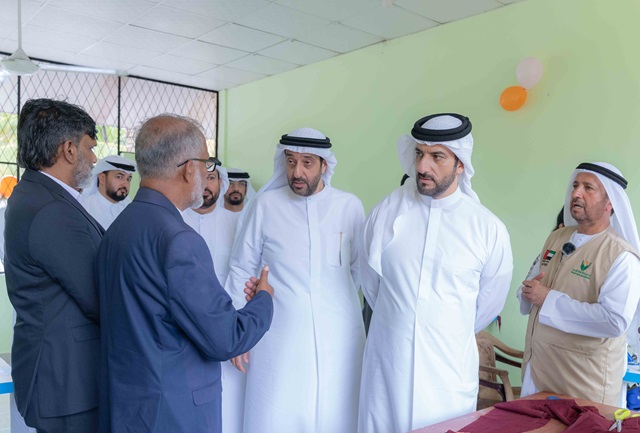
Sheikh Sultan bin Ahmed Al Qasimi, Deputy Ruler of Sharjah and Chairman of the Sharjah Media Council, inaugurated 40 new homes for widows, orphans, and their families in Puttalam during a high-profile visit this week. The housing units, each equipped with two bedrooms, a living room, bathroom, and water tank, form part of a broader settlement project overseen by Sharjah Charity International.
Since 2012, Sharjah-backed initiatives have established six dedicated villages in Sri Lanka, comprising nearly 200 homes, schools, medical centres, Qur’an memorisation centres, and wells. These facilities, while offering relief and opportunities for disadvantaged families, have also contributed to the consolidation of Muslim-majority enclaves in a district already marked by religious diversity.
The newly expanded settlement includes not only housing but also a mosque, classrooms, a medical centre, and vocational training spaces aimed at providing women with skills for self-reliance. Children in the village are given access to structured educational programmes that emphasise both academic and religious instruction.
Sharjah officials describe the initiative as a humanitarian commitment to protect vulnerable groups and uplift women and children. “This reflects Sharjah’s values of solidarity and compassion,” Sheikh Sultan said during the tour.
Yet, the concentrated development of Muslim-majority villages also reflects the UAE’s strategic approach to aid, in ways that carry long-term social implications. In a country celebrated for its pluralist traditions—where Buddhists, Hindus, Muslims, and Christians have coexisted for centuries—programmes that target single communities can reshape demographics, deepen identity-based clustering, and quietly shift the balance of settlement in contested regions.
Local voices in Puttalam acknowledge both sides of the initiative. For struggling families, the assistance is life-changing. But as one community observer noted, “Support of this scale is never neutral—it redraws maps, builds influence, and creates exclusive spaces in a society where inclusion is the goal.”
The UAE has made similar investments across Asia and Africa, combining charitable relief with visible, long-term projects that extend its soft power. In Sri Lanka, the pattern of village-building continues to grow, raising new questions about how humanitarian aid intersects with the island’s pluralist social fabric.