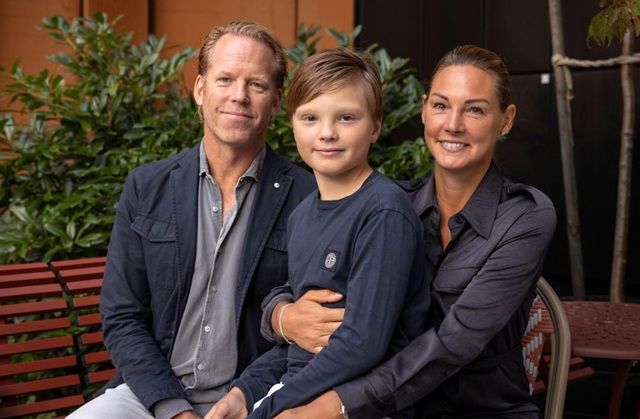
A decade after Vincent Stenberg made medical history in Sweden as the world’s first baby born from a transplanted womb, Britain has now celebrated its own historic moment with the birth of baby Amy Isabel Davidson — a milestone that marks the UK’s entry into one of the most remarkable advances in reproductive medicine.
Vincent, now 10, is hardly distinguishable from any other energetic schoolboy. “He has a lot of energy, he has lots of friends, he is very good at hockey and golf,” his mother, Malin Stenberg, 46, told Times UK. “We do have to be on him with homework. But he is a very sweet and happy boy.”
Yet his birth in September 2014 in Gothenburg was anything but ordinary. Malin, born with the rare MRKH syndrome that meant she had no womb, was the first woman to give birth after receiving a uterus transplant — donated by a family friend, Ewa Rosen, then 61. The successful procedure launched a new era in fertility treatment, paving the way for more than 135 womb transplants globally, resulting in 65 live births across countries such as the United States, China, France, Germany, Brazil, India, and Turkey.
Last week, the UK officially joined this pioneering list with the announcement of Amy Isabel Davidson’s birth at Queen Charlotte’s and Chelsea Hospital in London. Her mother, Grace Davidson, 36, who also has MRKH, carried the child after receiving a womb from her sister, Amy Purdie, 42. The baby was born on February 27, making headlines as Britain’s first successful case of its kind.
Malin, who now runs a finance business in Sweden with her husband Claes Nilsson, 49, shared her joy over the news: “I’m very, very happy for them. We wanted to have kids and were so truly grateful for the opportunity. I wish this family all the luck and happiness.”
The UK’s achievement comes after years of determination and delay. Professor Richard Smith, a consultant gynaecologist at Imperial College NHS Trust, has been pursuing womb transplant research for nearly 30 years. “In some ways we have been way behind the rest of the world,” he told Times UK, “but we were actually there from the very start.” He vividly remembers the moment he learned of Vincent’s birth: “The Swedes have got a baby,” a colleague had said during a phone call in 2014 — a moment that both inspired and reignited UK efforts.
Smith’s team, backed by the charity Womb Transplant UK, has permission for 15 total procedures, including five with living donors and ten with deceased ones. So far, three additional transplants have been funded, and interest has soared — with over 400 women contacting the charity to donate their womb altruistically.
Experts believe the potential impact in Britain is enormous. Around 15,000 women of childbearing age are estimated to be unable to carry a child due to congenital conditions like MRKH or medical complications requiring hysterectomy. Until now, their options have been limited to adoption or surrogacy — pathways fraught with legal and emotional complexities.
Surgeons like Isabel Quiroga-Giraldez, who performed the transplant on Grace Davidson, believe this is only the beginning. “I was humbled that they gave their baby the middle name Isabel,” she said. “But it’s more than that. It’s about changing perceptions. Women’s fertility has not been taken as seriously as men’s for a long time.”
Smith agrees, emphasizing that infertility must be acknowledged as a genuine health issue. “There’s a terrible amount of suffering. [Womb transplantation] is the beginning of something, and this birth is vital proof.”
Womb Transplant UK currently covers the £25,000–£30,000 cost of each procedure, with medical professionals volunteering their time. Smith hopes that after the pilot phase, the NHS will incorporate womb transplants into routine care. “We’re ready,” he said. “It’s been done around the world, and we can do it here.”
Back in Gothenburg, Malin and her family continue to celebrate the miracle that brought them Vincent. “It was a gift,” she said. “We are truly grateful to the doctors. Life is fantastic for us as a family.”