The United States plans to provide $1 billion in security assistance to Colombia’s new government, signalling a major strengthening of ties with President Abelardo De La Espriella as he begins a presidency centred on security, crime and a closer alignment with Washington.
The US State Department said on Friday that the Trump administration, working with Congress, intends to announce the assistance as part of a security package designed to support De La Espriella’s government in pursuing shared goals. The announcement came on the same day that the new president was sworn into office after an election campaign in which he promised a crackdown on crime and an economic revival.
“As a cornerstone of this renewed partnership, the United States, working with Congress, intends to announce $1 billion in assistance as part of a security package to support President De La Espriella’s Administration in achieving our shared goals,” the State Department said.
The announcement marks a sharp change in the political relationship between Washington and Bogotá following the presidency of Gustavo Petro, Colombia’s first leftist president. Petro had repeatedly clashed with US President Donald Trump over foreign policy and other issues, including the war in Gaza and US military operations against boats in Caribbean waters.
Trump had endorsed De La Espriella during the Colombian elections. The State Department said the Trump administration had also welcomed Colombia into the “Shield of the Americas”, a Trump-created military alliance of right-wing leaders committed to fighting drug trafficking.
The closer relationship comes as Trump has sought to increase US influence and presence across Latin America. His administration ordered the seizure of ousted Venezuelan leader Nicolas Maduro in a deadly raid, while US forces have carried out multiple strikes on boats in the Caribbean that have killed dozens. Rights advocates in the United States and elsewhere have described such actions as illegal, imperial and amounting to extrajudicial killings. Trump has presented them as efforts to counter drug trafficking and illegal immigration.
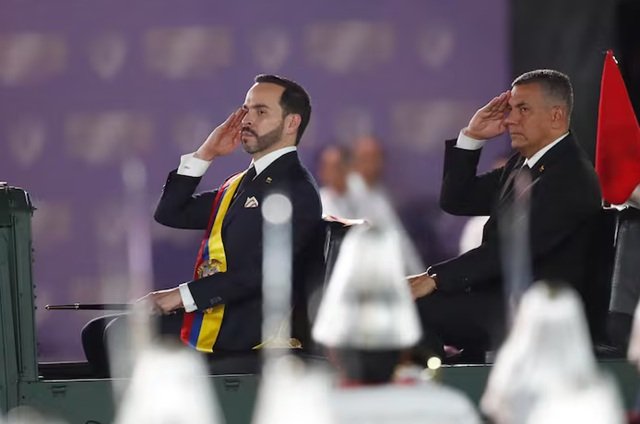
In Colombia, De La Espriella has entered office promising to make the fight against criminal organisations a central priority. His inauguration took place in Cali, rather than Bogotá, in an unprecedented move that made the city the first outside the capital to host a Colombian presidential swearing-in ceremony.
More than 11,000 uniformed personnel were deployed in Cali for the occasion, as the city was decorated with Colombian flags. De La Espriella was sworn in at the auditorium of a university, a venue normally used for concerts and capable of holding more than 2,500 people.
After receiving the presidential sash from Senate President Honorio Henríquez, De La Espriella left the formal ceremony before it had concluded and travelled to the nearby Pichincha military battalion. It was there, in front of dozens of uniformed personnel in ceremonial dress, that he delivered his first major address as president.
He thanked “Nuestro Señor Jesucristo” for sustaining Colombia through a history marked by violence and said he had come to “close a long chapter of national resignation”. Referring to the symbolism of speaking at the military canton, he declared himself president of all Colombians and described his victory as one belonging to “Colombian democracy”, distancing it from “Bolivarian totalitarian models”.
“Ha comenzado el tiempo de la recuperación del orden, la libertad y la autoridad,” he declared, announcing an order to confront all criminal structures. “El Tigre ha llegado y sabrán lo duro que muerde cuando se trata de defender al pueblo colombiano,” he said.
His programme extends beyond security. De La Espriella announced a tax reform, the elimination of the wealth tax, the eradication of coca cultivation and intensified efforts against organised crime. He also promised greater access to the economy and credit for informal workers, stronger energy security and measures to improve conditions for farmers.
He pledged to end the crisis in healthcare and improve education, which he said should never become “an instrument of ideological indoctrination”. His administration is therefore expected to pursue both an aggressive security agenda and a broader political and cultural programme.
De La Espriella’s victory was narrow. He won the presidency by just 250,830 votes, or less than one percentage point, over left-wing candidate Iván Cepeda, the choice of Petro to continue his policies. The result followed a tense election count on June 21, during which Petro questioned the election process in real time.
De La Espriella has presented himself as an outsider despite being a lawyer without an established political career, using a marketing-driven campaign to challenge traditional party machinery. His government, however, has already appointed figures with established political and institutional connections, including an heir to one of Colombia’s oldest conservative dynasties to oversee state finances, a MAGA supporter with two decades at the United Nations as foreign minister, and the president of an association representing outsourced companies to lead the health ministry.
The inauguration also demonstrated the regional political alliances surrounding the new government. Ten heads of state, two vice-presidents and 15 foreign ministers attended, many from governments on the political right that share De La Espriella’s conservative values and opposition to the left.
Among those who met him bilaterally were Argentina’s Javier Milei, Chile’s José Antonio Kast, Ecuador’s Daniel Noboa, a US delegation and Spain’s King Felipe VI. Other prominent figures were absent, including Nayib Bukele, Keiko Fujimori and the left-wing presidents Lula da Silva, Claudia Sheinbaum and Yamandú Orsi.
The US delegation was also notable for its relatively low-ranking composition. Trump, Vice-President JD Vance and Secretary of State Marco Rubio did not travel to Cali. Instead, Washington sent a delegation led by acting Attorney General Todd Blanche, accompanied by Sara Carter, director of the Office of National Drug Control Policy, and Cliff Sims, the vice-president’s national security adviser.
Petro did not attend and continues not to recognise the election result. Members of his Historical Pact also stayed away, instead leading marches in Bogotá, Barranquilla and Cali. Former presidents Juan Manuel Santos and Ernesto Samper were expressly excluded from the invitation list, while Álvaro Uribe ultimately attended.
The choice of Cali was intended to reinforce De La Espriella’s campaign message of governing from Colombia’s regions rather than exclusively from Bogotá. His supporters have also portrayed the country’s southwest as the starting point for a renewed campaign against narcotics trafficking.
The location itself had been contested until the final hours. De La Espriella wanted to take the oath at a military installation to reinforce his message of a hard line alongside the armed forces. Petro opposed the plan and ordered military and police facilities not to prepare for the ceremony, arguing that until the final moment of his presidency he remained commander-in-chief of the armed forces and that a civilian president should be sworn in before the people rather than before weapons.
Against that political backdrop, Washington’s planned $1 billion security package gives De La Espriella’s security agenda an important international dimension. The new partnership places Colombia’s fight against crime and drug trafficking at the centre of closer US engagement with a government that has made order, authority and security defining themes of its first days in office.