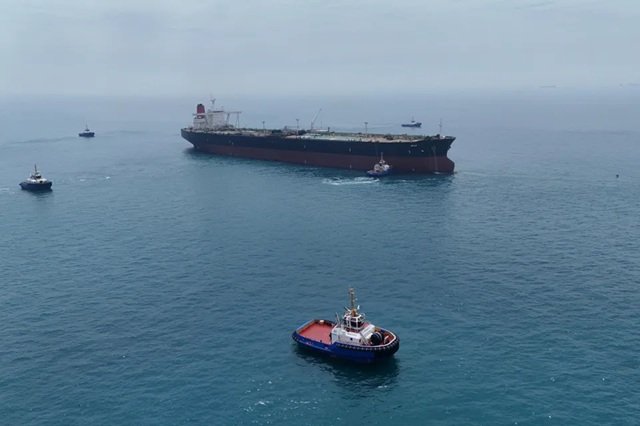
The US military says it has destroyed or disabled three Iranian oil tankers linked to Iran’s Islamic Revolutionary Guard Corps (IRGC), following what it described as missile attacks on two US Navy vessels patrolling international waters.
According to the US Central Command, known as Centcom, the Revolutionary Guards fired missiles at the two American ships. The United States then responded by “completely” destroying an Iranian tanker in the Gulf of Oman and “permanently disabling” two others near the Iranian island of Kharg and near Jask.
Centcom released video footage showing fire and flames over the vessels. It said the three tankers were part of a “multi-billion-dollar shadow network” that finances the IRGC and its regional proxies. No US personnel were injured, according to the command.
Adm. Brad Cooper, the commander of Centcom, issued a direct warning to Iran’s Revolutionary Guards following the strikes. “Let the message to the IRGC be clear: If you shoot at two of our ships, we will impose an even higher economic cost — taking out three of yours,” he said. Cooper added that the United States would not hesitate to defend its forces and, if necessary, destroy Iran’s “limited and exposed oil fleet”.
The reported strikes mark a renewed escalation around the Strait of Hormuz after weeks of a ceasefire. Fighting has now resumed in an area critical to Iran’s oil trade, with the latest US actions targeting vessels that Washington says are connected to a network supporting the IRGC.
Iranian media had earlier reported several explosions near Kharg Island, located about 30 kilometres off the northern coast of the Persian Gulf. The island is home to the oil terminal through which almost all of Iran’s crude oil exports are handled. It has repeatedly been targeted by US attacks during the war, which has been under way since February.
The renewed fighting follows US efforts to increase economic pressure on Iran. Despite sanctions and a blockade of its ports, Tehran has found ways to continue moving oil and reducing the impact of international restrictions.
A central element of that strategy is Iran’s so-called shadow fleet, which transports oil to buyers and helps ease the growing economic pressure on the country.
The latest US strikes therefore carry both military and economic significance. The vessels targeted by the US were described by Centcom as part of a network supporting Iran’s Revolutionary Guards, while the attacks occurred in and around waters central to Iran’s oil exports.
The confrontation also comes after a period of relative calm following a weeks-long ceasefire. The return of fighting around the Strait of Hormuz has once again placed military activity alongside the region’s vital energy infrastructure.
For Washington, the strikes are being presented as a direct response to attacks on US naval forces. For Tehran, the destruction of oil tankers adds further pressure to an economy already facing sanctions, port blockades and efforts to restrict its ability to export crude.
With the United States warning that further attacks could bring additional strikes against Iran’s oil fleet, the latest confrontation signals a renewed and potentially costly phase in the conflict.