


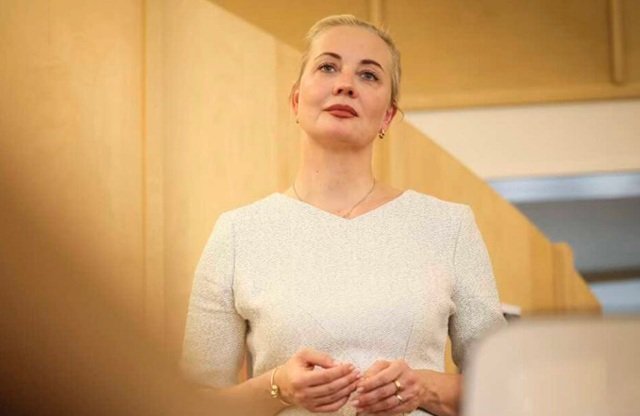
Two years after the death of Russia’s most prominent opposition leader, Yulia Navalnaya says she still hears her husband’s voice. It is not only a memory but a guiding force, shaping her determination to continue a struggle that defined both of their lives. Speaking in an interview with the Times UK, Navalnaya has emerged as a central figure in Russia’s fractured opposition, transforming personal loss into a broader campaign against authoritarian rule.
Yulia Navalnaya describes her late husband, Alexei Navalny, as a man who endured years of relentless pressure from the Russian state. He survived imprisonment, isolation, and even an assassination attempt involving a military-grade nerve agent. Yet the circumstances of his death in an Arctic penal colony have added a new and unsettling dimension to his story. According to findings released earlier this year by several European governments, laboratory analysis identified the presence of epibatidine, a highly toxic compound linked to the venom of a South American dart frog.
Navalnaya has struggled to make sense of the method. She describes it as something that feels more like fiction than modern science, underscoring the opacity she associates with the Kremlin’s actions. In her view, the evidence points clearly to responsibility at the highest level. She has openly stated her belief that Vladimir Putin ordered the killing, and she has expressed a desire to see him face trial. Her words reflect both anger and a long-term conviction that accountability, however distant, is possible.
Since her husband’s death, Navalnaya has stepped into a role she once avoided. From an undisclosed location in Europe, she now leads the Anti-Corruption Foundation, the organization Navalny built into a powerful platform for exposing corruption. The work continues largely in exile, as the movement has been effectively dismantled within Russia. Despite these constraints, she has taken her message to international audiences, lobbying governments to maintain pressure on Moscow while trying to sustain momentum among supporters.
Her personal life remains closely intertwined with her public mission. She speaks with pride about her two children, who have grown up under extraordinary circumstances. Balancing family life with political activism has not been easy, particularly in the aftermath of such a high-profile loss, but she portrays resilience as essential. The family’s experience mirrors the broader reality faced by many Russians who oppose the government but must navigate fear and uncertainty.
In recent months, Navalnaya has opened a new front in her campaign: publishing. She has launched One Book Publishing, an imprint designed to bring critical ideas back into the Russian-language space. Among its first releases is her husband’s memoir, Patriot, published posthumously. The initiative also includes works by international authors that examine authoritarianism and its mechanisms, offering readers intellectual tools to understand and challenge the systems that govern them.
For Navalnaya, the project is about more than literature. It is an effort to preserve access to ideas in an environment where censorship has become increasingly pervasive. By operating خارج Russia, she is able to bypass restrictions that would otherwise prevent such works from reaching readers. She emphasizes the importance of giving a voice to those who have been silenced, framing books as a form of resistance that can endure even when political movements are suppressed.
The risks associated with her position are ever-present. Navalnaya acknowledges that opposing the Kremlin carries significant danger, a reality underscored by her husband’s fate. While she echoes his message not to be afraid, she adds a note of caution, recognizing the need for vigilance. Her own security arrangements reflect this awareness, as she continues to operate in an environment where threats cannot be dismissed.
Her reflections on the past reveal the intensity of life alongside Navalny. From constant surveillance in Moscow to the dramatic events surrounding his poisoning in 2020, their lives were marked by confrontation with state power. When he collapsed on a flight and was later transferred to Berlin for treatment, Navalnaya played a critical role in ensuring he received care. His recovery was remarkable, but it did not lead to retreat. Instead, he returned to Russia, fully aware of the consequences.
That decision ultimately led to his imprisonment. Navalny continued his work from behind bars, releasing investigations that exposed alleged corruption at the highest levels, including a widely viewed report on a lavish Black Sea residence linked to Putin. These efforts further intensified the pressure against him, resulting in harsher conditions and eventual transfer to one of Russia’s most remote penal colonies.
Navalnaya describes his final months as deliberately isolating, suggesting that the location made it easier for authorities to act without scrutiny. His death, officially described as sudden and natural, was immediately disputed by supporters. The subsequent discovery of toxic substances in his body has only deepened those suspicions, raising questions about the use of chemical agents and potential violations of international norms.
Beyond the personal tragedy, Navalnaya situates her struggle within a broader political context. She argues that Putin’s rule depends on fear and control, and she believes that many Russians oppose the war in Ukraine but are unwilling to speak out due to the risk of imprisonment. Her assessment reflects a view of a society constrained by repression but not devoid of dissent.
She has also been critical of international engagement with the Kremlin, suggesting that treating Putin as a conventional political leader lends him undeserved legitimacy. In her view, sustained pressure from abroad remains essential, even as change within Russia may take time.
Despite the challenges, Navalnaya maintains a sense of optimism. She does not predict when change will come, acknowledging that it could take years or even decades. What matters, she says, is the willingness to continue the effort. Her resolve is grounded in the belief that Russia’s future can be different, even if the path toward that future is uncertain.
As she builds her publishing venture and continues her advocacy, Navalnaya carries forward a legacy that is both deeply personal and profoundly political. The voice she hears is no longer just her husband’s; it has become part of a larger chorus calling for accountability, freedom, and change.









